Label audit
Quiet Nerves Supplement Facts, read line by line
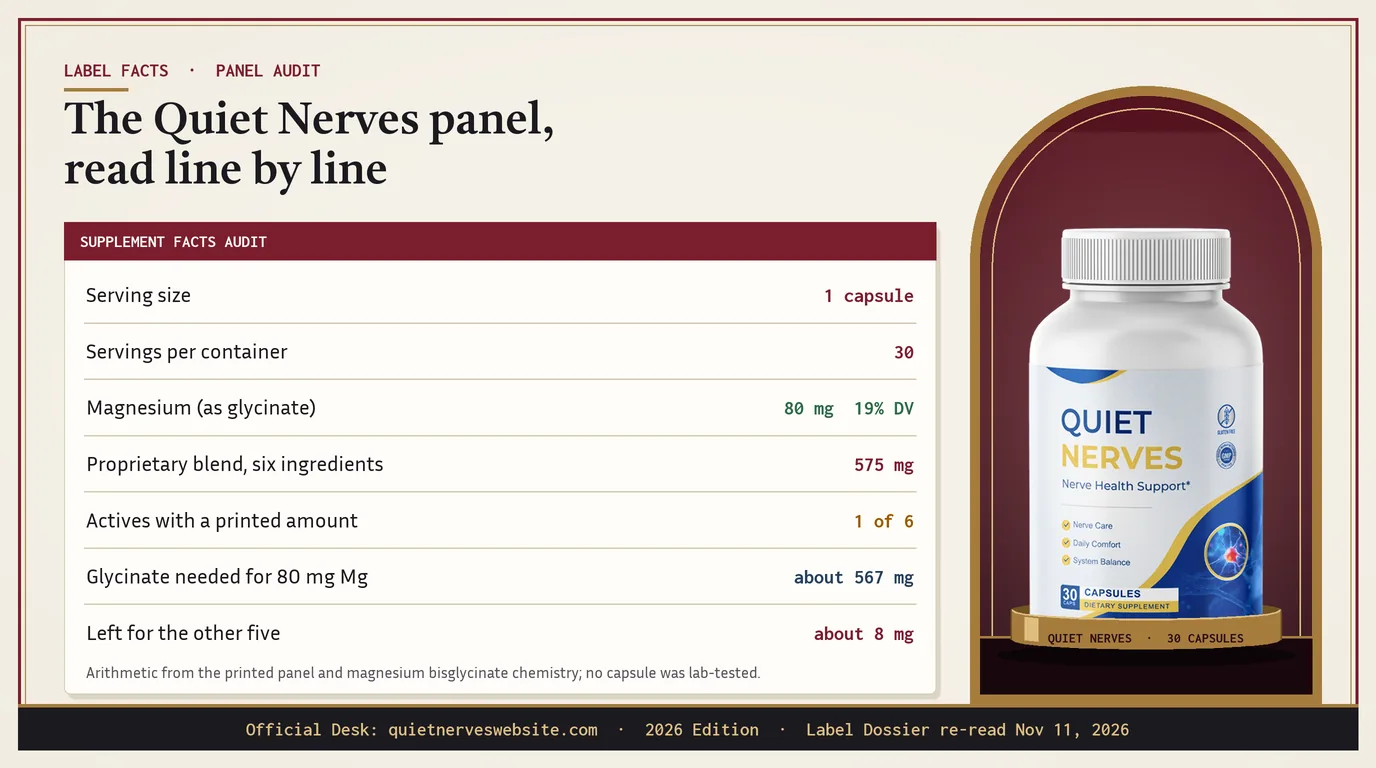
The Quiet Nerves panel prints one measurable promise: 80 mg of magnesium in a single daily capsule. Everything else sits inside a 575 mg proprietary blend with no individual amounts. This audit transcribes the label as published, runs the arithmetic the blend allows, explains each excipient, and sets out what federal rules do and do not require the seller to tell you.
The panel in six numbers
- Serving size, once a day
- 1 capsule
- Servings per bottle
- 30
- Magnesium, the only itemized amount (19% DV)
- 80 mg
- Proprietary blend: six names, one total
- 575 mg
- Actives with no printed milligrams
- 5
- Certificates of analysis published
- 0
What the front of the bottle commits to
The front panel carries the brand name, the phrase Nerve Health Support followed by an asterisk, three short bullets (Nerve Care, Daily Comfort, System Balance), the count of 30 capsules and the words Dietary Supplement. Two small badges sit beside the name: Gluten Free and GMP. No ingredient, no milligram figure and no medical condition appears on the front. [1]
That asterisk is doing legal work. A phrase like nerve health support is a structure/function claim, the kind of statement a supplement may make without premarket review as long as the label also prints the familiar disclaimer: the Food and Drug Administration has not evaluated the statement, and the product is not intended to diagnose, treat, cure or prevent any disease. [2,3] The Quiet Nerves artwork prints that disclaimer in a ruled box on the back panel, keyed to the asterisk.
The wording on the bottle is careful. The wording on the seller's website is less so: its FAQ describes the capsule as designed to ease the discomfort of neuropathy, which names a medical condition, a few paragraphs above the same FDA disclaimer. [4] A label is the document a company is held to, so where the two disagree we treat the label as the claim and the sales copy as advertising. Our reviews audit follows that gap claim by claim.
The facts panel, transcribed as printed
We read the panel from the label artwork the seller publishes on its order page and copied it without rounding, reordering or filling gaps. [1] Where the label is silent, the table says so.
| Panel line | Printed entry | Amount per serving |
|---|---|---|
| Serving size | 1 capsule | Taken once daily per the directions |
| Servings per container | 30 | One bottle covers 30 days |
| Magnesium | as magnesium glycinate, "from proprietary blend" | 80 mg, 19% of the Daily Value |
| Proprietary Blend | six ingredients, in the order below | 575 mg in total; no Daily Value established |
| Blend, position 1 | Magnesium glycinate | not printed |
| Blend, position 2 | Alpha lipoic acid | not printed |
| Blend, position 3 | Butcher's broom (Ruscus aculeatus) root extract | not printed |
| Blend, position 4 | L-carnitine | not printed |
| Blend, position 5 | Turmeric (Curcuma longa) rhizome extract, 95% curcuminoids | not printed |
| Blend, position 6 | Coenzyme Q10 (as ubiquinone) | not printed |
| Footnotes | Daily Values based on a 2,000 calorie diet; a dagger marks entries with no Daily Value | not applicable |
The 19% is correct arithmetic: the Daily Value for magnesium is 420 mg, and 80 divided by 420 is 19.0%. [5] The figure is elemental magnesium, meaning the mineral itself, not the weight of the compound that carries it.
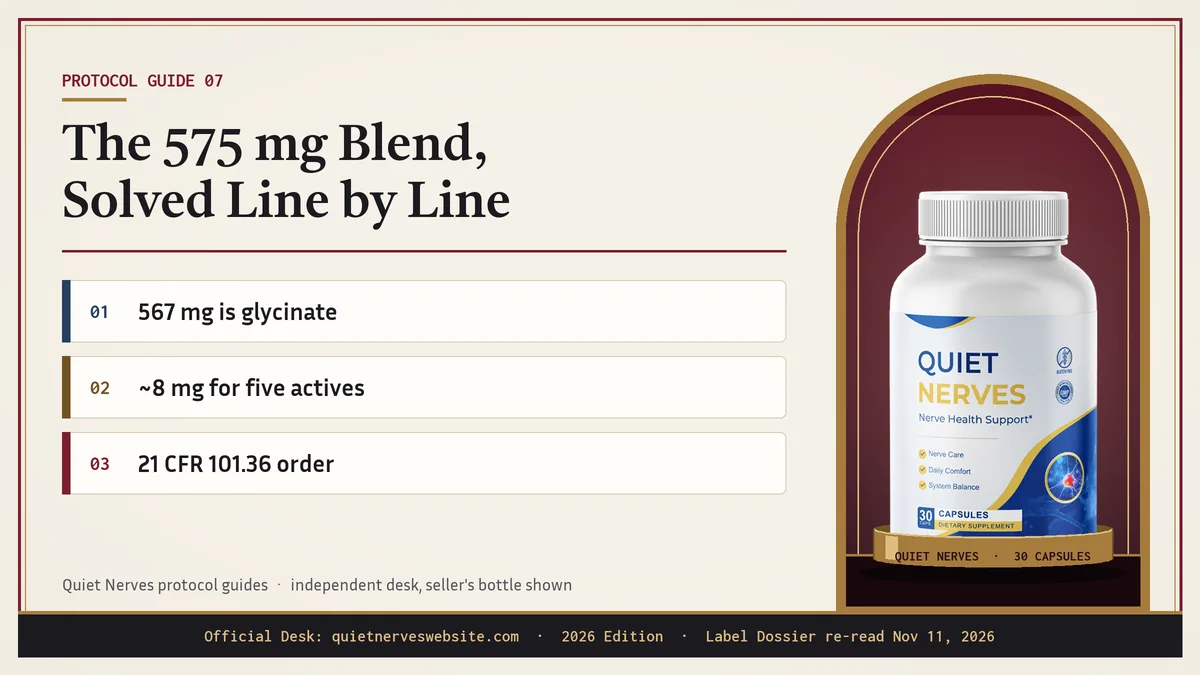
Two phrases in the magnesium line deserve a slow reading. "As magnesium glycinate" names the compound that supplies the mineral, a source declaration the labeling rule allows in parentheses. [6] "From proprietary blend" tells you the magnesium is not an additional ingredient stacked on top of the blend. The 80 mg is the mineral content of the glycinate, and the glycinate is itself the first and heaviest member of the 575 mg blend.
How much room the magnesium leaves in the blend
Magnesium glycinate (chemically, magnesium bisglycinate) is one magnesium ion bound to two molecules of the amino acid glycine. In its anhydrous form, magnesium accounts for 14.1% of the weight: 24.305 divided by a molar mass of 172.42. No fully reacted glycinate can carry more magnesium than that, and any grade that holds water or a carrier carries less.
There is also a floor. For 80 mg of magnesium to fit inside 575 mg at all, the glycinate ingredient must contain at least 13.9% magnesium (80 divided by 575). The printed numbers are internally consistent only in a narrow band, and at the bottom of that band the glycinate would be the entire blend.
The order of the list adds a second constraint. Federal labeling rules require the members of a proprietary blend to be listed in descending order of predominance by weight. [6] Call the remainder R. With five ingredients sharing R in a fixed order, the first of them can weigh at most R, the next at most half of R, the next at most a third, then a quarter, then a fifth. Those are ceilings, not estimates, and they cannot all be reached at once because together they would add up to more than R.
| Ingredient (label order) | Ceiling rule | Scenario A (R = 7.5 mg) | Scenario B (R = 131 mg) | Dose in human trials | Ceiling as a share of the trial dose |
|---|---|---|---|---|---|
| Alpha lipoic acid | R | 7.5 mg | 131 mg | 600 mg a day | 1.3% to 22% |
| Butcher's broom extract | R / 2 | 3.8 mg | 65 mg | 72 to 75 mg a day, in vein trials | 5% to about 90% |
| L-carnitine | R / 3 | 2.5 mg | 44 mg | 1,500 to 3,000 mg a day, acetyl form | 0.1% to 2.9% |
| Turmeric extract, 95% curcuminoids | R / 4 | 1.9 mg | 33 mg | 80 mg a day as nano-curcumin, a different form | 2.4% to 41%, forms not comparable |
| Coenzyme Q10 | R / 5 | 1.5 mg | 26 mg | 400 mg a day | 0.4% to 6.5% |
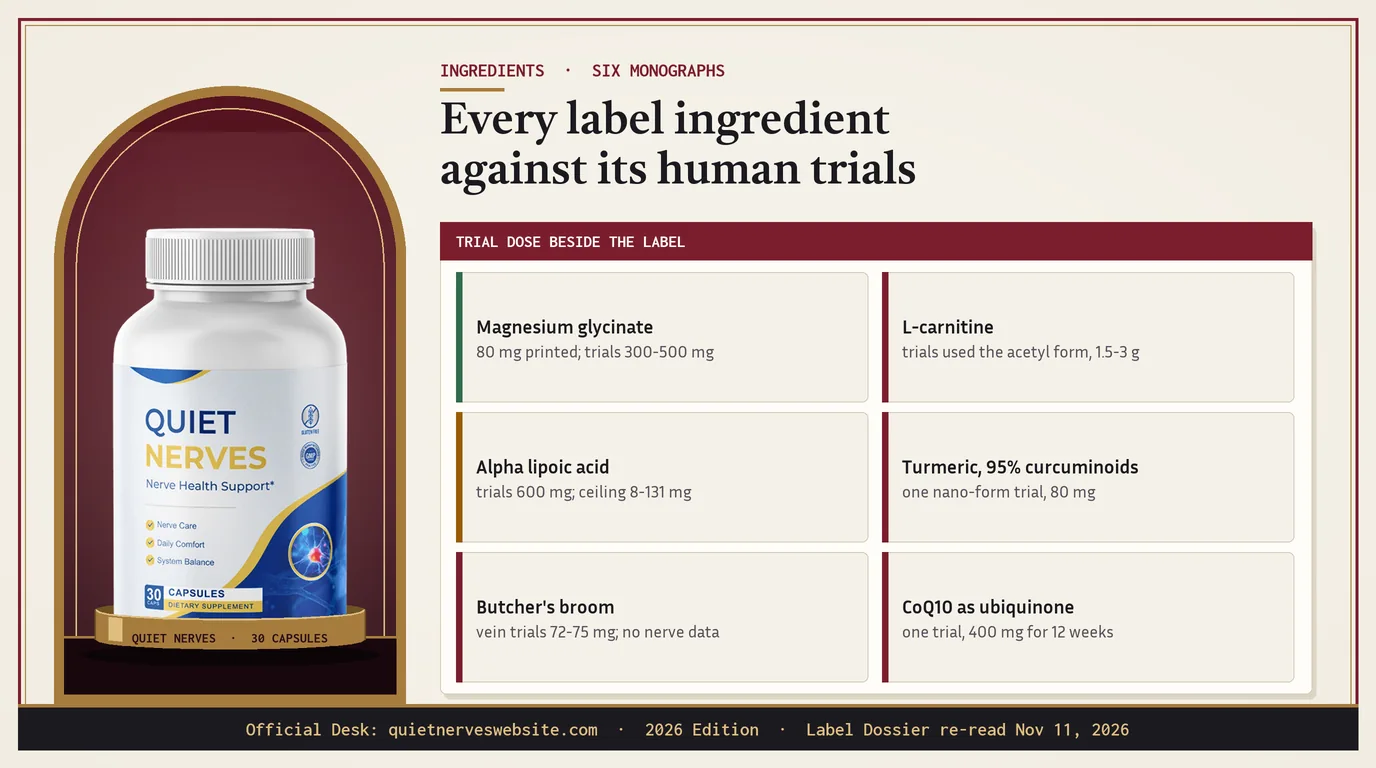
The trial doses come from the studies discussed on our ingredients page: oral alpha lipoic acid at 600 mg, [7] a Ruscus extract in chronic venous insufficiency, [8] acetyl-L-carnitine in diabetic neuropathy, [9] nano-curcumin in diabetic neuropathy [10] and ubiquinone in diabetic polyneuropathy. [11] If the remainder were split evenly, each of the five would receive 1.5 mg in scenario A and 26 mg in scenario B. In both scenarios magnesium is the only ingredient present at an amount that is both printed and nutritionally meaningful.
What a proprietary blend may keep private
"Proprietary blend" is a regulatory term, not a marketing flourish. The supplement labeling rule lets a company group dietary ingredients that have no established Daily Value under a blend name, provided the panel states the total weight of the blend and lists its members in descending order by weight. Individual amounts inside the blend may stay undisclosed. [6]
Nutrients that do have a Daily Value are treated differently: when a product supplies a declarable amount, the amount and the percentage of the Daily Value must be printed. [6,12] That is why magnesium has its own line here even though its source sits inside the blend. The seller did not volunteer the magnesium figure; the format requires it.
The same ordering principle governs the inactive components: the "Other ingredients" statement lists them by common name in descending order of predominance by weight, with no amounts. [13]
What descending order gives a reader is a chain of inequalities, not quantities. Magnesium glycinate weighs at least as much as alpha lipoic acid, which weighs at least as much as butcher's broom extract, and so on down to CoQ10. Combined with one hard number (80 mg) and one total (575 mg), those inequalities are enough to draw the ceilings above, which is more than most blends allow. They are not enough to tell you what you are swallowing.
Five excipients and the job each one does
| Excipient | What it is | Why it is in a capsule |
|---|---|---|
| Hypromellose | A cellulose derivative, also called HPMC | Forms the two-piece shell; the label calls it a vegetable capsule |
| Microcrystalline cellulose | Purified plant cellulose | Filler that evens out fill weight and helps powders pack consistently |
| Magnesium stearate | The magnesium salt of stearic acid | Lubricant that keeps powder from sticking to filling equipment |
| Stearic acid | A saturated fatty acid | Second lubricant and flow aid |
| Silicon dioxide | Fine silica | Glidant and anti-caking agent that keeps the blend free-flowing |
These five are among the most common inactive ingredients in capsule supplements, and nothing in the list is unusual. The shell is plant-derived, so no gelatin is involved, although the label stops short of a vegetarian or vegan claim and we do not make one for it. The magnesium stearate contributes a trace of magnesium that is not counted in the 80 mg line and is too small to matter nutritionally.
What the list cannot tell you is how much of each excipient is present, because inactive ingredients are declared by order, not by amount. [13] With 575 mg of blend already declared, the capsule has to be a large one; a fill of that weight plus flow agents generally points to a size 00 shell, though the seller does not publish the capsule size. If large capsules are hard for you to swallow, that is worth knowing before a six-bottle order arrives.
The front panel's Gluten Free badge is consistent with this list, none of which is a gluten source. The artwork carries no separate allergen statement, and the seller publishes no allergen testing, so anyone with a severe allergy should ask support in writing before use. The addresses are in our support directory.
Directions, warnings and storage, as worded on the label
- Suggested use
- Take one (1) capsule daily, as a dietary supplement.
- Seller FAQ addition
- With a meal and a full glass of water (this line is not on the label).
- Dose limit
- Do not exceed recommended dose.
- Excluded groups
- Anyone under 18; pregnant or nursing mothers.
- Medical check
- Consult a physician before use, especially if taking a medication or living with a medical condition.
- Storage
- A cool, dry place below 30°C (86°F).
- Tamper notice
- Do not use if the safety seal is damaged or missing. Keep out of reach of children.
The one-capsule direction is the same on the label and in the seller's FAQ, so there is no dosing conflict to resolve. The FAQ's meal advice suits magnesium, which is gentler on the stomach with food. Alpha lipoic acid is the exception: food lowers its bioavailability, and trial protocols gave it before meals. [14] At the amounts this blend can hold, that difference is academic.
"Do not exceed recommended dose" deserves respect for a practical reason. The arithmetic above may tempt a reader to take several capsules in pursuit of a study dose. It would not work. Even in the generous scenario, and even if alpha lipoic acid filled its entire ceiling, reaching 600 mg would take five capsules, which is 400 mg of supplemental magnesium: above the 350 mg tolerable upper intake level set for magnesium from supplements. [5] In the strict scenario it would take eighty capsules. The usual result of overshooting magnesium is diarrhea and cramping, not calmer nerves.
The exclusions for people under 18 and for pregnancy and nursing are printed on the bottle itself, and the physician line is not boilerplate here. Magnesium is cleared by the kidneys and binds certain antibiotics and osteoporosis medicines in the gut, and three of the other ingredients carry documented signals with anticoagulants or glucose-lowering drugs. [5,15] We cover those in side effects and interactions and in the guide to Quiet Nerves with prescriptions.
The distributor line and the lot field
The last block of the back panel reads: Distributed by QUIET NERVES, Aurora CO 80011, followed by [email protected]. [1] Three things follow from those few words.
- The brand is a distributor. "Distributed by" is the conventional qualifier a company uses when another firm manufactured the product. The manufacturer is not named on the label or anywhere on the seller's website.
- There is no street address or phone number on the bottle. The label gives a city, state and ZIP code. The street address the seller uses elsewhere (19655 E 35th Drive, Suite 100, Aurora) is described on its own refund page as care of a fulfillment center. [16]
- The only web domain on the bottle is quietnerves.com. That matters because several other sites present themselves as the product's home. This site is not the seller either; we are an independent desk, and the label is how you tell the difference.
On the published artwork, the field where a lot number and date would be stamped shows a template string, ENB_000_00_MMDDYY. That is normal for artwork and says nothing about any real bottle. A bottle in your hand should carry a stamped or printed lot code and an expiration date; the seller's FAQ says each bottle is dated and that shelf life is typically two years from manufacture. [4] Manufacturing rules require a batch, lot or control number to be assigned to every packaged lot so that its history can be traced. [17] If your bottle arrives with the placeholder still on it, or with no code at all, photograph it and work through our bottle verification checklist.
Company identity is thin in general. Across the seller's pages the business appears as Quiet Nerves, QuietNerves and Quiet Nerves Research, never with LLC or Inc. attached, and the retailer of record at checkout is BuyGoods, a Delaware company. [18,19]
Reading "FDA-registered, GMP-certified facility" correctly
The sales page states that Quiet Nerves is produced in an FDA-registered, GMP-certified facility and is made in the USA. [4] Each phrase is narrower than it sounds.
Registration is a listing, not an endorsement. Facilities that manufacture, process, pack or hold food for U.S. consumption, supplements included, must register with the agency. Registration does not mean the FDA has inspected the site, reviewed the formula or approved the product. [20]
No supplement is FDA approved. The agency does not review dietary supplements for safety or effectiveness before they are sold; responsibility for both sits with the company that markets them. [21,22]
GMP is a legal baseline. Every supplement manufacturer selling in the United States must follow the current good manufacturing practice rule, which covers identity testing of ingredients, specifications for purity, strength and composition, and batch records. [17] The FDA enforces that rule through inspections; it does not hand out GMP certificates. A "GMP certified" seal therefore refers, at best, to an audit by a private body, and the seller names neither the facility nor the auditor.
None of this suggests the product is poorly made. It means the quality claims cannot be verified as published. An analysis of FDA warnings issued between 2007 and 2016 documented supplements that contained unapproved drug ingredients, and a commentary published alongside it criticized the regulatory response. [23,24] That background is why a lot-specific document is worth more than a badge.
Requesting a Certificate of Analysis
A Certificate of Analysis (CoA) is the laboratory report for one production lot. The seller does not publish one for Quiet Nerves, and nothing obliges it to, but a company confident in its batch can usually e-mail a copy on request. A useful CoA for this product would show:
- the product name and a lot number that matches the code on your bottle
- manufacture and expiration dates
- identity confirmation for each of the six actives
- an assay for magnesium (to confirm the 80 mg) and, ideally, measured amounts of alpha lipoic acid, curcuminoids and CoQ10
- heavy metal results for lead, arsenic, cadmium and mercury
- microbial limits (total plate count, yeast and mold, E. coli, Salmonella)
- the name of the testing laboratory, preferably one accredited to ISO/IEC 17025, with a signature and date
The single most informative line would be any individual amount for a blend member, because one measured number would start turning the ceilings in our table into facts.
E-mail to [email protected]
Subject: Certificate of Analysis request - Quiet Nerves, lot [code from your bottle]

Hello,

I purchased Quiet Nerves (order # [number]) and would like a copy of the Certificate of Analysis for my lot before I continue using it.

Lot / expiration code on my bottle: [code]

Please include, if available:
1. Assay result for magnesium per capsule
2. Individual amounts of alpha lipoic acid, butcher's broom extract, L-carnitine, turmeric extract (curcuminoids) and coenzyme Q10 per capsule
3. Heavy metal results (lead, arsenic, cadmium, mercury)
4. Microbial test results
5. Name of the manufacturing facility and of the testing laboratory

Thank you,
[Name]
Keep the reply, whatever it says. A CoA that matches your lot is the strongest evidence a buyer can hold; a refusal or silence is also information, and the 60-day refund window gives you time to act on it. The dates and steps are in refund steps. If the label as it stands is acceptable to you, the current packs run from $49 a bottle in the six-bottle pack to $79 in the two-bottle pack, compared in full on the pricing page. The seller's order page opens through our disclosed affiliate link.
Questions readers ask
How much magnesium is in one Quiet Nerves capsule?
One capsule supplies 80 mg of magnesium, 19% of the Daily Value, as magnesium glycinate. It is the only amount the label itemizes. The figure is elemental magnesium, meaning the mineral itself and not the weight of the glycinate compound, and it sits far below the 350 mg upper level for magnesium from supplements. [1,5]
How many milligrams of alpha lipoic acid, CoQ10 or turmeric does Quiet Nerves contain?
The label does not say. All five non-magnesium actives share a 575 mg proprietary blend with a single total. Label math caps alpha lipoic acid at about 8 mg if the magnesium source is a fully reacted glycinate and about 131 mg if it is a buffered grade, with lower ceilings for each ingredient listed after it. The steps are in the 575 mg blend, solved.
What does 'from proprietary blend' mean on the magnesium line?
It means the magnesium is not an extra ingredient. The 80 mg is the mineral content of the magnesium glycinate that is already counted as the first member of the 575 mg blend, so the two lines describe one pool of material, not two. That single phrase is what limits the room left for the other five actives.
Is Quiet Nerves FDA approved?
No. No dietary supplement is FDA approved, because the agency does not review supplements for safety or effectiveness before sale. The seller's wording is that the product is made in an FDA-registered facility, and registration is a mandatory listing, not an inspection result or an endorsement. [21,20]
What are the other ingredients in Quiet Nerves?
Five excipients: hypromellose (the vegetable capsule shell), microcrystalline cellulose, magnesium stearate, stearic acid and silicon dioxide. They form the shell, bulk out the fill and keep the powder flowing through filling machines. None is an active ingredient and none is a gluten source. [1]
Does Quiet Nerves publish a Certificate of Analysis or third-party test?
No. As of November 11, 2026 the seller's pages show no certificate of analysis, lab report or third-party testing seal. You can request the report for your lot by e-mail using the template on this page; the lot code stamped on your bottle is the number to quote.
Who manufactures Quiet Nerves?
The manufacturer is not published. The label says only that the product is distributed by Quiet Nerves, Aurora CO 80011, which is the wording a brand uses when another company makes the product, and the seller's website names no facility. [1]
References
Numbered in order of first citation on this page. Study records were checked against PubMed on November 11, 2026; seller documents are quoted as read on the same day.
- Quiet Nerves. Bottle label artwork with Supplement Facts panel, as published on the seller's order page. Read November 11, 2026. Source
- 21 CFR 101.93. Certain types of statements for dietary supplements (structure/function claims and the disclaimer). Source
- U.S. Food and Drug Administration. Structure/Function Claims. Source
- Quiet Nerves. Sales page, ingredient descriptions, testimonials and FAQ. Read November 11, 2026. Source
- NIH Office of Dietary Supplements. Magnesium: Fact Sheet for Health Professionals. Updated January 6, 2026. Source
- 21 CFR 101.36. Nutrition labeling of dietary supplements (proprietary blends listed in descending order of predominance by weight). Source
- Ziegler D, Ametov A, Barinov A, et al. Oral treatment with alpha-lipoic acid improves symptomatic diabetic polyneuropathy: the SYDNEY 2 trial. Diabetes Care. 2006;29(11):2365-70. PMID 17065669. PubMed
- Vanscheidt W, Jost V, Wolna P, et al. Efficacy and safety of a Butcher's broom preparation (Ruscus aculeatus L. extract) compared to placebo in patients suffering from chronic venous insufficiency. Arzneimittelforschung. 2002;52(4):243-50. PMID 12040966. PubMed
- Sima AA, Calvani M, Mehra M, et al. Acetyl-L-carnitine improves pain, nerve regeneration, and vibratory perception in patients with chronic diabetic neuropathy: an analysis of two randomized placebo-controlled trials. Diabetes Care. 2005;28(1):89-94. PMID 15616239. PubMed
- Asadi S, Gholami MS, Siassi F, et al. Nano curcumin supplementation reduced the severity of diabetic sensorimotor polyneuropathy in patients with type 2 diabetes mellitus: A randomized double-blind placebo- controlled clinical trial. Complement Ther Med. 2019;43:253-260. PMID 30935539. PubMed
- Hernández-Ojeda J, Cardona-Muñoz EG, Román-Pintos LM, et al. The effect of ubiquinone in diabetic polyneuropathy: a randomized double-blind placebo-controlled study. J Diabetes Complications. 2012;26(4):352-8. PMID 22595020. PubMed
- U.S. Food and Drug Administration. Dietary Supplement Labeling Guide. Source
- 21 CFR 101.4. Food; designation of ingredients. Source
- Gleiter CH, Schug BS, Hermann R, et al. Influence of food intake on the bioavailability of thioctic acid enantiomers. Eur J Clin Pharmacol. 1996;50(6):513-4. PMID 8858282. PubMed
- U.S. Food and Drug Administration. Mixing Medications and Dietary Supplements Can Endanger Your Health. Source
- Quiet Nerves. Refund Policy. Read November 11, 2026. Source
- 21 CFR Part 111. Current Good Manufacturing Practice in Manufacturing, Packaging, Labeling, or Holding Operations for Dietary Supplements. Source
- Quiet Nerves. Terms and Conditions, effective January 2026. Read November 11, 2026. Source
- BuyGoods. Secure checkout for Quiet Nerves (order totals, shipping line, retailer statement). Read November 11, 2026. Source
- U.S. Food and Drug Administration. Registration of Food Facilities and Other Submissions. Source
- U.S. Food and Drug Administration. Questions and Answers on Dietary Supplements. Source
- U.S. Food and Drug Administration. Dietary Supplements. Source
- Tucker J, Fischer T, Upjohn L, et al. Unapproved Pharmaceutical Ingredients Included in Dietary Supplements Associated With US Food and Drug Administration Warnings. JAMA Netw Open. 2018;1(6):e183337. PMID 30646238. PubMed
- Cohen PA. The FDA and Adulterated Supplements-Dereliction of Duty. JAMA Netw Open. 2018;1(6):e183329. PMID 30646231. PubMed