Mechanisms and limits
How Quiet Nerves is meant to work, and what the evidence allows
The seller's case for Quiet Nerves rests on five biological ideas: calmer nerve signaling, less oxidative stress, better mitochondrial energy, a quieter inflammatory response and healthier small-vessel circulation. Each idea has real science behind it. This page separates the human findings from the animal models, follows each ingredient through absorption, and asks what a single 575 mg capsule can contribute to any of them.
The seller's model, and the test we apply to it
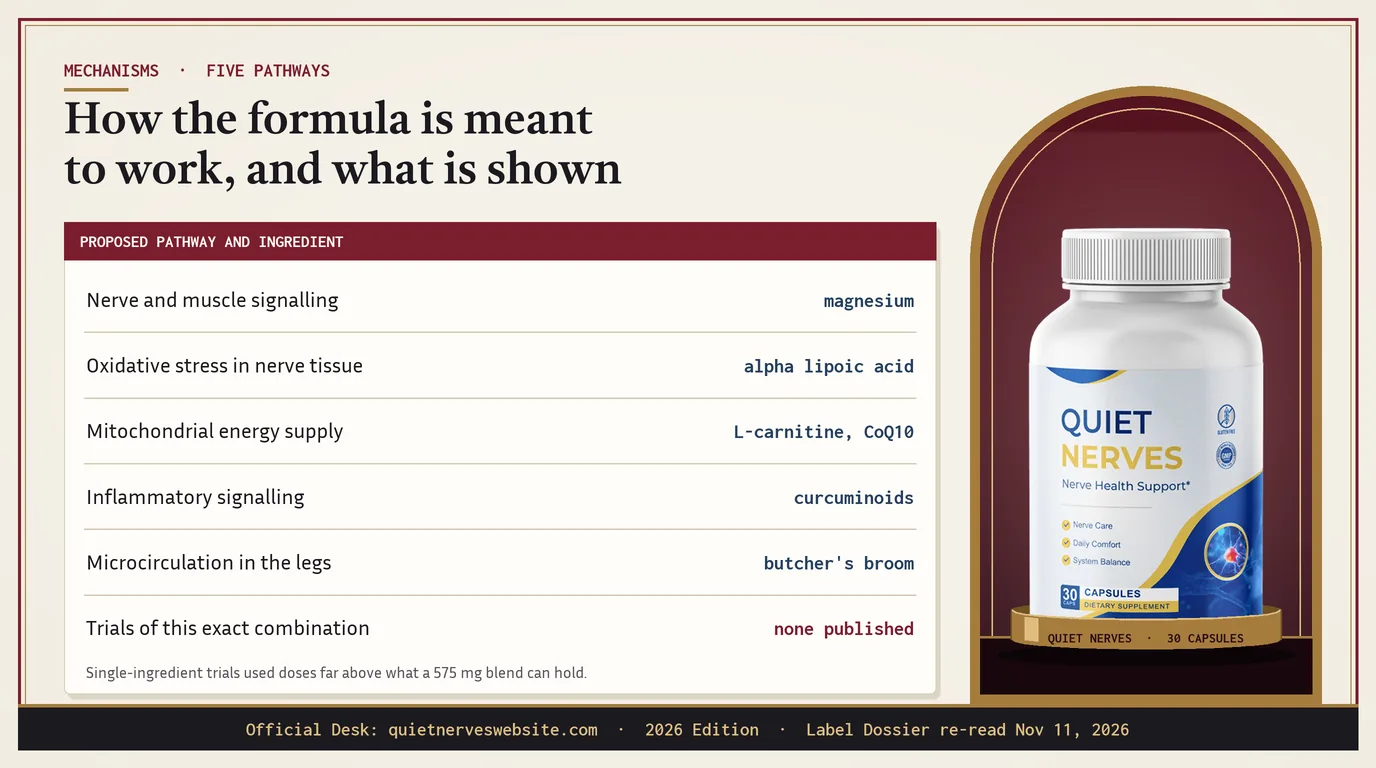
The sales page presents Quiet Nerves as six ingredients, each chosen for a purpose, working together on what its FAQ calls a trinity of nerve discomfort: easing discomfort, supporting nerve function and countering inflammation. [1] Its ingredient paragraphs map onto five familiar mechanisms, which we take one at a time below.
For each mechanism we ask three questions. Is the biology real? Has it produced benefits in human trials, and at what dose? Can one capsule deliver that dose? The first answer is usually yes. The third is where the formula meets its own label: 80 mg of magnesium is printed, and the other five actives share whatever remains of a 575 mg blend once roughly 444 to 567 mg of magnesium glycinate is accounted for. The derivation is in our label audit.
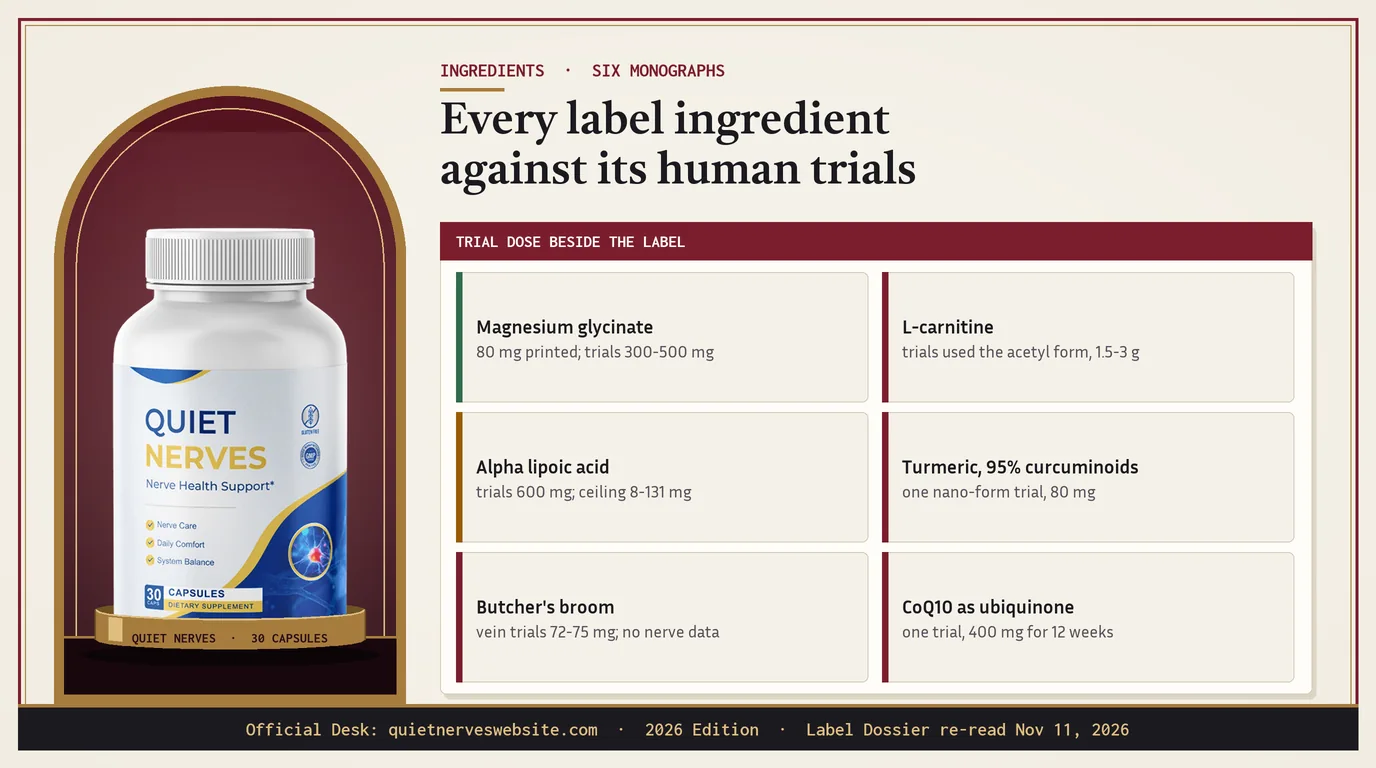
| Pillar | Ingredient | Strongest evidence available | Dose in human studies | What one capsule can supply |
|---|---|---|---|---|
| Nerve excitability | Magnesium glycinate | Human trials with mixed results; animal pain models | 300 to 500 mg a day | 80 mg, printed |
| Oxidative stress | Alpha lipoic acid | Randomized trials in diabetic neuropathy | 600 mg a day or more | At most 7.5 to 131 mg |
| Mitochondrial energy | L-carnitine and coenzyme Q10 | Trials of acetyl-L-carnitine and of ubiquinone | 1,500 to 3,000 mg; 400 mg a day | At most 2.5 to 44 mg; 1.5 to 26 mg |
| Inflammatory signaling | Turmeric extract | One trial of nano-curcumin; animal models | 80 mg a day, enhanced form | At most 1.9 to 33 mg |
| Small-vessel circulation | Butcher's broom extract | Vein trials in people; microvessel studies in animals | 72 to 75 mg a day | At most 3.8 to 65 mg |
The two figures in the last column are the strict and generous readings of the label. They are ceilings from label math, not measurements, and they cannot all be reached together.
Pillar one: magnesium and the excitability of nerve cells
Magnesium is the best-characterized actor in the formula. Inside the nervous system, magnesium ions sit in the channel of the NMDA receptor and block it while a nerve cell is at rest; the block lifts only when the cell is strongly stimulated. NMDA receptor activity in the spinal cord is one of the ways persistent pain signals become amplified, so a mineral that restrains the receptor is a logical candidate for calming overactive pain pathways. At the junction between nerve and muscle, magnesium also competes with calcium and tempers the release of the transmitter that triggers contraction, which is why it is associated with muscle relaxation. [2,3]
Animal evidence. In a rat model of diabetic neuropathic pain, magnesium reduced hypersensitivity and the phosphorylation of spinal NMDA receptors. [4] This is the type of study that underlies most nerve-comfort claims for the mineral.
Human evidence. People are less tidy than rats. A randomized trial in 45 patients with neuropathic pain found that four weeks of oral magnesium did not reduce pain intensity more than placebo. [5] An open five-year study in magnesium-depleted adults with type 1 diabetes found less progression of neuropathy with 300 mg a day, [6] which suggests that any benefit depends on correcting a shortfall. For sleep, 500 mg a day improved insomnia scores over eight weeks in older adults, and pooled data show sleep onset about 17 minutes faster on low-quality evidence. [7,8] For anxiety, a systematic review called the evidence suggestive but poor. [9] For muscle cramps in older adults, a Cochrane review found magnesium unlikely to help. [10]
What one capsule adds. 80 mg a day raises intake by 19% of the Daily Value. Dietary surveys consistently find that many Americans consume less magnesium than recommended, [2] so for a reader whose diet runs low the capsule closes part of a real gap. For a reader who already eats enough, the trials above give little reason to expect a change in nerve symptoms from an extra 80 mg.
Pillar two: oxidative stress and alpha lipoic acid
Long-standing high blood glucose drives oxidative stress in nerve cells and in the small vessels that feed them, one of several recognized contributors to diabetic nerve damage. [11,12] Alpha lipoic acid and its reduced form make up a redox pair that neutralizes reactive oxygen species in laboratory systems, which is the rationale for testing it in neuropathy. [13]
Human evidence. Unlike most supplement ingredients, alpha lipoic acid has been through large randomized trials. Given by mouth at 600 mg a day for five weeks, it improved symptom scores in the 181-patient SYDNEY 2 trial. [14] Longer and larger studies were less encouraging: ALADIN III found no significant difference in symptoms after seven months of treatment, NATHAN 1 missed its primary endpoint after four years, and the 2024 Cochrane review concluded that oral treatment probably makes little or no difference to symptoms at six months. [15,16,17] The fair summary is a short-term symptomatic signal at 600 mg that has not held up as a durable effect.
What one capsule adds. Between 1.3% and 22% of the studied dose, depending on which reading of the label is right, and then only if alpha lipoic acid takes up the entire remainder of the blend and leaves nothing for the four ingredients after it. The trials we reviewed did not test doses in that range for nerve symptoms. A related property deserves a mention for safety's sake: in pooled trials the compound modestly lowers fasting glucose, [18] which people on diabetes medication should know even at small doses.
Pillar three: mitochondrial energy, carnitine and coenzyme Q10
Nerve fibers are long, metabolically expensive cells, and their mitochondria have to supply energy along the whole length of the fiber. Two of the formula's ingredients belong to that machinery. Carnitine carries long-chain fatty acids across the mitochondrial membrane so they can be burned for energy. [19] Coenzyme Q10 moves electrons along the respiratory chain that produces ATP and doubles as a membrane antioxidant. [20]
Human evidence for carnitine. The trials used acetyl-L-carnitine, not the plain L-carnitine on this label. At 1,500 to 3,000 mg a day for a year, the acetyl form was tested in two trials totaling 1,257 patients; the higher dose improved pain, and the investigators also reported gains in vibration perception and signs of nerve fiber regeneration. [21] A Cochrane review nonetheless rates the certainty of the pain benefit as very low, [22] and in women receiving taxane chemotherapy the same compound made neuropathy worse. [23]
Human evidence for CoQ10. One randomized trial: 49 patients with diabetic polyneuropathy, 400 mg of ubiquinone a day, 12 weeks, with better symptom and conduction scores than placebo. [24]
What one capsule adds. Carnitine is capped at 2.5 to 44 mg and CoQ10 at 1.5 to 26 mg. For scale, healthy adults synthesize their own carnitine and obtain more from foods of animal origin, [19] and only 14 to 18% of a supplemental dose is absorbed. [25] A few milligrams of either compound is small change against the body's own supply.
Pillars four and five: inflammatory signaling and small-vessel flow
Curcumin and inflammation
In cell cultures and animal models, curcumin interferes with inflammatory signaling, and animal models of peripheral neuropathy have been used to test turmeric preparations; a 2023 systematic review collected that literature. [26] The obstacle between those experiments and a person is absorption. Curcumin is poorly taken up and quickly metabolized, and a 2 g dose taken alone is barely detectable in blood. [27,28]
Human evidence. One trial in neuropathy, and it used a nano-formulation designed to get around the absorption problem: 80 mg a day for eight weeks lowered neuropathy scores in 80 people with type 2 diabetes. [29] The Quiet Nerves label lists a conventional 95% extract with no enhancer, capped at 1.9 to 33 mg.
Butcher's broom and circulation
Peripheral nerves depend on a mesh of small blood vessels, and impaired circulation is one route to nerve injury, so a circulation herb has surface logic. The evidence for butcher's broom, though, concerns veins. In hamster microvessels, Ruscus extract reduced the leakiness provoked by histamine, [30] and in women with chronic venous insufficiency 72 to 75 mg of extract a day for 12 weeks reduced leg volume. [31] European regulators accordingly recognize the herb for heavy, uncomfortable legs related to minor venous circulation problems. [32]
What one capsule adds. At most 3.8 to 65 mg of an extract whose strength is not stated. We found no trial that measured nerve blood flow, nerve conduction or nerve symptoms with this herb at any dose, so its role here is an inference, not a finding.
From capsule to bloodstream: what absorption does to the numbers
| Ingredient | Uptake in humans | Timing | Effect of food | Consequence at this dose |
|---|---|---|---|---|
| Magnesium (glycinate) | Share absorbed rises as the dose falls; the chelate matched oxide overall in one small study and did better in poor absorbers | Hours | Food improves stomach comfort | The 80 mg is likely to be absorbed efficiently |
| Alpha lipoic acid | Rapid | Short plasma half-life | Food lowers bioavailability | A small dose with a brief presence in blood |
| L-carnitine | 14 to 18% of a supplemental dose | Not the limiting factor here | Carnitine in food is absorbed far better (54 to 87%) | Milligram amounts shrink to fractions of a milligram |
| Curcuminoids | Poor, with rapid metabolism | Barely detectable after 2 g taken alone | Piperine raised uptake about twentyfold in volunteers; none is listed here | Little of a small dose reaches circulation |
| Coenzyme Q10 | Slow and fat-dependent | Peak near 6 hours; half-life about 33 hours | Fat in the meal helps | Levels build over days from a very small daily input |
| Butcher's broom saponins | Human data are sparse | Not established | Not established | Cannot be estimated without a ruscogenin figure |
Sources for the table: magnesium, [33,34] alpha lipoic acid, [35,36] carnitine, [25] curcumin [27,28] and CoQ10. [20]
Absorption cuts in one direction only. Trial doses already include their own losses: when 600 mg of alpha lipoic acid helped in a study, it helped at whatever fraction of 600 mg reached the blood. A capsule that starts with a few percent of the trial dose ends with a few percent of the trial exposure. The one ingredient that gains from the small-dose effect is magnesium, because the gut absorbs a larger share of a small amount.
On timing, the seller's FAQ advises taking the capsule with a meal and a full glass of water, which suits magnesium and CoQ10, while alpha lipoic acid protocols dosed before meals. With one capsule a day, pick the time you will remember. At these amounts the differences are not large enough to justify a complicated schedule.
Synergy on paper, evidence in practice
Multi-ingredient formulas are usually defended with the word synergy: small amounts of several compounds, each nudging a different pathway, adding up to more than the parts. It is a reasonable hypothesis. Here it is also an untested one.
Three of the seven PubMed numbers printed on that page also open a different paper from the one named: PMID 12403983 leads to a review of neurotrophins, 22453537 to a thoracic-surgery paper and 12620600 to a fibromyalgia study. [40,41,42] We read that as carelessness, but a reference list assembled this loosely cannot carry the weight of the phrase clinically effective doses, which the seller's FAQ uses without publishing a single dose other than magnesium. [1]
A realistic 90-day outlook
The seller's FAQ says many users notice improvement within two to four weeks. [1] No study of this capsule supports or contradicts that. What can be said is how long the single-ingredient trials ran at full dose (five weeks for alpha lipoic acid, eight for nano-curcumin, twelve for CoQ10 and for Ruscus, a year for acetyl-L-carnitine) and how the seller's 60-day refund terms sit against that calendar.
| Window | What is plausible | What to record | Decision point |
|---|---|---|---|
| Days 1 to 14 | A tolerance check. Loose stools or stomach upset are the likeliest early effects of any magnesium product; no change in nerve symptoms is expected this early. | Baseline scores from 0 to 10 for burning, tingling, numbness and sleep, plus your medication list | Stop and call a clinician if symptoms worsen or new ones appear |
| Days 15 to 30 | If your diet was short on magnesium, intake is now steadier. Any change in sleep or muscle tension would most plausibly come from that. | Weekly scores, taken at the same time of day | None yet; keep the packing slip and every bottle, empty or not |
| Days 31 to 60 | The period in which full-dose ingredient trials ran their course. At this capsule's amounts, magnesium remains the only plausible contributor. | Compare week 6 with your baseline | Day 40: decide. If the log shows nothing, start the refund request so the return is delivered by day 60 |
| Days 61 to 90 | Outside the refund window. Continuing is a cost decision at $1.63 to $2.80 a day. | Monthly scores | Review with your clinician; ask whether plain magnesium would do the same job |
The day-40 marker is not arbitrary. The seller's policies describe the 60 days in five differently worded ways, and the strictest requires the returned bottles to arrive at the fulfillment center within 60 days of the order date. [43,44] Counting back for the return authorization and for transit gives day 40 as the last comfortable moment to ask. The dated walk-through is in refund steps, and a printable log is in your first 60 days.
What the capsule cannot do, and what has guideline support
Read against the evidence, a few limits are firm.
- It cannot diagnose anything. Burning, tingling or numb feet have many causes, including diabetes, low B12, alcohol, thyroid and kidney disease and several common medicines. [45,46]
- It has not been shown to repair damaged nerves or to restore sensation.
- It does not replace prescribed treatment, and stopping a prescription in favor of a supplement is a decision for the prescriber.
- It will not produce overnight relief; none of its ingredients is an analgesic or a sedative.
- It is not a treatment for neuropathy. The label says so itself, in the FDA disclaimer.
What does carry guideline-level support is less exciting and more effective.
Find the cause. For the common pattern of symmetrical symptoms in both feet, the American Academy of Neurology identifies blood glucose, vitamin B12 and serum protein electrophoresis as the highest-yield laboratory tests. [47] Long-term metformin use is a recognized cause of B12 deficiency, so people with diabetes have a double reason to ask. [48] Polyneuropathy also becomes more common with age, which is all the more reason not to assume a cause. [49]
Manage glucose. The American Diabetes Association's position statement places glucose management at the center of preventing and slowing diabetic neuropathy, alongside regular foot examination. [50]
Move. In a small study of 17 people with diabetic neuropathy, a 10-week exercise program improved neuropathic symptoms and increased nerve fiber branching in the skin. [51]
Use medicines that have trials behind them. For painful diabetic neuropathy, the 2022 American Academy of Neurology guideline supports four classes of oral medication (tricyclic antidepressants, SNRIs, gabapentinoids and sodium channel blockers) along with topical options, and a large meta-analysis quantifies how often each helps. [52,53] These are prescription decisions with real side effects, which is exactly why they belong with a clinician.
None of this argues against taking magnesium. It argues for putting a capsule in its proper place: a small nutritional addition that may suit some people, next to, not instead of, the steps that have evidence. The monographs on our ingredients page give the trial details, and side effects and interactions covers who should check with a pharmacist first.
Questions readers ask
How does Quiet Nerves work?
It supplies 80 mg of magnesium a day plus small, unpublished amounts of five compounds linked to antioxidant defense, mitochondrial energy, inflammatory signaling and circulation. Those mechanisms are real, but the benefits seen in trials came from single ingredients at doses many times larger than this blend can hold, and the product itself has not been tested. [54]
How long does Quiet Nerves take to work?
No study has timed it. The seller says two to four weeks; trials of the individual ingredients at full dose ran from five weeks to a year. Because the refund terms are tied to 60 days from the order date, we suggest judging by day 40 with a written symptom log.
Has Quiet Nerves been clinically tested?
No published clinical trial of Quiet Nerves exists. The seller's reference page lists eight papers, none of which studies the product or five of its six ingredients, and three of its PubMed numbers open unrelated articles. [37]
Can Quiet Nerves repair nerve damage or cure neuropathy?
No. Nothing in the evidence shows this capsule repairing nerves, and as a dietary supplement it is not intended to diagnose, treat, cure or prevent any disease. Persistent numbness, burning or tingling needs a medical evaluation to find the cause. [46]
Should Quiet Nerves be taken with food?
The label says only one capsule daily; the seller's FAQ adds with a meal and a full glass of water. Taking it with food is reasonable: magnesium is easier on the stomach that way and CoQ10 is absorbed better with dietary fat. [20]
Would taking two capsules make Quiet Nerves work better?
No, and the label says not to exceed the recommended dose. Doubling the serving doubles the magnesium to 160 mg but still leaves the other five ingredients far below trial amounts, and larger multiples push supplemental magnesium past the 350 mg upper level, where diarrhea is the usual result. [2]
References
Numbered in order of first citation on this page. Study records were checked against PubMed on November 11, 2026; seller documents are quoted as read on the same day.
- Quiet Nerves. Sales page, ingredient descriptions, testimonials and FAQ. Read November 11, 2026. Source
- NIH Office of Dietary Supplements. Magnesium: Fact Sheet for Health Professionals. Updated January 6, 2026. Source
- Schwalfenberg GK, Genuis SJ. The Importance of Magnesium in Clinical Healthcare. Scientifica (Cairo). 2017;2017:4179326. PMID 29093983. PubMed
- Rondón LJ, Privat AM, Daulhac L, et al. Magnesium attenuates chronic hypersensitivity and spinal cord NMDA receptor phosphorylation in a rat model of diabetic neuropathic pain. J Physiol. 2010;588(Pt 21):4205-15. PMID 20837644. PubMed
- Pickering G, Morel V, Simen E, et al. Oral magnesium treatment in patients with neuropathic pain: a randomized clinical trial. Magnes Res. 2011;24(2):28-35. PMID 21659058. PubMed
- De Leeuw I, Engelen W, De Block C, et al. Long term magnesium supplementation influences favourably the natural evolution of neuropathy in Mg-depleted type 1 diabetic patients (T1dm). Magnes Res. 2004;17(2):109-14. PMID 15319143. PubMed
- Abbasi B, Kimiagar M, Sadeghniiat K, et al. The effect of magnesium supplementation on primary insomnia in elderly: A double-blind placebo-controlled clinical trial. J Res Med Sci. 2012;17(12):1161-9. PMID 23853635. PubMed
- Mah J, Pitre T. Oral magnesium supplementation for insomnia in older adults: a Systematic Review & Meta-Analysis. BMC Complement Med Ther. 2021;21(1):125. PMID 33865376. PubMed
- Boyle NB, Lawton C, Dye L. The Effects of Magnesium Supplementation on Subjective Anxiety and Stress-A Systematic Review. Nutrients. 2017;9(5). PMID 28445426. PubMed
- Garrison SR, Korownyk CS, Kolber MR, et al. Magnesium for skeletal muscle cramps. Cochrane Database Syst Rev. 2020;9(9):CD009402. PMID 32956536. PubMed
- Callaghan BC, Cheng HT, Stables CL, et al. Diabetic neuropathy: clinical manifestations and current treatments. Lancet Neurol. 2012;11(6):521-34. PMID 22608666. PubMed
- Vinik AI, Nevoret ML, Casellini C, et al. Diabetic neuropathy. Endocrinol Metab Clin North Am. 2013;42(4):747-87. PMID 24286949. PubMed
- Papanas N, Ziegler D. Efficacy of α-lipoic acid in diabetic neuropathy. Expert Opin Pharmacother. 2014;15(18):2721-31. PMID 25381809. PubMed
- Ziegler D, Ametov A, Barinov A, et al. Oral treatment with alpha-lipoic acid improves symptomatic diabetic polyneuropathy: the SYDNEY 2 trial. Diabetes Care. 2006;29(11):2365-70. PMID 17065669. PubMed
- Ziegler D, Hanefeld M, Ruhnau KJ, et al. Treatment of symptomatic diabetic polyneuropathy with the antioxidant alpha-lipoic acid: a 7-month multicenter randomized controlled trial (ALADIN III Study). ALADIN III Study Group. Alpha-Lipoic Acid in Diabetic Neuropathy. Diabetes Care. 1999;22(8):1296-301. PMID 10480774. PubMed
- Ziegler D, Low PA, Litchy WJ, et al. Efficacy and safety of antioxidant treatment with α-lipoic acid over 4 years in diabetic polyneuropathy: the NATHAN 1 trial. Diabetes Care. 2011;34(9):2054-60. PMID 21775755. PubMed
- Baicus C, Purcarea A, von Elm E, et al. Alpha-lipoic acid for diabetic peripheral neuropathy. Cochrane Database Syst Rev. 2024;1(1):CD012967. PMID 38205823. PubMed
- Rahimlou M, Asadi M, Banaei Jahromi N, et al. Alpha-lipoic acid (ALA) supplementation effect on glycemic and inflammatory biomarkers: A Systematic Review and meta- analysis. Clin Nutr ESPEN. 2019;32:16-28. PMID 31221283. PubMed
- NIH Office of Dietary Supplements. Carnitine: Fact Sheet for Health Professionals. Source
- Bhagavan HN, Chopra RK. Coenzyme Q10: absorption, tissue uptake, metabolism and pharmacokinetics. Free Radic Res. 2006;40(5):445-53. PMID 16551570. PubMed
- Sima AA, Calvani M, Mehra M, et al. Acetyl-L-carnitine improves pain, nerve regeneration, and vibratory perception in patients with chronic diabetic neuropathy: an analysis of two randomized placebo-controlled trials. Diabetes Care. 2005;28(1):89-94. PMID 15616239. PubMed
- Rolim LC, da Silva EM, Flumignan RL, et al. Acetyl-L-carnitine for the treatment of diabetic peripheral neuropathy. Cochrane Database Syst Rev. 2019;6(6):CD011265. PMID 31201734. PubMed
- Hershman DL, Unger JM, Crew KD, et al. Randomized double-blind placebo-controlled trial of acetyl-L-carnitine for the prevention of taxane-induced neuropathy in women undergoing adjuvant breast cancer therapy. J Clin Oncol. 2013;31(20):2627-33. PMID 23733756. PubMed
- Hernández-Ojeda J, Cardona-Muñoz EG, Román-Pintos LM, et al. The effect of ubiquinone in diabetic polyneuropathy: a randomized double-blind placebo-controlled study. J Diabetes Complications. 2012;26(4):352-8. PMID 22595020. PubMed
- Rebouche CJ. Kinetics, pharmacokinetics, and regulation of L-carnitine and acetyl-L-carnitine metabolism. Ann N Y Acad Sci. 2004;1033:30-41. PMID 15591001. PubMed
- Silveira RS, Baldoni AO, Couto RO, et al. In vivo efficacy of turmeric (Curcuma longa L.) in the treatment of peripheral neuropathy: A systematic review of animal models. An Acad Bras Cienc. 2023;95(3):e20200447. PMID 37937613. PubMed
- Anand P, Kunnumakkara AB, Newman RA, et al. Bioavailability of curcumin: problems and promises. Mol Pharm. 2007;4(6):807-18. PMID 17999464. PubMed
- Shoba G, Joy D, Joseph T, et al. Influence of piperine on the pharmacokinetics of curcumin in animals and human volunteers. Planta Med. 1998;64(4):353-6. PMID 9619120. PubMed
- Asadi S, Gholami MS, Siassi F, et al. Nano curcumin supplementation reduced the severity of diabetic sensorimotor polyneuropathy in patients with type 2 diabetes mellitus: A randomized double-blind placebo- controlled clinical trial. Complement Ther Med. 2019;43:253-260. PMID 30935539. PubMed
- Bouskela E, Cyrino FZ, Marcelon G. Possible mechanisms for the inhibitory effect of Ruscus extract on increased microvascular permeability induced by histamine in hamster cheek pouch. J Cardiovasc Pharmacol. 1994;24(2):281-5. PMID 7526061. PubMed
- Vanscheidt W, Jost V, Wolna P, et al. Efficacy and safety of a Butcher's broom preparation (Ruscus aculeatus L. extract) compared to placebo in patients suffering from chronic venous insufficiency. Arzneimittelforschung. 2002;52(4):243-50. PMID 12040966. PubMed
- European Medicines Agency, Committee on Herbal Medicinal Products. Rusci rhizoma (butcher's broom): herbal monograph. Source
- Schuchardt JP, Hahn A. Intestinal Absorption and Factors Influencing Bioavailability of Magnesium-An Update. Curr Nutr Food Sci. 2017;13(4):260-278. PMID 29123461. PubMed
- Schuette SA, Lashner BA, Janghorbani M. Bioavailability of magnesium diglycinate vs magnesium oxide in patients with ileal resection. JPEN J Parenter Enteral Nutr. 1994;18(5):430-5. PMID 7815675. PubMed
- Teichert J, Hermann R, Ruus P, et al. Plasma kinetics, metabolism, and urinary excretion of alpha-lipoic acid following oral administration in healthy volunteers. J Clin Pharmacol. 2003;43(11):1257-67. PMID 14551180. PubMed
- Gleiter CH, Schug BS, Hermann R, et al. Influence of food intake on the bioavailability of thioctic acid enantiomers. Eur J Clin Pharmacol. 1996;50(6):513-4. PMID 8858282. PubMed
- Quiet Nerves. Scientific References page (eight citations). Read November 11, 2026. Source
- Cinar V, Polat Y, Baltaci AK, et al. Effects of magnesium supplementation on testosterone levels of athletes and sedentary subjects at rest and after exhaustion. Biol Trace Elem Res. 2011;140(1):18-23. PMID 20352370. PubMed
- Maggio M, De Vita F, Lauretani F, et al. The Interplay between Magnesium and Testosterone in Modulating Physical Function in Men. Int J Endocrinol. 2014;2014:525249. PMID 24723948. PubMed
- Thoenen H, Sendtner M. Neurotrophins: from enthusiastic expectations through sobering experiences to rational therapeutic approaches. Nat Neurosci. 2002;5 Suppl:1046-50. PMID 12403983. PubMed
- Bertolaccini L, Terzi A, Spada E, et al. Not palpable? Role of radio-guided video-assisted thoracic surgery for nonpalpable solitary pulmonary nodules. Gen Thorac Cardiovasc Surg. 2012;60(5):280-4. PMID 22453537. PubMed
- Staud R, Cannon RC, Mauderli AP, et al. Temporal summation of pain from mechanical stimulation of muscle tissue in normal controls and subjects with fibromyalgia syndrome. Pain. 2003;102(1-2):87-95. PMID 12620600. PubMed
- Quiet Nerves. Shipping Policy, including the Returns clause. Read November 11, 2026. Source
- Quiet Nerves. Refund Policy. Read November 11, 2026. Source
- Staff NP, Windebank AJ. Peripheral neuropathy due to vitamin deficiency, toxins, and medications. Continuum (Minneap Minn). 2014;20(5 Peripheral Nervous System Disorders):1293-306. PMID 25299283. PubMed
- National Institute of Neurological Disorders and Stroke. Peripheral Neuropathy. Source
- England JD, Gronseth GS, Franklin G, et al. Practice Parameter: evaluation of distal symmetric polyneuropathy: role of laboratory and genetic testing (an evidence-based review). Report of the American Academy of Neurology, American Association of Neuromuscular and Electrodiagnostic Medicine, and American Academy of Physical Medicine and Rehabilitation. Neurology. 2009;72(2):185-92. PMID 19056666. PubMed
- Aroda VR, Edelstein SL, Goldberg RB, et al. Long-term Metformin Use and Vitamin B12 Deficiency in the Diabetes Prevention Program Outcomes Study. J Clin Endocrinol Metab. 2016;101(4):1754-61. PMID 26900641. PubMed
- Hanewinckel R, Drenthen J, van Oijen M, et al. Prevalence of polyneuropathy in the general middle-aged and elderly population. Neurology. 2016;87(18):1892-1898. PMID 27683845. PubMed
- Pop-Busui R, Boulton AJ, Feldman EL, et al. Diabetic Neuropathy: A Position Statement by the American Diabetes Association. Diabetes Care. 2017;40(1):136-154. PMID 27999003. PubMed
- Kluding PM, Pasnoor M, Singh R, et al. The effect of exercise on neuropathic symptoms, nerve function, and cutaneous innervation in people with diabetic peripheral neuropathy. J Diabetes Complications. 2012;26(5):424-9. PMID 22717465. PubMed
- Price R, Smith D, Franklin G, et al. Oral and Topical Treatment of Painful Diabetic Polyneuropathy: Practice Guideline Update Summary: Report of the AAN Guideline Subcommittee. Neurology. 2022;98(1):31-43. PMID 34965987. PubMed
- Finnerup NB, Attal N, Haroutounian S, et al. Pharmacotherapy for neuropathic pain in adults: a systematic review and meta-analysis. Lancet Neurol. 2015;14(2):162-73. PMID 25575710. PubMed
- Quiet Nerves. Bottle label artwork with Supplement Facts panel, as published on the seller's order page. Read November 11, 2026. Source