Monograph 03
L-Carnitine vs Acetyl-L-Carnitine: Which One Did the Neuropathy Trials Use?
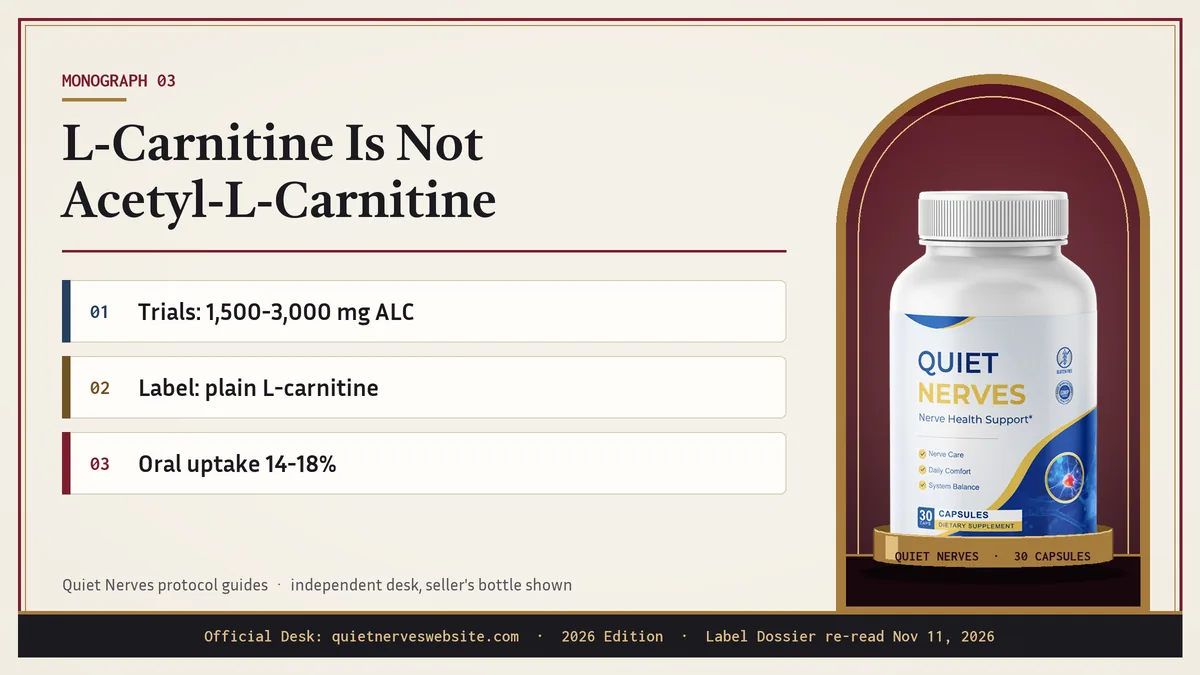
The Quiet Nerves label lists L-carnitine. The clinical trials usually cited for carnitine and nerve symptoms tested a different compound, acetyl-L-carnitine, at 1,500 to 3,000 mg a day. This monograph separates the two molecules, reviews what the acetyl form did and did not achieve in people, and sets those doses beside what one capsule can hold.
One word on the label, two compounds in the literature
"Carnitine" is a family name. The NIH Office of Dietary Supplements uses it as the generic term for several related compounds, including L-carnitine, acetyl-L-carnitine and propionyl-L-carnitine.[1] The body makes its own supply in the liver, kidneys and brain from the amino acids lysine and methionine, and uses it in energy production, where it helps carry fatty acids into the mitochondria that burn them. Healthy adults generally make enough, which is why the fact sheet describes carnitine as conditionally essential.
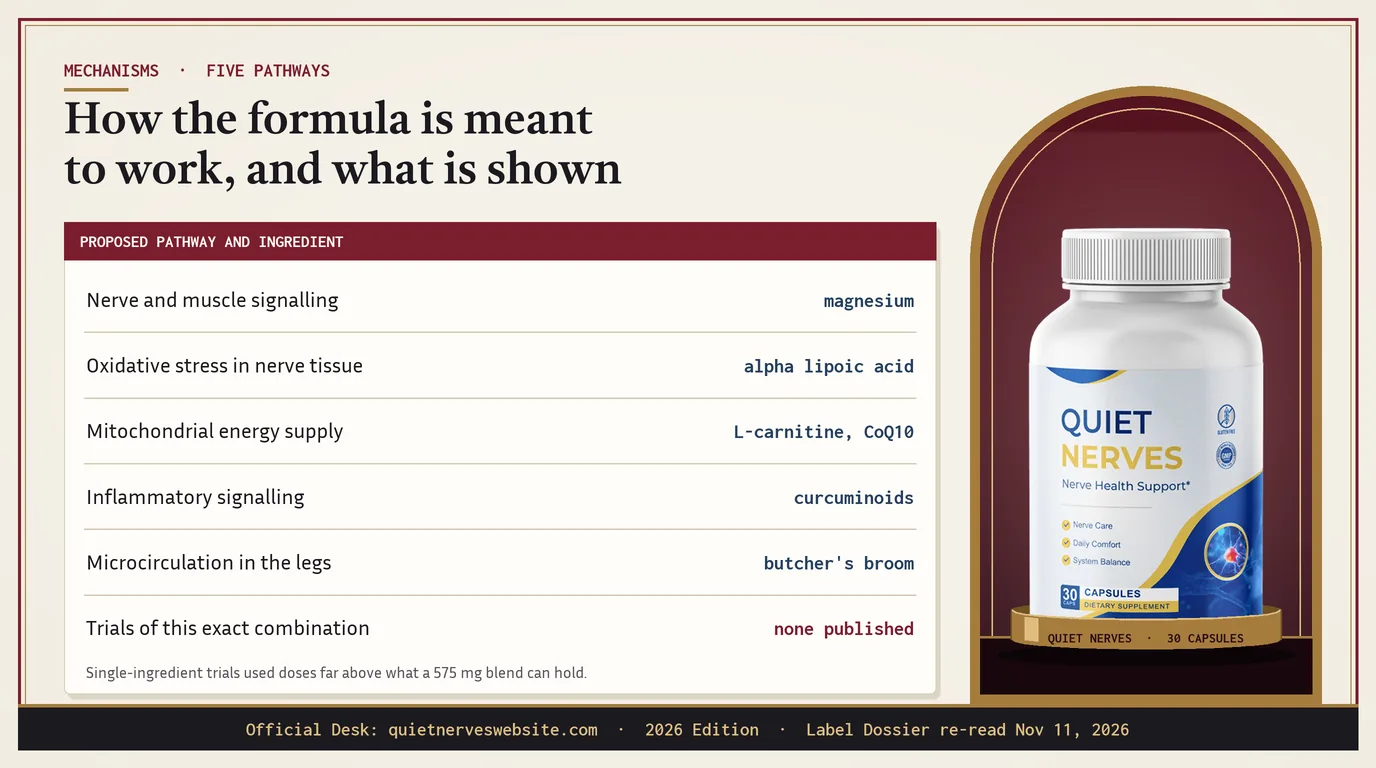
The Quiet Nerves panel names one member of that family: L-carnitine, fourth in the 575 mg proprietary blend, with no amount beside it.[2] Acetyl-L-carnitine is the same molecule with an acetyl group attached. The two are related and the body can convert one to the other, but they are sold as different ingredients, they have been studied for different purposes, and a label that says one does not mean the other.
That distinction matters because of how the seller describes the ingredient. The sales page says L-carnitine "helps maintain the energy supply your nerve endings need", "particularly in the hands, feet, and legs where neuropathic discomfort tends to settle".[3] The human studies behind statements of that kind did not use L-carnitine. They used the acetyl form, in gram quantities.
What acetyl-L-carnitine did in diabetic neuropathy
Two publications carry most of the weight.
| Publication | People | Compound and daily dose | Duration | Reported outcome |
|---|---|---|---|---|
| Sima 2005 (two trials analyzed together) | 1,257 with diabetic neuropathy | Acetyl-L-carnitine, 1,500 mg or 3,000 mg | 52 weeks | Pain improved at 3,000 mg a day |
| De Grandis 2002 | 333 with diabetic neuropathy | Acetyl-L-carnitine, 2,000 mg | 1 year | Nerve conduction and pain improved |
| Hershman 2013 | 409 women receiving taxane chemotherapy | Acetyl-L-carnitine, 3,000 mg | 24 weeks | Neuropathy was worse than with placebo |
| Quiet Nerves label | Not a trial | L-carnitine, amount not printed | One capsule daily | Ceiling of about 2.5 mg to about 44 mg by label math |
The Sima analysis combined two randomized, placebo-controlled trials that ran for 52 weeks and enrolled 1,257 patients between them. Participants took 500 mg or 1,000 mg of acetyl-L-carnitine three times a day. Pain improved in the group taking 1,000 mg three times daily, a total of 3 grams.[4] The De Grandis trial followed 333 patients for a year on 2 grams a day and reported better nerve conduction and less pain than placebo.[5]
Three features of these trials are easy to lose when they are condensed onto a sales page. The compound was acetyl-L-carnitine. The effective dose was measured in grams, taken every day. And the participants all had diabetic neuropathy, studied for a full year.
A cautious Cochrane verdict and one trial that went the wrong way
When Cochrane reviewers assessed acetyl-L-carnitine for diabetic peripheral neuropathy in 2019, they rated the certainty of the evidence as very low and could not say with confidence that it reduces pain.[6] Large trials existed, yet the reviewers were left unconvinced by what those trials could prove.
A different population produced a result nobody expected. In a randomized, double-blind trial, 409 women starting taxane chemotherapy for breast cancer took 3 grams of acetyl-L-carnitine a day or placebo, in the hope of preventing chemotherapy-induced neuropathy. At 24 weeks the women taking the supplement had more neuropathy, not less.[7]
Third in line: what the label leaves for L-carnitine
The label gives enough information to bound the amount. Magnesium glycinate must supply the printed 80 mg of magnesium, and at 14.1% magnesium by weight that takes about 567 mg of a fully reacted glycinate, leaving about 7.5 mg of the 575 mg blend for five ingredients. Blend ingredients are listed in descending order by weight, and L-carnitine is the third of those five, behind alpha lipoic acid and butcher's broom.[8]
We did not test a capsule, and these are boundaries derived from the printed panel, not measurements. Even so, the gap is wide enough that no plausible reading closes it: under the most generous assumption, a person would need more than 30 capsules to reach the lower trial dose, and that trial used a different form of carnitine. The step-by-step derivation is in the 575 mg blend, solved, and the panel itself is transcribed on the label facts page.
How much supplemental carnitine reaches the blood
Absorption widens the gap a little further. A pharmacokinetic review found that carnitine eaten in food is absorbed well, with bioavailability of 54% to 87%, whereas L-carnitine taken as a supplement is absorbed far less efficiently, at 14% to 18% of the dose.[9] The portion that is not absorbed travels on to the large intestine.
What happens there has drawn attention from cardiologists. Gut bacteria convert unabsorbed L-carnitine into trimethylamine, which the liver turns into TMAO, a compound that has been linked to atherosclerosis in animal experiments and in human association studies.[10] That research concerns habitual intakes far larger than a few milligrams, and it does not make this capsule a cardiovascular risk. It does show that carnitine supplements are biologically active in ways that have nothing to do with nerves.
Thyroid hormone, anticoagulants and tolerability
Carnitine has a short list of documented interactions, all observed at doses much higher than this label can contain.
- Thyroid hormone. In a randomized trial in 50 women, 2 to 4 grams of L-carnitine a day counteracted the effects of excess thyroid hormone, which is why it has been described as a peripheral antagonist of thyroid hormone action.[11] People taking thyroid hormone should mention any carnitine supplement to their prescriber.
- Anticoagulants. A published case describes L-carnitine increasing the effect of the anticoagulant acenocoumarol.[12] Acenocoumarol belongs to the same drug family as warfarin, so the prudent step for anyone on that class is to tell the clinic that manages their INR.
- Seizure medicines. The concern that levocarnitine might provoke seizures in people taking valproate was examined in a systematic review, which found no evidence to support it.[13]
On tolerability, the NIH fact sheet notes that doses around 3 grams a day can cause nausea, vomiting, abdominal cramps, diarrhea and a fishy body odor.[1] Those effects belong to gram-level dosing. We cover the interaction points for every ingredient on the side effects and interactions page and in the guide to Quiet Nerves with prescriptions.
Where the carnitine line leaves a buyer
The carnitine story has three layers, and the label misses the trials on each. The form is different: L-carnitine on the bottle, acetyl-L-carnitine in the studies. The dose is lower by a factor of at least 30 and possibly more than 1,000. And the evidence itself, at full dose in the right form, earned a very-low-certainty rating from Cochrane and included one trial with harm.
None of that makes a few milligrams of L-carnitine hazardous. It means the ingredient contributes a name to the panel more than an effect to the capsule. The next monograph applies the same test to turmeric at 95% curcuminoids. Readers who have read the whole file and still prefer to try the product can open the seller's 6-bottle order page at $49 a bottle; we may earn a commission, which is why the arithmetic above is laid out before the link.
Questions readers ask
Is L-carnitine the same as acetyl-L-carnitine?
No. They are related compounds in the carnitine family and the body can interconvert them, but they are distinct ingredients. Quiet Nerves lists L-carnitine; the neuropathy trials usually cited for carnitine used acetyl-L-carnitine.
How much L-carnitine does Quiet Nerves contain?
The amount is not printed. Label arithmetic caps it at about 2.5 mg if the magnesium glycinate is fully reacted and at about 44 mg under the most generous reading, because it is third among the five ingredients that share what is left of the 575 mg blend.
What dose of carnitine was used in nerve studies?
Between 1,500 and 3,000 mg of acetyl-L-carnitine a day for up to a year. Pain improved at 3,000 mg a day in a pooled analysis of 1,257 people with diabetic neuropathy, and a one-year trial used 2,000 mg.
Can carnitine make neuropathy worse?
In one setting it did. Women taking 3,000 mg of acetyl-L-carnitine a day during taxane chemotherapy had more neuropathy at 24 weeks than women on placebo. That finding applies to chemotherapy patients at a gram-level dose, and it is the reason oncology teams should approve any supplement.
Does L-carnitine interact with thyroid or blood-thinning medicine?
It can at gram doses. A trial showed 2 to 4 grams a day opposing thyroid hormone action, and a case report describes a stronger effect of the anticoagulant acenocoumarol. The amount in this capsule is far smaller, but prescribers should still be told.
References
Numbered in order of first citation on this page. Study records were checked against PubMed on November 11, 2026; seller documents are quoted as read on the same day.
- NIH Office of Dietary Supplements. Carnitine: Fact Sheet for Health Professionals. Source
- Quiet Nerves. Bottle label artwork with Supplement Facts panel, as published on the seller's order page. Read November 11, 2026. Source
- Quiet Nerves. Sales page, ingredient descriptions, testimonials and FAQ. Read November 11, 2026. Source
- Sima AA, Calvani M, Mehra M, et al. Acetyl-L-carnitine improves pain, nerve regeneration, and vibratory perception in patients with chronic diabetic neuropathy: an analysis of two randomized placebo-controlled trials. Diabetes Care. 2005;28(1):89-94. PMID 15616239. PubMed
- De Grandis D, Minardi C. Acetyl-L-carnitine (levacecarnine) in the treatment of diabetic neuropathy. A long-term, randomised, double-blind, placebo-controlled study. Drugs R D. 2002;3(4):223-31. PMID 12455197. PubMed
- Rolim LC, da Silva EM, Flumignan RL, et al. Acetyl-L-carnitine for the treatment of diabetic peripheral neuropathy. Cochrane Database Syst Rev. 2019;6(6):CD011265. PMID 31201734. PubMed
- Hershman DL, Unger JM, Crew KD, et al. Randomized double-blind placebo-controlled trial of acetyl-L-carnitine for the prevention of taxane-induced neuropathy in women undergoing adjuvant breast cancer therapy. J Clin Oncol. 2013;31(20):2627-33. PMID 23733756. PubMed
- 21 CFR 101.36. Nutrition labeling of dietary supplements (proprietary blends listed in descending order of predominance by weight). Source
- Rebouche CJ. Kinetics, pharmacokinetics, and regulation of L-carnitine and acetyl-L-carnitine metabolism. Ann N Y Acad Sci. 2004;1033:30-41. PMID 15591001. PubMed
- Koeth RA, Wang Z, Levison BS, et al. Intestinal microbiota metabolism of L-carnitine, a nutrient in red meat, promotes atherosclerosis. Nat Med. 2013;19(5):576-85. PMID 23563705. PubMed
- Benvenga S, Ruggeri RM, Russo A, et al. Usefulness of L-carnitine, a naturally occurring peripheral antagonist of thyroid hormone action, in iatrogenic hyperthyroidism: a randomized, double-blind, placebo-controlled clinical trial. J Clin Endocrinol Metab. 2001;86(8):3579-94. PMID 11502782. PubMed
- Martinez E, Domingo P, Roca-Cusachs A. Potentiation of acenocoumarol action by L-carnitine. J Intern Med. 1993;233(1):94. PMID 8429297. PubMed
- Zeiler FA, Sader N, Gillman LM, et al. Levocarnitine induced seizures in patients on valproic acid: A negative systematic review. Seizure. 2016;36:36-39. PMID 26889779. PubMed
- Quiet Nerves. Scientific References page (eight citations). Read November 11, 2026. Source