Monograph 01
Magnesium Glycinate at 80 mg: What 19% of the Daily Value Can and Cannot Do
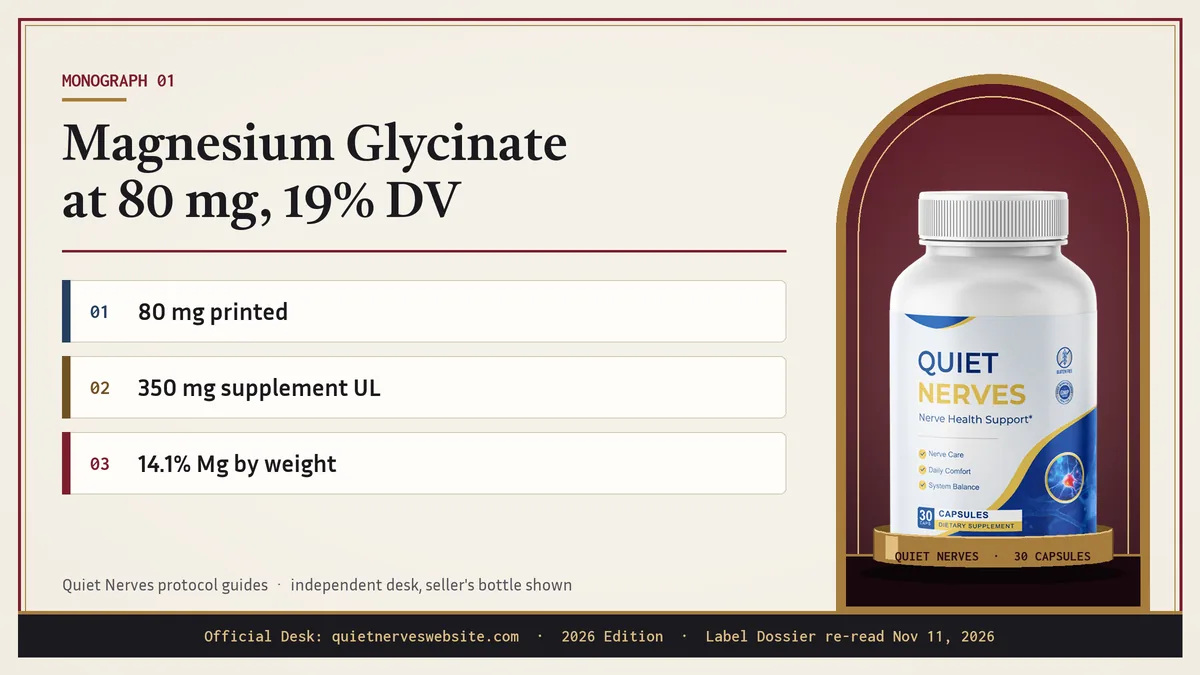
Magnesium is the only ingredient in Quiet Nerves with a printed amount: 80 mg per capsule, 19% of the Daily Value, supplied as magnesium glycinate. This monograph places that number next to dietary reference intakes, absorption studies and the doses used in human trials, and shows what the same line reveals about the rest of the 575 mg blend.
The one number the label commits to
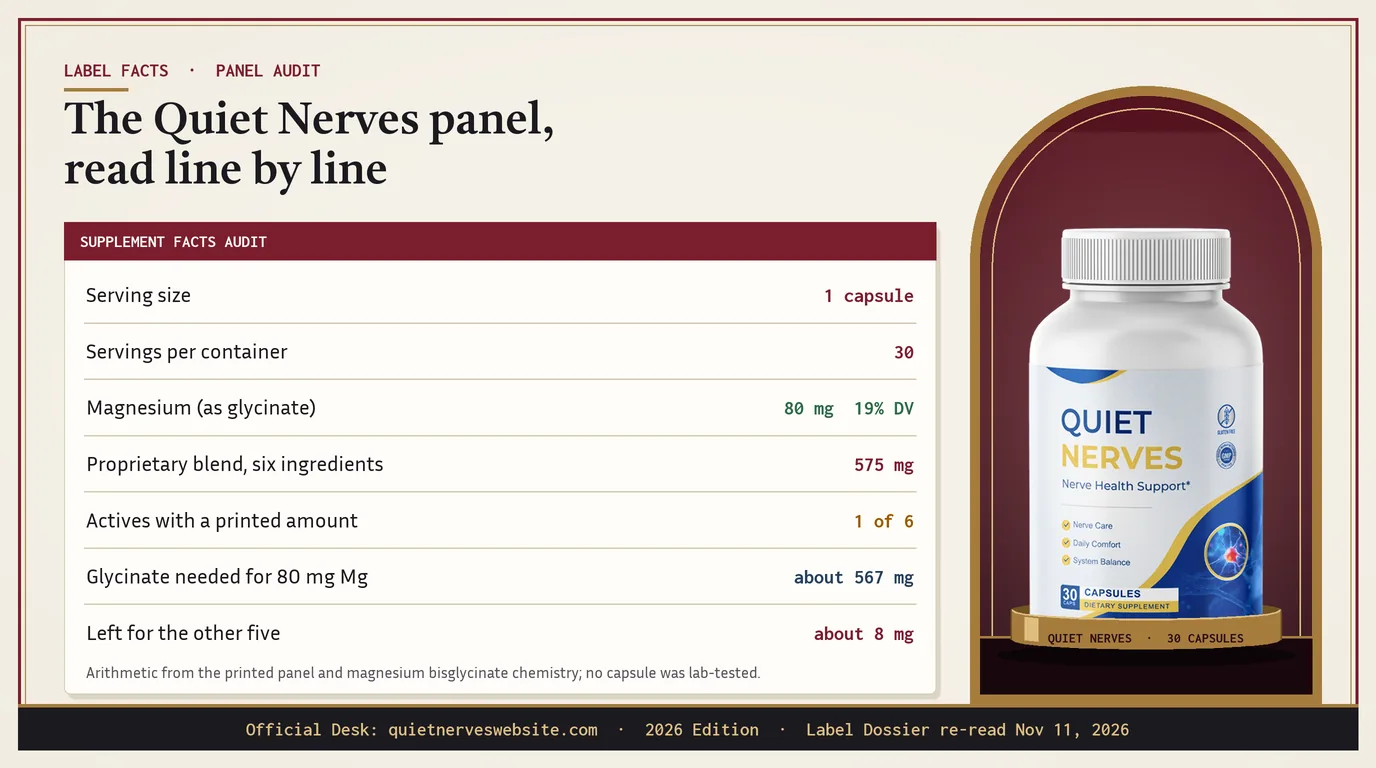
The Supplement Facts panel on Quiet Nerves itemizes a single nutrient. It reads: Magnesium (as Magnesium Glycinate from proprietary blend) 80 mg, 19% Daily Value, in a serving of one capsule taken once a day.[1] Everything else in the capsule sits inside a 575 mg proprietary blend with no individual milligrams. For a reader trying to judge the formula, that makes the magnesium line the only fixed point, and it is worth reading slowly.
The percentage checks out. The current Daily Value for magnesium on U.S. labels is 420 mg, and 80 divided by 420 is 19%. The Recommended Dietary Allowance differs slightly from the Daily Value because it varies by age and sex: the NIH Office of Dietary Supplements lists 400 to 420 mg a day for adult men and 310 to 320 mg for adult women, from food and supplements combined.[2] One capsule therefore supplies roughly a fifth to a quarter of a day's target. It is a top-up, comparable to a modest serving of a magnesium-rich food, and it is not a replacement for a diet that is short on the mineral.
| Reference point | Amount | 80 mg as a share |
|---|---|---|
| Quiet Nerves, one capsule | 80 mg | 100% |
| Daily Value used on labels | 420 mg | 19% |
| RDA, adult women | 310 to 320 mg | 25% to 26% |
| RDA, adult men | 400 to 420 mg | 19% to 20% |
| Upper level for supplemental magnesium, adults | 350 mg | 23% |
The last row matters for safety. The tolerable upper intake level of 350 mg applies only to magnesium from supplements and medicines, not to magnesium in food, and it was set because larger supplemental doses commonly cause diarrhea and cramping.[2] At 80 mg, a single capsule uses less than a quarter of that allowance. People who also take a multivitamin, an antacid or a laxative that contains magnesium should add those amounts together before deciding the total is small.
Stoichiometry: what 80 mg of magnesium weighs as glycinate
Magnesium never travels alone in a capsule. It is bound to a partner, and the partner has weight. In magnesium glycinate (chemists also call it bisglycinate) one magnesium atom is held by two molecules of the amino acid glycine. The molar mass of the anhydrous compound is 172.42 grams per mole, of which magnesium accounts for 24.305. Divide one by the other and magnesium turns out to be 14.1% of the compound by weight.
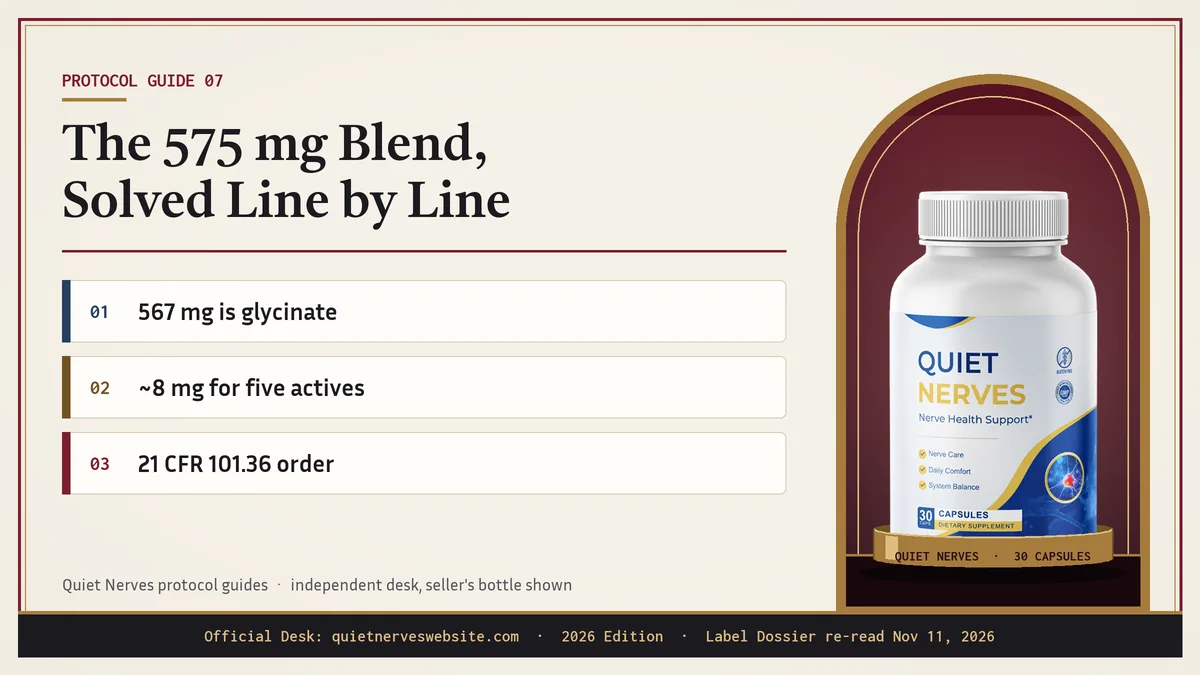
That last line is the reason this monograph exists. The label states that the magnesium comes "from proprietary blend", so the glycinate is counted inside the 575 mg. If the raw material is a fully reacted glycinate, alpha lipoic acid, butcher's broom, L-carnitine, turmeric extract and CoQ10 share about 8 mg between them. We work through every line of that calculation in the 575 mg blend, solved.
There is a more generous reading. Some commercial magnesium glycinate is "buffered", meaning it is blended with magnesium oxide, a compound that is 60.3% magnesium by weight. A buffered material at about 18% magnesium would need only about 444 mg to supply 80 mg, leaving about 131 mg for the other five ingredients. The label does not say buffered, and it names only glycinate as the magnesium source, so we treat this as the upper bound of what the panel allows. We did not assay a capsule; both figures are label arithmetic under stated assumptions.
Glycinate, oxide, citrate: what absorption studies measured
The seller's ingredient card calls magnesium glycinate "one of the most bioavailable and gentle forms of magnesium available".[3] The published comparisons are thinner and more mixed than that sentence suggests.
The classic glycinate study enrolled 12 patients who had part of the small intestine removed and compared magnesium diglycinate with magnesium oxide. Overall absorption was similar; the glycinate did better in the patients whose absorption was most impaired.[4] A randomized, double-blind study that followed 46 volunteers for 60 days found magnesium citrate more bioavailable than either an amino-acid chelate or magnesium oxide.[5] A study of U.S. commercial preparations put the fractional absorption of magnesium oxide at about 4%, well below the chloride, lactate and aspartate salts tested alongside it.[6]
Taken with the wider review literature, these studies suggest that organic salts and chelates are usually absorbed somewhat better than oxide, with the size of the difference varying from study to study.[7,8] The reviews add a second point: absorption depends on the dose, and the gut takes up a larger fraction of a small amount than of a large one. An 80 mg serving is a small amount, so a good share of it is likely to be absorbed whichever reading of the raw material is correct. The form is a reasonable choice. The quantity is the limiting factor.
What human trials tested, and at what dose
Magnesium has been studied for several complaints that overlap with the way Quiet Nerves is advertised: restless sleep, tension, cramps and nerve pain. The seller's FAQ goes further and credits magnesium glycinate with supporting "a healthy inflammatory response" and easing "mild discomfort".[3] The table lists the human evidence we could verify and sets each dose beside the 80 mg on the label.
| Study | People | Daily dose and duration | Result | Label as a share of the dose |
|---|---|---|---|---|
| Abbasi 2012, randomized | 46 older adults with insomnia | 500 mg for 8 weeks | Insomnia scores improved versus placebo | 16% |
| Mah 2021, meta-analysis | 151 older adults in 3 trials | Varied | Fell asleep about 17 minutes sooner; evidence rated low quality | Not comparable |
| Boyle 2017, systematic review | Adults prone to anxiety or stress | Varied | Suggestive benefit, poor-quality studies | Not comparable |
| Garrison 2020, Cochrane review | Older adults with muscle cramps | Varied | Unlikely to help idiopathic cramps | Not comparable |
| Pickering 2011, randomized | 45 patients with neuropathic pain | Oral magnesium for 4 weeks | No difference from placebo in pain intensity | Not compared |
| De Leeuw 2004, open study | Magnesium-depleted adults with type 1 diabetes | 300 mg for 5 years | Less progression of neuropathy than without supplementation | 27% |
Read in order, the table tells a consistent story.[9,10,11,12,13,14] The sleep signal is real but modest and comes from a 500 mg dose. The anxiety literature is suggestive and methodologically weak. For ordinary muscle cramps in older adults, the best review concludes magnesium is unlikely to help. For established neuropathic pain, the one randomized trial found no advantage over placebo on pain intensity. The long diabetes study is the most encouraging for nerves, but it was open label, ran for five years, used 300 mg a day and enrolled people who were measurably short of magnesium to begin with.
Animal work adds a mechanism without adding proof. In a rat model of diabetic neuropathic pain, magnesium reduced hypersensitivity and altered NMDA receptor signaling in the spinal cord.[15] That is a reason to study the mineral in people, and the human trials above are what that study has produced so far.
One more detail from the seller's own paperwork belongs here. The reference page on the seller's site lists eight citations, and the two that concern magnesium are about testosterone levels in athletes and physical function in older men, not nerves, sleep or calm.[16,17,18] The full review of that page, including three record numbers that open a different paper than the one named, is part of the document audit on our monograph home page.
Who should be careful with even 80 mg
The dose is low, and for most adults with healthy kidneys the risk from 80 mg is small. Three situations still deserve a conversation with a clinician or pharmacist before the first capsule.
- Reduced kidney function. The kidneys clear excess magnesium. The NIH fact sheet warns that the risk of magnesium toxicity rises when kidney function is impaired, so any supplemental magnesium should be cleared by the prescriber who follows the kidneys.[2]
- Antibiotics and bone medicines. Magnesium binds tetracycline and quinolone antibiotics and oral bisphosphonates in the gut and can reduce their absorption. The fact sheet advises taking those antibiotics at least 2 hours before or 4 to 6 hours after a magnesium supplement, and separating bisphosphonates by at least 2 hours.[2]
- Medicines that change magnesium levels. Diuretics and long-term proton pump inhibitors can alter magnesium status, which is a reason to have a level checked instead of guessing with a supplement.[2]
Reading the 80 mg line for what it is
Put the pieces together and the magnesium line supports a narrow, honest description. One capsule delivers a fifth of the Daily Value in a well-tolerated form. That can help close a small dietary gap. It is one sixth of the dose that improved sleep scores in older adults and about a quarter of the dose in the long diabetes study, and the randomized neuropathic pain trial was negative even at its own dose.
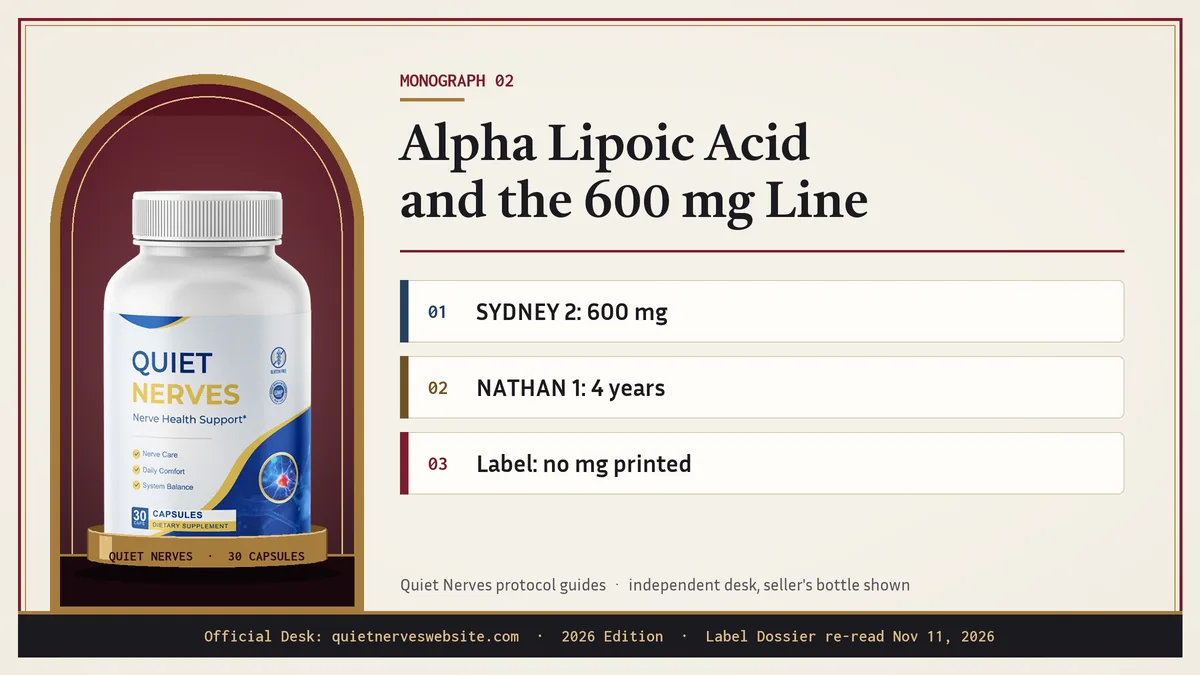
The same line also sets the ceiling for everything else in the capsule, which is why the other five ingredients have their own monographs, starting with alpha lipoic acid and the 600 mg line. The pricing page shows what the capsule costs per day: $1.63 to $2.80 depending on the pack. A reader who still wants this particular formula can open the seller's 6-bottle order page, the lowest price per bottle at $49; we may earn a commission on that order, and it changes nothing above.
Questions readers ask
How much magnesium is in one Quiet Nerves capsule?
One capsule contains 80 mg of magnesium, which is 19% of the 420 mg Daily Value. It is supplied as magnesium glycinate and it is the only ingredient on the label with a printed amount; the other five actives share a 575 mg proprietary blend without individual figures.
Is 80 mg of magnesium enough to help with sleep or nerve discomfort?
Probably not on its own. The sleep trial that showed a benefit used 500 mg a day for 8 weeks, the long diabetes study used 300 mg a day, and a randomized trial in neuropathic pain found no difference from placebo. An 80 mg serving is a dietary top-up.
Is magnesium glycinate better absorbed than magnesium oxide?
Somewhat, in most comparisons, but the evidence is modest. One small study found similar overall absorption with an advantage for glycinate in poor absorbers, and oxide absorption has been measured at about 4%. At a small dose the body absorbs a larger fraction of any form.
Can I take two capsules to get more magnesium?
The label says not to exceed the recommended dose of one capsule a day, and we would follow it. Doubling the serving would also double five ingredients whose amounts are not printed. If more magnesium is the goal, a single-ingredient product with a stated dose is the cleaner route, after checking with a clinician.
Does 80 mg of magnesium interact with medication?
It can. Magnesium reduces absorption of tetracycline and quinolone antibiotics and oral bisphosphonates, so the doses need spacing by hours, and people with reduced kidney function should not add magnesium without medical advice.
References
Numbered in order of first citation on this page. Study records were checked against PubMed on November 11, 2026; seller documents are quoted as read on the same day.
- Quiet Nerves. Bottle label artwork with Supplement Facts panel, as published on the seller's order page. Read November 11, 2026. Source
- NIH Office of Dietary Supplements. Magnesium: Fact Sheet for Health Professionals. Updated January 6, 2026. Source
- Quiet Nerves. Sales page, ingredient descriptions, testimonials and FAQ. Read November 11, 2026. Source
- Schuette SA, Lashner BA, Janghorbani M. Bioavailability of magnesium diglycinate vs magnesium oxide in patients with ileal resection. JPEN J Parenter Enteral Nutr. 1994;18(5):430-5. PMID 7815675. PubMed
- Walker AF, Marakis G, Christie S, et al. Mg citrate found more bioavailable than other Mg preparations in a randomised, double-blind study. Magnes Res. 2003;16(3):183-91. PMID 14596323. PubMed
- Firoz M, Graber M. Bioavailability of US commercial magnesium preparations. Magnes Res. 2001;14(4):257-62. PMID 11794633. PubMed
- Ranade VV, Somberg JC. Bioavailability and pharmacokinetics of magnesium after administration of magnesium salts to humans. Am J Ther. 2001;8(5):345-57. PMID 11550076. PubMed
- Schuchardt JP, Hahn A. Intestinal Absorption and Factors Influencing Bioavailability of Magnesium-An Update. Curr Nutr Food Sci. 2017;13(4):260-278. PMID 29123461. PubMed
- Abbasi B, Kimiagar M, Sadeghniiat K, et al. The effect of magnesium supplementation on primary insomnia in elderly: A double-blind placebo-controlled clinical trial. J Res Med Sci. 2012;17(12):1161-9. PMID 23853635. PubMed
- Mah J, Pitre T. Oral magnesium supplementation for insomnia in older adults: a Systematic Review & Meta-Analysis. BMC Complement Med Ther. 2021;21(1):125. PMID 33865376. PubMed
- Boyle NB, Lawton C, Dye L. The Effects of Magnesium Supplementation on Subjective Anxiety and Stress-A Systematic Review. Nutrients. 2017;9(5). PMID 28445426. PubMed
- Garrison SR, Korownyk CS, Kolber MR, et al. Magnesium for skeletal muscle cramps. Cochrane Database Syst Rev. 2020;9(9):CD009402. PMID 32956536. PubMed
- Pickering G, Morel V, Simen E, et al. Oral magnesium treatment in patients with neuropathic pain: a randomized clinical trial. Magnes Res. 2011;24(2):28-35. PMID 21659058. PubMed
- De Leeuw I, Engelen W, De Block C, et al. Long term magnesium supplementation influences favourably the natural evolution of neuropathy in Mg-depleted type 1 diabetic patients (T1dm). Magnes Res. 2004;17(2):109-14. PMID 15319143. PubMed
- Rondón LJ, Privat AM, Daulhac L, et al. Magnesium attenuates chronic hypersensitivity and spinal cord NMDA receptor phosphorylation in a rat model of diabetic neuropathic pain. J Physiol. 2010;588(Pt 21):4205-15. PMID 20837644. PubMed
- Quiet Nerves. Scientific References page (eight citations). Read November 11, 2026. Source
- Cinar V, Polat Y, Baltaci AK, et al. Effects of magnesium supplementation on testosterone levels of athletes and sedentary subjects at rest and after exhaustion. Biol Trace Elem Res. 2011;140(1):18-23. PMID 20352370. PubMed
- Maggio M, De Vita F, Lauretani F, et al. The Interplay between Magnesium and Testosterone in Modulating Physical Function in Men. Int J Endocrinol. 2014;2014:525249. PMID 24723948. PubMed