Monograph 06
Butcher's Broom: A Vein Herb in a Nerve Formula (What Ruscus Trials Measured)
Butcher's broom, Ruscus aculeatus, is third in the Quiet Nerves blend and the one ingredient with no nerve research at all. Its clinical record concerns veins: heavy, swollen legs in chronic venous insufficiency. This monograph reviews that record, explains the seller's circulation argument, and shows how much extract the label can hold.
A spiny shrub with a venous reputation
Butcher's broom is a low evergreen shrub of the Mediterranean region, known to botanists as Ruscus aculeatus. Its underground stem and roots contain steroidal saponins called ruscogenins, which are the compounds that herbal medicine has traditionally linked to its effects on blood vessels. In European pharmacies the extract has been sold for decades in products for tired, heavy legs and for hemorrhoids.
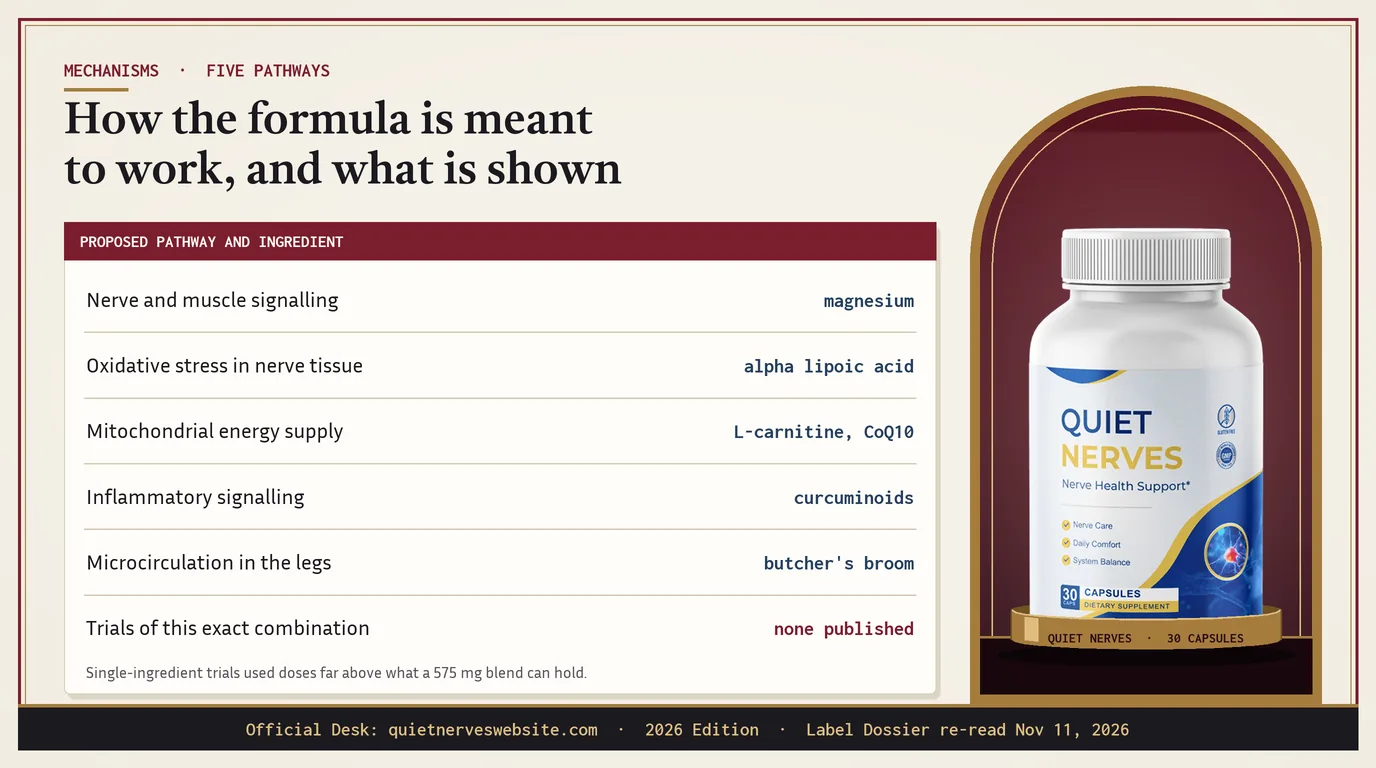
The Quiet Nerves panel lists it as "Butcher's Broom (Ruscus aculeatus) Root Extract", third in the 575 mg proprietary blend after magnesium glycinate and alpha lipoic acid.[1] The label gives no amount, no extraction ratio and no ruscogenin content, three details that monographs normally use to describe a Ruscus preparation.
The seller presents the herb as "prized for its role in supporting healthy circulation, particularly in the lower limbs", and calls that circulation "a foundational element of overall nerve comfort".[2] The first half of the sentence matches the herb's history. The second half is an inference, and this monograph checks whether any study supports it.
What the European monograph recognizes
The European Medicines Agency's Committee on Herbal Medicinal Products has published a monograph on butcher's broom rhizome. It recognizes two traditional uses: relief of discomfort and heaviness of the legs related to minor venous circulatory disturbances, and relief of itching and burning associated with hemorrhoids.[3]
Two things about that monograph are worth noting. The category is "traditional use", which in European regulation means the indication rests on long-standing use and plausibility, not on the level of clinical proof demanded of a conventional medicine. And neither indication involves nerves. Tingling, burning or numbness from neuropathy do not appear in it.
The placebo-controlled vein trial
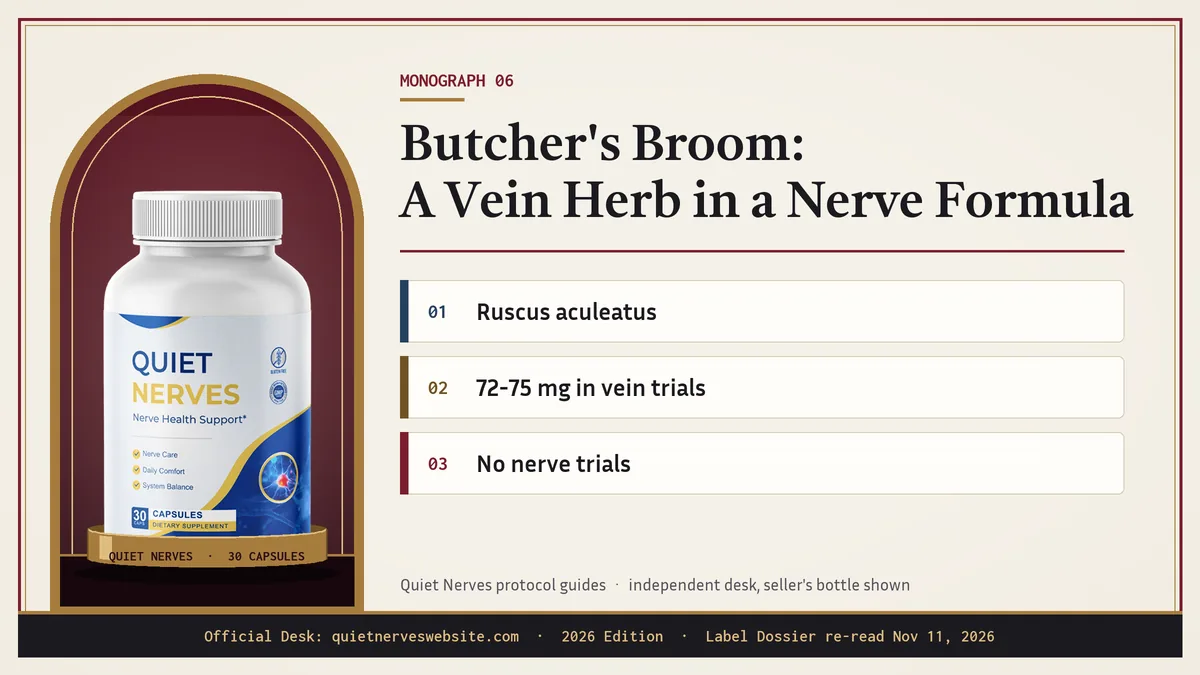
The most direct evidence for Ruscus extract on its own is a randomized, placebo-controlled trial in 166 women with chronic venous insufficiency. They took a butcher's broom preparation supplying 72 to 75 mg of extract a day for 12 weeks. Leg volume, an objective measure of swelling, fell in the treated group compared with placebo.[5]
This is a clean piece of clinical research, and its scope is narrow. The participants were women with a diagnosed venous condition. The outcome was leg swelling and related symptoms. Nothing in the trial measured nerve function or nerve pain, and nobody was enrolled because of neuropathy.
Cyclo 3 Fort: a three-part product, not Ruscus alone
Most of the remaining human data come from a branded European medicine, Cyclo 3 Fort, which combines 150 mg of Ruscus extract with hesperidin methyl chalcone (a citrus flavonoid derivative, abbreviated HMC) and vitamin C in each capsule.
| Source | Preparation | People and condition | Finding | People with neuropathy enrolled |
|---|---|---|---|---|
| Vanscheidt 2002, randomized trial | Ruscus extract alone, 72 to 75 mg a day | 166 women, chronic venous insufficiency, 12 weeks | Reduced leg volume versus placebo | No |
| Boyle 2003, meta-analysis | Cyclo 3 Fort (Ruscus 150 mg + HMC + vitamin C per capsule) | Trials in chronic venous insufficiency | Venous symptoms improved | No |
| Kakkos 2017, systematic review | Ruscus + HMC + vitamin C | 10 randomized trials in venous disease | Venous symptoms and ankle swelling improved | No |
| Quiet Nerves label | Root extract, amount not printed | Not tested | No data | Not tested |
A 2003 meta-analysis of Cyclo 3 Fort trials and a 2017 systematic review of ten randomized, double-blind, placebo-controlled trials both concluded that the combination improved venous symptoms, and the later review also found reduced ankle swelling.[6,7] Some of these trials tracked tingling in the legs as one of several venous symptoms, in patients whose diagnosis was venous disease; none enrolled people with neuropathy or measured nerve function.
Because the product has three active components, its results cannot be credited to Ruscus alone. The dose also differs: each capsule of that medicine carried more than twice the highest amount of butcher's broom the Quiet Nerves blend could supply under any reading of the label.
From hamster vessels to human nerves: the missing link
Laboratory work offers a mechanism for the venous effect. In the hamster cheek pouch, a standard model for watching small blood vessels under a microscope, Ruscus extract inhibited the rise in microvascular permeability triggered by histamine.[8] Less leakage from small vessels is consistent with less swelling, which fits the clinical trials.
The seller's argument extends that chain by one link: better circulation in the legs, therefore more comfortable nerves. The idea is not absurd, since nerves do depend on a blood supply. But a plausible chain is not a tested one. Among the studies we could verify there is no human trial of butcher's broom for neuropathy, nerve pain or any nerve outcome, and the seller's own list of eight citations contains no butcher's broom study of any kind.[9]
Half the remainder at most
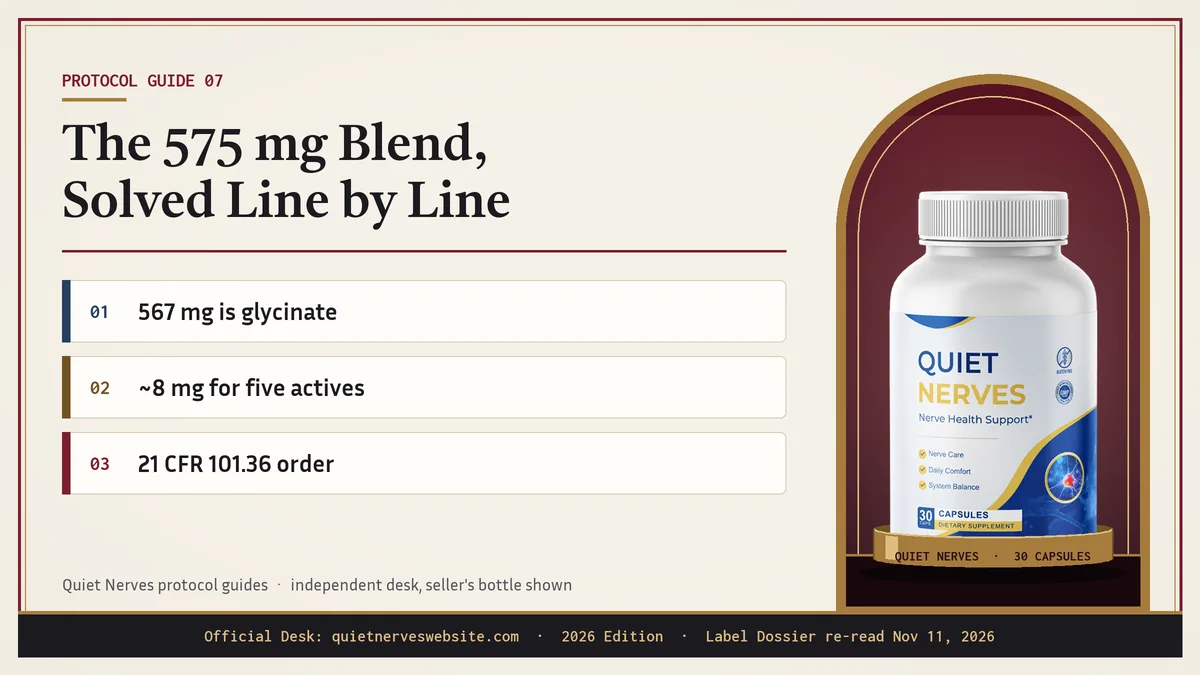
The label does allow a boundary on the amount. Magnesium is printed at 80 mg "from proprietary blend", and fully reacted magnesium glycinate is 14.1% magnesium, so about 567 mg of the 575 mg blend is glycinate and about 7.5 mg remains for five ingredients. Butcher's broom is second among those five, behind alpha lipoic acid.[10]
This is the one place in the formula where the generous reading comes close to a studied dose, so it deserves a careful statement. If the glycinate is buffered, and if the blend is split almost entirely between alpha lipoic acid and butcher's broom, the herb could approach the amount tested for swollen legs in women with venous disease. That scenario would leave L-carnitine, turmeric and CoQ10 as traces, and it would still be a vein dose for a vein outcome. Under the plain reading of the label, the amount is a few milligrams. No capsule was assayed for this monograph; the derivation is in the 575 mg blend, solved.
Tolerability, and who should ask first
The venous trials reported butcher's broom preparations as generally well tolerated. The European Medicines Agency's public summary says no side effects had been reported with these medicines at the time of its assessment, and it limits the traditional use to adults.[3] The Quiet Nerves label independently excludes pregnant and nursing women and anyone under 18.[1]
Persistent diarrhea after starting any product that contains Ruscus is a reason to stop it and speak to a clinician. Leg swelling itself also deserves attention: new swelling in one leg, or swelling with pain, warmth or breathlessness, needs prompt medical assessment and should never be managed with a supplement. Our side effects and interactions page covers the formula as a whole, and symptoms that need a doctor lists the warning signs for nerve complaints.
To sum up the file: butcher's broom is a credible traditional remedy for heavy legs, supported by a placebo-controlled trial at 72 to 75 mg a day and by combination-product reviews. It has not been studied for nerves, and this label can hold between about 4 mg and about 65 mg of it. How its supposed role fits the seller's overall story is examined on the how it works page. Readers who want the capsule regardless can open the seller's 6-bottle order page at $49 a bottle; we may earn a commission, and nothing in this monograph depends on it.
Questions readers ask
What is butcher's broom used for?
Traditionally, for heavy, tired legs and hemorrhoids. The European herbal monograph recognizes those two uses, both related to veins. It is not a recognized remedy for nerve symptoms.
Has butcher's broom been studied for neuropathy?
No. Among the studies we could verify there is no human trial of butcher's broom for neuropathy or nerve pain. Its trials enrolled people with chronic venous insufficiency and measured leg swelling and venous symptoms.
How much butcher's broom is in Quiet Nerves?
The amount is not printed. By label arithmetic it can be at most about 3.8 mg if the magnesium glycinate is fully reacted, or about 65 mg under the most generous reading, because it is second among the five ingredients sharing what remains of the 575 mg blend.
What dose was used in butcher's broom trials?
72 to 75 mg of extract a day for 12 weeks in the main placebo-controlled trial of the herb alone, in 166 women with chronic venous insufficiency. The combination medicine Cyclo 3 Fort contains 150 mg of Ruscus extract per capsule along with two other actives.
Why is a vein herb in a nerve supplement?
The seller argues that healthy circulation in the legs supports nerve comfort. That is a plausible idea without a clinical test behind it. The evidence for butcher's broom ends at veins.
References
Numbered in order of first citation on this page. Study records were checked against PubMed on November 11, 2026; seller documents are quoted as read on the same day.
- Quiet Nerves. Bottle label artwork with Supplement Facts panel, as published on the seller's order page. Read November 11, 2026. Source
- Quiet Nerves. Sales page, ingredient descriptions, testimonials and FAQ. Read November 11, 2026. Source
- European Medicines Agency, Committee on Herbal Medicinal Products. Rusci rhizoma (butcher's broom): herbal monograph. Source
- National Institute of Neurological Disorders and Stroke. Peripheral Neuropathy. Source
- Vanscheidt W, Jost V, Wolna P, et al. Efficacy and safety of a Butcher's broom preparation (Ruscus aculeatus L. extract) compared to placebo in patients suffering from chronic venous insufficiency. Arzneimittelforschung. 2002;52(4):243-50. PMID 12040966. PubMed
- Boyle P, Diehm C, Robertson C. Meta-analysis of clinical trials of Cyclo 3 Fort in the treatment of chronic venous insufficiency. Int Angiol. 2003;22(3):250-62. PMID 14612852. PubMed
- Kakkos SK, Allaert FA. Efficacy of Ruscus extract, HMC and vitamin C, constituents of Cyclo 3 fort®, on improving individual venous symptoms and edema: a systematic review and meta-analysis of randomized double-blind placebo-controlled trials. Int Angiol. 2017;36(2):93-106. PMID 28225220. PubMed
- Bouskela E, Cyrino FZ, Marcelon G. Possible mechanisms for the inhibitory effect of Ruscus extract on increased microvascular permeability induced by histamine in hamster cheek pouch. J Cardiovasc Pharmacol. 1994;24(2):281-5. PMID 7526061. PubMed
- Quiet Nerves. Scientific References page (eight citations). Read November 11, 2026. Source
- 21 CFR 101.36. Nutrition labeling of dietary supplements (proprietary blends listed in descending order of predominance by weight). Source