Monograph 02
Alpha Lipoic Acid for Nerve Symptoms: SYDNEY 2, NATHAN 1 and the 600 mg Line
Alpha lipoic acid is the best-studied ingredient on the Quiet Nerves label and the second item in its proprietary blend. Its nerve trials share one feature: a daily dose of 600 mg or more, usually in people with diabetic polyneuropathy. This monograph walks through those trials, the reviews that pooled them, and the arithmetic that separates them from one capsule.
Second in the blend, first in the evidence file
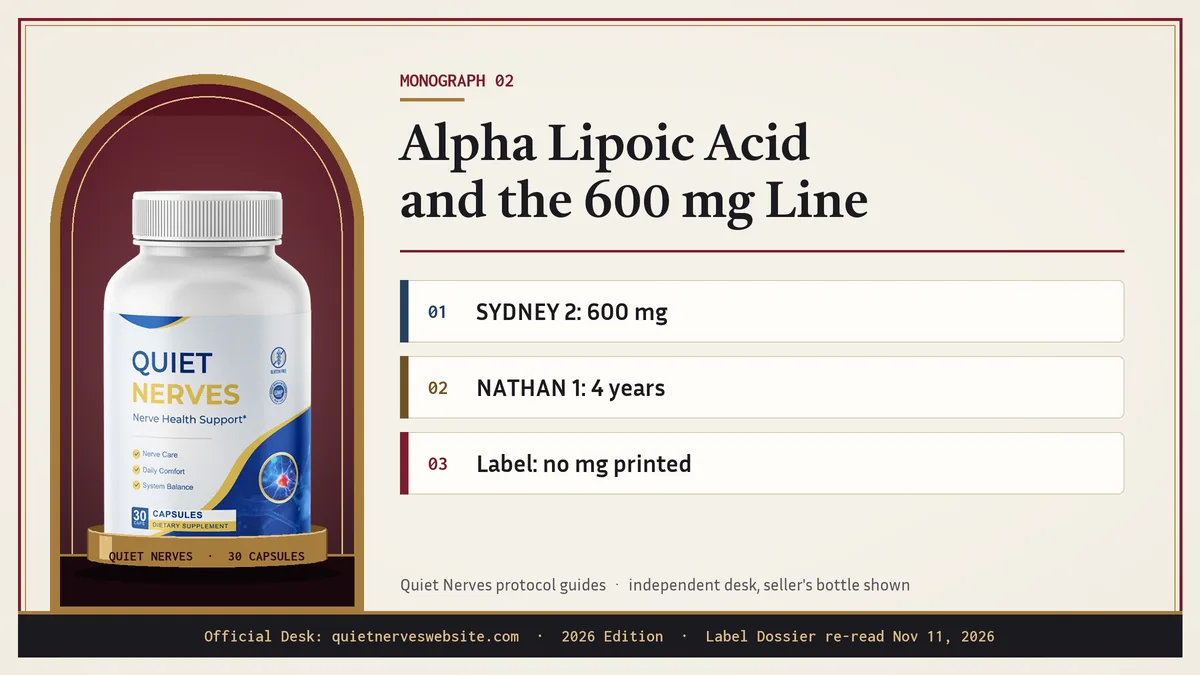
On the Quiet Nerves panel, alpha lipoic acid appears immediately after magnesium glycinate in the 575 mg proprietary blend.[1] Federal labeling rules require the ingredients of a blend to be listed in descending order of weight, so that position tells us it is the second-heaviest component and nothing more precise than that.[2] No milligram figure is printed for it.
The seller describes it as "a rare antioxidant that is both water- and fat-soluble" that "supports healthy nerve function".[3] Of the six ingredients, this is the one with the deepest clinical record for nerve symptoms, which makes it the natural place to test the seller's FAQ statement that the formula uses "clinically effective doses". Alpha lipoic acid (also sold as thioctic acid, and abbreviated ALA below) has been through large randomized trials. Their doses are known. The question is how far one capsule sits from them.
A caveat before the data: almost every trial enrolled people with diabetic polyneuropathy, nerve damage caused by long-standing high blood sugar. Results in that group do not automatically carry over to tingling from other causes, a point we return to in symptoms that need a doctor.
Infusions came first, capsules second
The early positive results came from intravenous dosing. A meta-analysis covering 1,258 patients found that 600 mg a day by infusion for three weeks improved neuropathy symptom scores more than placebo.[4] An infusion places the whole dose in the bloodstream, which a capsule cannot do, so the oral trials are the relevant ones for a supplement.
| Trial | People | Dose and route | Duration | Main result |
|---|---|---|---|---|
| SYDNEY 2 (2006) | 181 | 600, 1,200 or 1,800 mg by mouth once daily | 5 weeks | Symptom scores improved at every dose; 600 mg was the best tolerated |
| ALADIN III (1999) | 509 | Infusions, then 1,800 mg a day by mouth | About 7 months | No significant difference in symptom score versus placebo |
| NATHAN 1 (2011) | 460 | 600 mg by mouth once daily | 4 years | Primary composite endpoint not met; some deficit scores improved |
SYDNEY 2 is the trial most often quoted in favor of oral ALA. It randomized 181 patients to placebo or to one of three daily doses for five weeks. All three active groups reported lower symptom scores than placebo, and because side effects were more frequent at the higher doses, the investigators judged 600 mg once daily to offer the best balance of benefit and risk.[5]
The two longer trials are less flattering. ALADIN III followed 509 patients through a course of infusions and then six months of 1,800 mg a day by mouth, and found no significant difference from placebo on the symptom score.[6] NATHAN 1 gave 600 mg a day for four years to 460 patients with diabetic polyneuropathy. Its primary endpoint, a composite of an examination score and nerve function tests, was not met, although some measures of neuropathic deficits favored ALA.[7]
How the pooled reviews read the same trials
Reviewers who pooled these studies reached conclusions that became more cautious over time. A 2012 meta-analysis of four randomized trials with 653 patients judged the benefit of intravenous treatment clinically relevant and the benefit of oral treatment unclear.[8] An expert review of ALA efficacy published two years later was co-written by the lead investigator of the main trials, a relationship worth keeping in mind when weighing it.[9]
The most recent and most rigorous assessment is the 2024 Cochrane review, which concluded that oral ALA probably makes little or no difference to neuropathy symptoms at six months compared with placebo.[10] That is a statement about 600 mg and above, taken daily for half a year.
The 600 mg line and the capsule
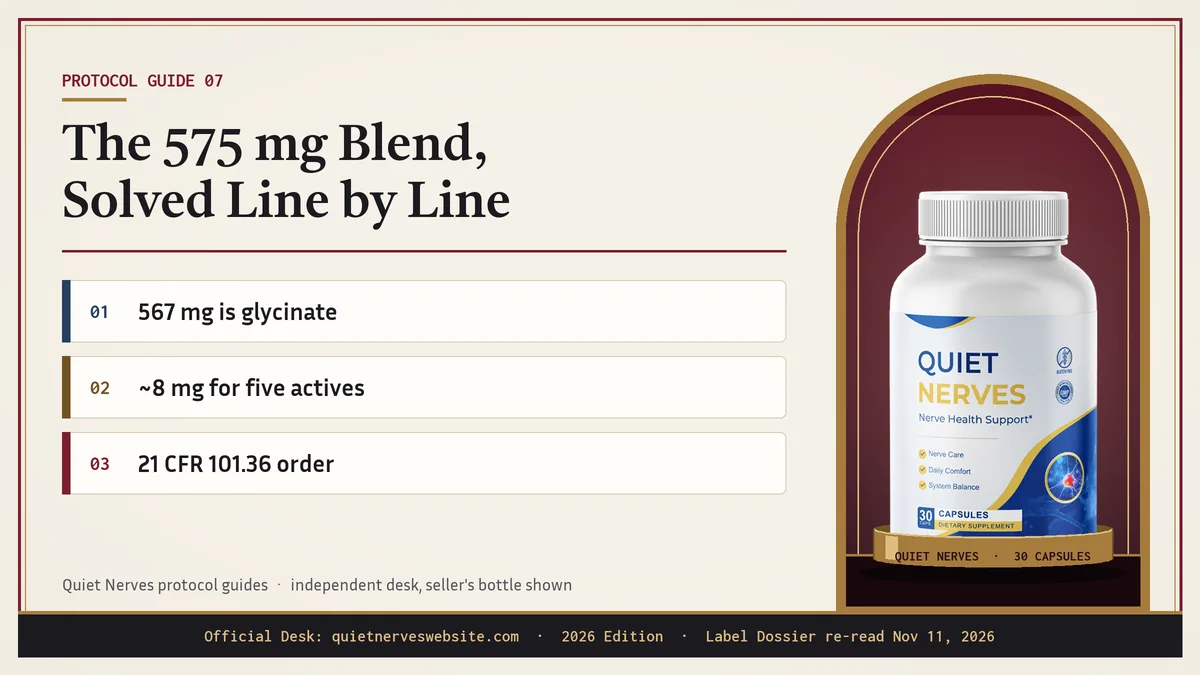
Now the arithmetic. The label prints 80 mg of magnesium "from proprietary blend", and magnesium is 14.1% of fully reacted magnesium glycinate by weight. Supplying 80 mg therefore takes about 567 mg of glycinate, which leaves about 8 mg of the 575 mg blend for the remaining five ingredients together. ALA is the first of those five, so its ceiling is that whole remainder.
These numbers are label math under stated assumptions, not a laboratory result; no capsule was sent for analysis, and the seller could settle the question by printing the amount. What the arithmetic does establish is a boundary. Under the reading most favorable to the product, one capsule cannot contain more than about a fifth of the lowest dose tested in SYDNEY 2, and under the plain reading of "magnesium glycinate" it contains barely more than a hundredth. The full derivation, including why descending order fixes each ceiling, is in the 575 mg blend, solved, and the ingredients page covers all six actives side by side.
Half-life, food and the "with a meal" instruction
Pharmacokinetic work in healthy volunteers shows that oral ALA is absorbed quickly and cleared quickly, with a short plasma half-life.[13] A study of the two mirror-image forms of the molecule (its enantiomers) found that food intake lowered bioavailability, which is why trial protocols typically scheduled the dose before a meal.[14]
The Quiet Nerves label says only "take one (1) capsule daily". The seller's FAQ adds "with a meal and a full glass of water".[1,3] For magnesium that advice is reasonable, since food tends to soften any stomach upset. For ALA it is the opposite of how the trials were run. At a ceiling of a few milligrams the difference is academic, but it is one more sign that the instructions were not written around this ingredient's research.
Blood sugar and a rare immune reaction
ALA has measurable metabolic effects at research doses. A meta-analysis of randomized trials found modest reductions in fasting glucose and HbA1c, and a six-month trial in people with type 2 diabetes saw a dose-related downward trend in glucose across 300 to 1,200 mg a day.[15,16] For someone using insulin or another glucose-lowering medicine, anything that lowers glucose further is a reason to monitor more closely.
There is also a rare reaction worth knowing by name. Insulin autoimmune syndrome is a condition in which the body makes antibodies against its own insulin, causing episodes of low blood sugar. Reviews list ALA among the sulfur-containing compounds that can trigger it in susceptible people, and individual cases in ALA users have been published.[17,18]
What a careful reader can take from the ALA file
Three statements survive the evidence. First, the positive oral result for ALA is short term, at 600 mg a day, in diabetic polyneuropathy. Second, longer trials and the latest Cochrane review are lukewarm even at that dose. Third, the Quiet Nerves label caps ALA at somewhere between about 8 mg and about 131 mg, so the capsule cannot reproduce any of the trials above.
None of this makes the ingredient unsafe at the label amount; small doses are the least likely to cause the side effects that rose with dose in SYDNEY 2. It does mean ALA's research cannot be borrowed to describe this product. The same test applied to the next ingredient is in L-carnitine vs acetyl-L-carnitine. Readers who have weighed this and still wish to try the capsule can go to the seller's 6-bottle order page at $49 a bottle; we may earn a commission, and the 60-day refund reading is on our refund steps page.
Questions readers ask
How much alpha lipoic acid is in Quiet Nerves?
The label does not say. Alpha lipoic acid is listed second in a 575 mg proprietary blend with no individual amount. Label arithmetic puts its ceiling at about 8 mg if the magnesium glycinate is fully reacted, or about 131 mg at most if a buffered glycinate is used.
What dose of alpha lipoic acid was used in neuropathy trials?
600 mg a day or more. SYDNEY 2 tested 600, 1,200 and 1,800 mg by mouth for five weeks, NATHAN 1 used 600 mg a day for four years, and ALADIN III used 1,800 mg a day by mouth after a course of infusions. All three enrolled people with diabetic polyneuropathy.
Does oral alpha lipoic acid work for nerve pain?
The evidence is mixed. A five-week trial at 600 mg a day improved symptom scores, but two longer trials missed their primary endpoints and the 2024 Cochrane review concluded it probably makes little or no difference to symptoms at six months.
Should alpha lipoic acid be taken with food?
Trials dosed it before meals because food lowers its absorption. The seller's FAQ says to take Quiet Nerves with a meal, which suits the magnesium but not this ingredient. At the small amount the label allows, the practical effect is minor.
Can alpha lipoic acid lower blood sugar?
Yes, modestly, at research doses. A meta-analysis shows small falls in fasting glucose and HbA1c, and rare cases of insulin autoimmune syndrome, which causes low blood sugar, have been reported in people taking it. People on glucose-lowering medicine should tell their prescriber.
References
Numbered in order of first citation on this page. Study records were checked against PubMed on November 11, 2026; seller documents are quoted as read on the same day.
- Quiet Nerves. Bottle label artwork with Supplement Facts panel, as published on the seller's order page. Read November 11, 2026. Source
- 21 CFR 101.36. Nutrition labeling of dietary supplements (proprietary blends listed in descending order of predominance by weight). Source
- Quiet Nerves. Sales page, ingredient descriptions, testimonials and FAQ. Read November 11, 2026. Source
- Ziegler D, Nowak H, Kempler P, et al. Treatment of symptomatic diabetic polyneuropathy with the antioxidant alpha-lipoic acid: a meta-analysis. Diabet Med. 2004;21(2):114-21. PMID 14984445. PubMed
- Ziegler D, Ametov A, Barinov A, et al. Oral treatment with alpha-lipoic acid improves symptomatic diabetic polyneuropathy: the SYDNEY 2 trial. Diabetes Care. 2006;29(11):2365-70. PMID 17065669. PubMed
- Ziegler D, Hanefeld M, Ruhnau KJ, et al. Treatment of symptomatic diabetic polyneuropathy with the antioxidant alpha-lipoic acid: a 7-month multicenter randomized controlled trial (ALADIN III Study). ALADIN III Study Group. Alpha-Lipoic Acid in Diabetic Neuropathy. Diabetes Care. 1999;22(8):1296-301. PMID 10480774. PubMed
- Ziegler D, Low PA, Litchy WJ, et al. Efficacy and safety of antioxidant treatment with α-lipoic acid over 4 years in diabetic polyneuropathy: the NATHAN 1 trial. Diabetes Care. 2011;34(9):2054-60. PMID 21775755. PubMed
- Mijnhout GS, Kollen BJ, Alkhalaf A, et al. Alpha lipoic Acid for symptomatic peripheral neuropathy in patients with diabetes: a meta-analysis of randomized controlled trials. Int J Endocrinol. 2012;2012:456279. PMID 22331979. PubMed
- Papanas N, Ziegler D. Efficacy of α-lipoic acid in diabetic neuropathy. Expert Opin Pharmacother. 2014;15(18):2721-31. PMID 25381809. PubMed
- Baicus C, Purcarea A, von Elm E, et al. Alpha-lipoic acid for diabetic peripheral neuropathy. Cochrane Database Syst Rev. 2024;1(1):CD012967. PMID 38205823. PubMed
- Pop-Busui R, Boulton AJ, Feldman EL, et al. Diabetic Neuropathy: A Position Statement by the American Diabetes Association. Diabetes Care. 2017;40(1):136-154. PMID 27999003. PubMed
- Price R, Smith D, Franklin G, et al. Oral and Topical Treatment of Painful Diabetic Polyneuropathy: Practice Guideline Update Summary: Report of the AAN Guideline Subcommittee. Neurology. 2022;98(1):31-43. PMID 34965987. PubMed
- Teichert J, Hermann R, Ruus P, et al. Plasma kinetics, metabolism, and urinary excretion of alpha-lipoic acid following oral administration in healthy volunteers. J Clin Pharmacol. 2003;43(11):1257-67. PMID 14551180. PubMed
- Gleiter CH, Schug BS, Hermann R, et al. Influence of food intake on the bioavailability of thioctic acid enantiomers. Eur J Clin Pharmacol. 1996;50(6):513-4. PMID 8858282. PubMed
- Rahimlou M, Asadi M, Banaei Jahromi N, et al. Alpha-lipoic acid (ALA) supplementation effect on glycemic and inflammatory biomarkers: A Systematic Review and meta- analysis. Clin Nutr ESPEN. 2019;32:16-28. PMID 31221283. PubMed
- Porasuphatana S, Suddee S, Nartnampong A, et al. Glycemic and oxidative status of patients with type 2 diabetes mellitus following oral administration of alpha-lipoic acid: a randomized double-blinded placebo-controlled study. Asia Pac J Clin Nutr. 2012;21(1):12-21. PMID 22374556. PubMed
- Censi S, Mian C, Betterle C. Insulin autoimmune syndrome: from diagnosis to clinical management. Ann Transl Med. 2018;6(17):335. PMID 30306074. PubMed
- Cappellani D, Sardella C, Campopiano MC, et al. Spontaneously remitting insulin autoimmune syndrome in a patient taking alpha-lipoic acid. Endocrinol Diabetes Metab Case Rep. 2018;2018. PMID 30532997. PubMed