Protocol Guide 08
Quiet Nerves and Your Prescriptions: A Class-by-Class Check
Six ingredients, one capsule, and a typical reader who already takes several prescriptions. This guide goes through the medicine classes where the published record gives a reason to pause, says how strong that reason is at the amounts this label can hold, and ends with seven questions worth putting to a pharmacist before the first capsule.

Start with scale: small amounts, real questions
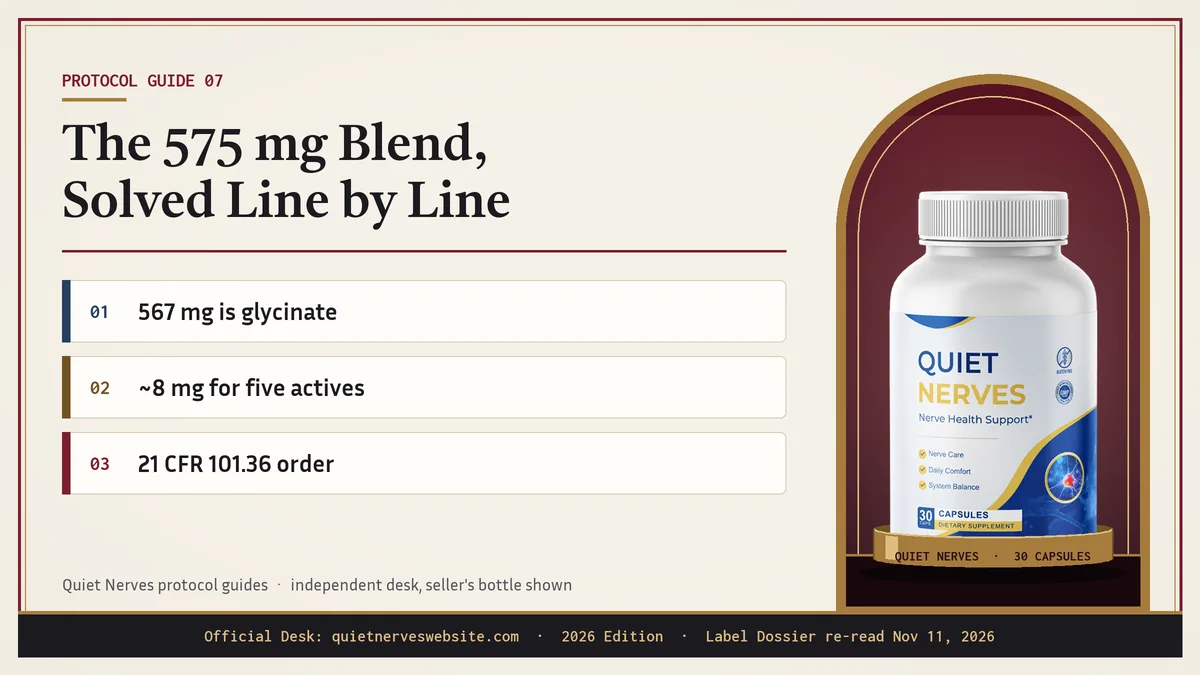
One capsule a day delivers 80 mg of magnesium and a 575 mg blend in which five other ingredients share somewhere between 8 and 131 mg, depending on the grade of magnesium glycinate used. Our blend arithmetic explains those limits. They matter here because nearly every interaction in the published record was observed at doses far above them: grams of carnitine, hundreds of milligrams of alpha lipoic acid or CoQ10.
Small amounts lower the odds of trouble. They do not remove the reason to ask. The bottle itself tells anyone taking medication or living with a medical condition to consult a physician before use [1]. The FDA warns that supplements can change how a medicine is absorbed, metabolized or excreted [2], and the National Institute on Aging advises older adults to go over every supplement with a clinician [3]. What follows is the ingredient-level evidence, class by class, with the strength of each signal stated plainly.
Antibiotics and bone tablets: a question of hours
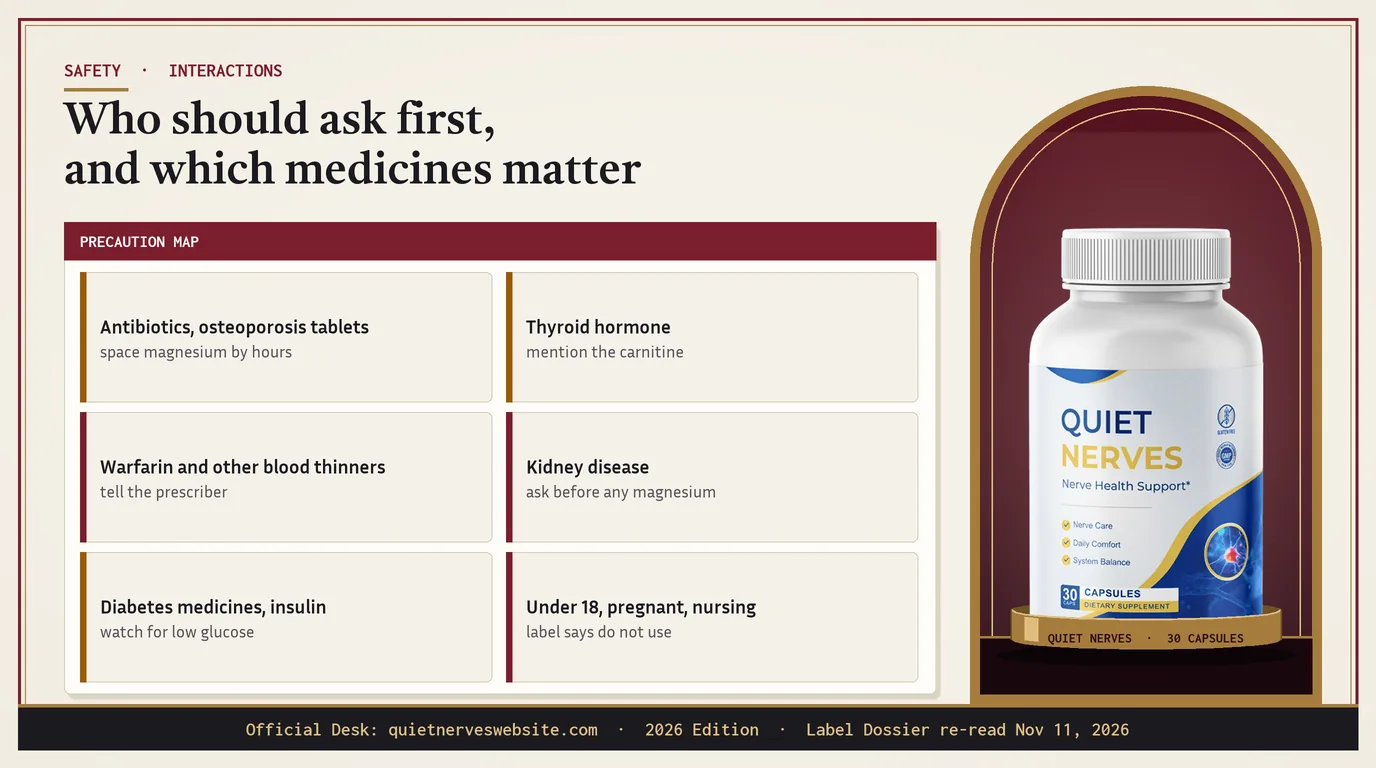
This is the best documented interaction on the list, and it involves the one ingredient with a printed amount. In the gut, magnesium binds to tetracycline antibiotics such as doxycycline and to quinolones such as ciprofloxacin and levofloxacin, forming complexes the body absorbs poorly. The NIH fact sheet for health professionals advises taking these antibiotics at least 2 hours before, or 4 to 6 hours after, a magnesium-containing supplement [4].
The same source lists oral bisphosphonates, the osteoporosis tablets that include alendronate. Magnesium-rich supplements can reduce their absorption, and the two should be separated by at least 2 hours [4]. Bisphosphonates already come with strict rules about an empty stomach and plain water, so the simplest routine is the bone tablet first thing in the morning and the capsule with a later meal, which is also when the seller's FAQ says to take it.
Water pills, acid reducers and kidneys: medicines that move magnesium itself
Some prescriptions do not clash with magnesium so much as change how much of it the body keeps. Loop and thiazide diuretics increase the amount lost in urine, potassium-sparing diuretics reduce that loss, and long-term use of proton pump inhibitors has been linked to low blood magnesium [4].
For a reader on one of these medicines, an 80 mg supplement is neither a problem nor a solution. It is too small to correct a true deficiency, and deciding whether a deficiency exists takes a blood test and a clinician. The reverse case deserves more care. Healthy kidneys clear surplus magnesium and damaged kidneys do not, which is why the NIH sheet singles out impaired kidney function as the setting in which magnesium from supplements can build up [4]. Anyone with chronic kidney disease should treat the capsule as off limits until a nephrologist says otherwise.
Diabetes medicines: glucose on one side, vitamin B12 on the other
Many people who look for nerve support have diabetes, so this class deserves the most attention. Alpha lipoic acid has a measurable effect on glucose. A meta-analysis of randomized trials found modest reductions in fasting glucose and HbA1c with supplementation [5], and a six-month trial in type 2 diabetes reported a dose-related trend across 300 to 1,200 mg a day [6]. CoQ10 at 200 mg a day lowered HbA1c slightly in another trial [7], and magnesium supplementation has been pooled for the same outcomes [8]. At the amounts this capsule can hold, each effect is probably small. Small effects still add to insulin or a sulfonylurea, so the practical advice is to keep testing as usual in the first weeks and to treat unexplained shakiness, sweating or confusion as a possible low.
There is also a rare reaction worth knowing by name. Alpha lipoic acid is among the reported triggers of insulin autoimmune syndrome, in which the body makes antibodies against its own insulin and blood sugar drops unpredictably [9,10]. It is uncommon and usually settles once the trigger is withdrawn, which is the reason to mention the capsule to whoever investigates a new pattern of lows.
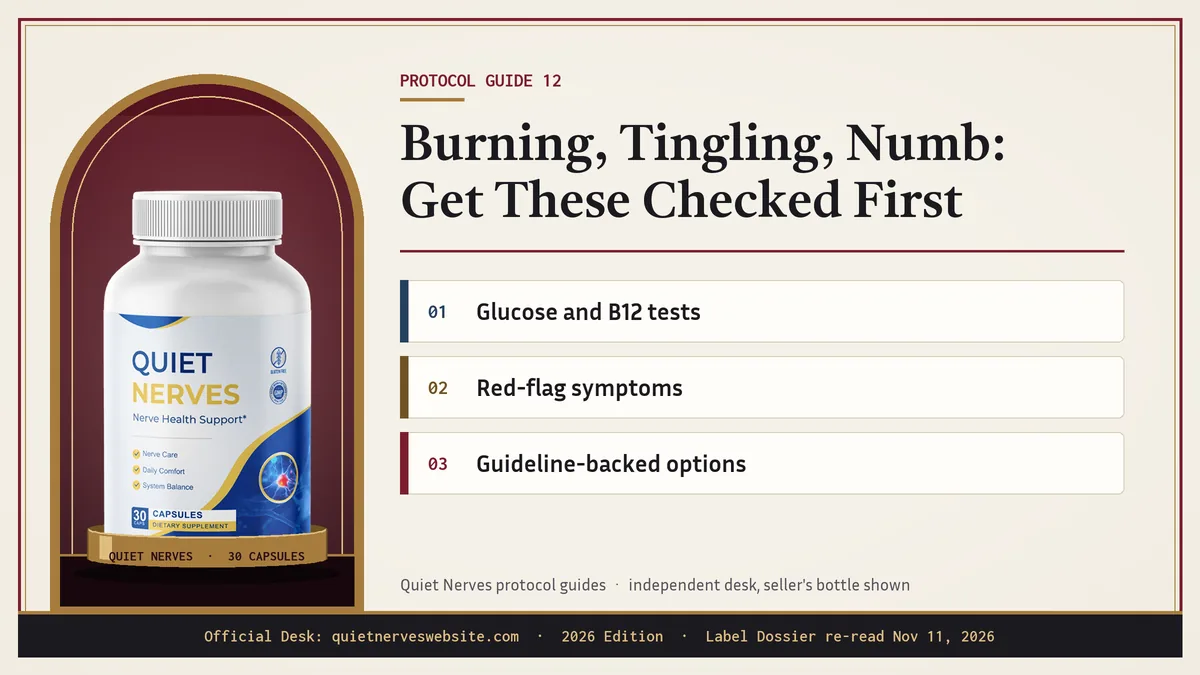
The second issue runs the other way: a medicine that can cause the symptom. Long-term metformin use is associated with vitamin B12 deficiency [11], and low B12 is a recognized cause of neuropathy [12]. Quiet Nerves contains no B12. A reader on metformin with new numbness needs a B12 level before any nerve supplement, a point we expand in the guide to symptoms that need a doctor.
Blood thinners: three ingredients with a paper trail
Warfarin and its relatives have a narrow margin, so even weak signals count. Three ingredients on this label have one.
- CoQ10. Its structure resembles vitamin K, and case reports describe a reduced warfarin effect in patients who added it [13]. A randomized crossover trial of 100 mg a day found no change in warfarin dose or INR [14]. The federal complementary health center still lists warfarin among the medicines CoQ10 may interact with [15].
- L-carnitine. A case report describes it strengthening the effect of acenocoumarol, an anticoagulant used widely outside the United States [16].
- Turmeric. In rats, curcumin altered the blood levels of warfarin and clopidogrel without changing clotting measures [17]. Human data on this point are thin.
Two of these point in opposite directions, one toward weaker anticoagulation and one toward stronger, and none was observed at the few milligrams this capsule can contain. The honest summary is that the direction is uncertain and the size is probably small. For a warfarin patient that is exactly the situation an anticoagulation clinic wants to hear about, because the answer is cheap: ask whether they want an extra INR check after you start, and another after you stop.
Thyroid hormone, chemotherapy, blood pressure and seizure medicines
Thyroid. In a randomized trial of 50 women, L-carnitine at 2 to 4 grams a day blunted the action of thyroid hormone [18]. Two grams is at least 45 times the most L-carnitine this capsule could hold under our generous reading, so a meaningful effect is unlikely. Mention it anyway if your thyroid dose is being adjusted, and ask about timing, since pharmacists often keep levothyroxine a few hours away from mineral-containing products.
Chemotherapy. Carnitine has a cautionary history here. In 409 women receiving taxane chemotherapy, acetyl-L-carnitine at 3 grams a day made neuropathy worse at 24 weeks instead of preventing it [19]. The Quiet Nerves label lists plain L-carnitine, not the acetyl form, and in tiny amounts, a distinction covered in the carnitine monograph. The lesson that transfers is procedural: during cancer treatment, every supplement goes past the oncology team first.
Blood pressure. Pooled trials suggest CoQ10 at 100 to 200 mg a day lowers systolic pressure by a few points in people with cardiometabolic conditions [20]. At 26 mg or less, the capsule is unlikely to move a reading. If you take antihypertensives and notice lightheadedness on standing after starting any new supplement, report it instead of guessing.
Seizure medicines. One older worry can be retired. A 2016 systematic review looked for evidence that levocarnitine provokes seizures in people taking valproate and did not find it [21].
One table and seven questions for the pharmacy counter
| Medicine class | Ingredient involved | What the record shows | First step |
|---|---|---|---|
| Tetracycline or quinolone antibiotics | Magnesium | Binding in the gut lowers antibiotic absorption | Antibiotic 2 hours before or 4 to 6 hours after the capsule |
| Oral bisphosphonates | Magnesium | Lower bisphosphonate absorption | Separate by at least 2 hours |
| Diuretics, long-term acid reducers | Magnesium status | These medicines change magnesium levels | Ask whether your level has been checked |
| Insulin, sulfonylureas | Alpha lipoic acid | Modest glucose lowering at trial doses; rare autoimmune lows | Test as usual; report shakiness or sweats |
| Metformin | None directly | Long-term use linked to low B12, itself a cause of neuropathy | Ask for a B12 level |
| Warfarin, acenocoumarol | CoQ10, L-carnitine, turmeric | Case reports in both directions; one neutral trial | Tell the anticoagulation clinic |
| Levothyroxine | L-carnitine | Antagonism at 2 to 4 g a day, far above this capsule | Mention it; ask about spacing |
| Taxane chemotherapy | Carnitine family | Acetyl-L-carnitine 3 g a day worsened neuropathy | Clear every supplement with oncology |
Bring the bottle, or a photo of the Supplement Facts panel from our label audit, and ask:
- Do any of my medicines need to be spaced away from magnesium, and by how many hours?
- I take warfarin (or another anticoagulant). Should my INR be checked after I start or stop this?
- Could alpha lipoic acid add to my diabetes medicine, and which readings should make me call?
- Has my magnesium level or my kidney function been checked in the past year?
- I take metformin. Has my vitamin B12 ever been measured?
- Is anything on this panel a concern alongside my thyroid, heart or cancer treatment?
- If I feel different after starting, which symptom should make me stop first and phone you?
At the label's amounts most of these interactions are theoretical, and a pharmacist may well say so. That is a good outcome, not a wasted trip. The decision belongs to the person who prescribes your medicines, the side effects page lists what to watch for afterwards, and any serious reaction can be reported to the FDA through MedWatch [22].
Questions readers ask
Can I take Quiet Nerves with metformin?
Does Quiet Nerves interact with warfarin?
How far apart should I take it from an antibiotic?
Take a tetracycline or quinolone antibiotic at least 2 hours before, or 4 to 6 hours after, any magnesium-containing supplement, according to the NIH fact sheet [4]. Pausing the capsule for the length of the course is simpler still.
Is the capsule safe with kidney disease?
Only with your nephrologist's approval. The kidneys clear magnesium, and impaired kidney function is the setting in which magnesium from supplements can accumulate [4]. The label also tells anyone with a medical condition to consult a physician first.
Should I change my prescription if the capsule seems to help?
No. Never stop, skip or reduce a prescribed medicine on the strength of a supplement. If you believe something has changed, take your notes to the prescriber and let them decide.
References
Numbered in order of first citation on this page. Study records were checked against PubMed on November 11, 2026; seller documents are quoted as read on the same day.
- Quiet Nerves. Bottle label artwork with Supplement Facts panel, as published on the seller's order page. Read November 11, 2026. Source
- U.S. Food and Drug Administration. Mixing Medications and Dietary Supplements Can Endanger Your Health. Source
- National Institute on Aging. Dietary Supplements for Older Adults. Source
- NIH Office of Dietary Supplements. Magnesium: Fact Sheet for Health Professionals. Updated January 6, 2026. Source
- Rahimlou M, Asadi M, Banaei Jahromi N, et al. Alpha-lipoic acid (ALA) supplementation effect on glycemic and inflammatory biomarkers: A Systematic Review and meta- analysis. Clin Nutr ESPEN. 2019;32:16-28. PMID 31221283. PubMed
- Porasuphatana S, Suddee S, Nartnampong A, et al. Glycemic and oxidative status of patients with type 2 diabetes mellitus following oral administration of alpha-lipoic acid: a randomized double-blinded placebo-controlled study. Asia Pac J Clin Nutr. 2012;21(1):12-21. PMID 22374556. PubMed
- Hodgson JM, Watts GF, Playford DA, et al. Coenzyme Q10 improves blood pressure and glycaemic control: a controlled trial in subjects with type 2 diabetes. Eur J Clin Nutr. 2002;56(11):1137-42. PMID 12428181. PubMed
- Veronese N, Dominguez LJ, Pizzol D, et al. Oral Magnesium Supplementation for Treating Glucose Metabolism Parameters in People with or at Risk of Diabetes: A Systematic Review and Meta-Analysis of Double-Blind Randomized Controlled Trials. Nutrients. 2021;13(11). PMID 34836329. PubMed
- Censi S, Mian C, Betterle C. Insulin autoimmune syndrome: from diagnosis to clinical management. Ann Transl Med. 2018;6(17):335. PMID 30306074. PubMed
- Cappellani D, Sardella C, Campopiano MC, et al. Spontaneously remitting insulin autoimmune syndrome in a patient taking alpha-lipoic acid. Endocrinol Diabetes Metab Case Rep. 2018;2018. PMID 30532997. PubMed
- Aroda VR, Edelstein SL, Goldberg RB, et al. Long-term Metformin Use and Vitamin B12 Deficiency in the Diabetes Prevention Program Outcomes Study. J Clin Endocrinol Metab. 2016;101(4):1754-61. PMID 26900641. PubMed
- Staff NP, Windebank AJ. Peripheral neuropathy due to vitamin deficiency, toxins, and medications. Continuum (Minneap Minn). 2014;20(5 Peripheral Nervous System Disorders):1293-306. PMID 25299283. PubMed
- Heck AM, DeWitt BA, Lukes AL. Potential interactions between alternative therapies and warfarin. Am J Health Syst Pharm. 2000;57(13):1221-7; quiz 1228-30. PMID 10902065. PubMed
- Engelsen J, Nielsen JD, Hansen KF. [Effect of Coenzyme Q10 and Ginkgo biloba on warfarin dosage in patients on long-term warfarin treatment. A randomized, double-blind, placebo-controlled cross-over trial]. Ugeskr Laeger. 2003;165(18):1868-71. PMID 12772396. PubMed
- National Center for Complementary and Integrative Health. Coenzyme Q10. Source
- Martinez E, Domingo P, Roca-Cusachs A. Potentiation of acenocoumarol action by L-carnitine. J Intern Med. 1993;233(1):94. PMID 8429297. PubMed
- Liu AC, Zhao LX, Lou HX. Curcumin alters the pharmacokinetics of warfarin and clopidogrel in Wistar rats but has no effect on anticoagulation or antiplatelet aggregation. Planta Med. 2013;79(11):971-7. PMID 23807811. PubMed
- Benvenga S, Ruggeri RM, Russo A, et al. Usefulness of L-carnitine, a naturally occurring peripheral antagonist of thyroid hormone action, in iatrogenic hyperthyroidism: a randomized, double-blind, placebo-controlled clinical trial. J Clin Endocrinol Metab. 2001;86(8):3579-94. PMID 11502782. PubMed
- Hershman DL, Unger JM, Crew KD, et al. Randomized double-blind placebo-controlled trial of acetyl-L-carnitine for the prevention of taxane-induced neuropathy in women undergoing adjuvant breast cancer therapy. J Clin Oncol. 2013;31(20):2627-33. PMID 23733756. PubMed
- Zhao D, Liang Y, Dai S, et al. Dose-Response Effect of Coenzyme Q10 Supplementation on Blood Pressure among Patients with Cardiometabolic Disorders: A Grading of Recommendations Assessment, Development, and Evaluation (GRADE)-Assessed Systematic Review and Meta-Analysis of Randomized Controlled Trials. Adv Nutr. 2022;13(6):2180-2194. PMID 36130103. PubMed
- Zeiler FA, Sader N, Gillman LM, et al. Levocarnitine induced seizures in patients on valproic acid: A negative systematic review. Seizure. 2016;36:36-39. PMID 26889779. PubMed
- U.S. Food and Drug Administration. MedWatch: The FDA Safety Information and Adverse Event Reporting Program. Source