Protocol Guide 09
Your First 60 Days on Quiet Nerves: A Log That Fits the Refund Window
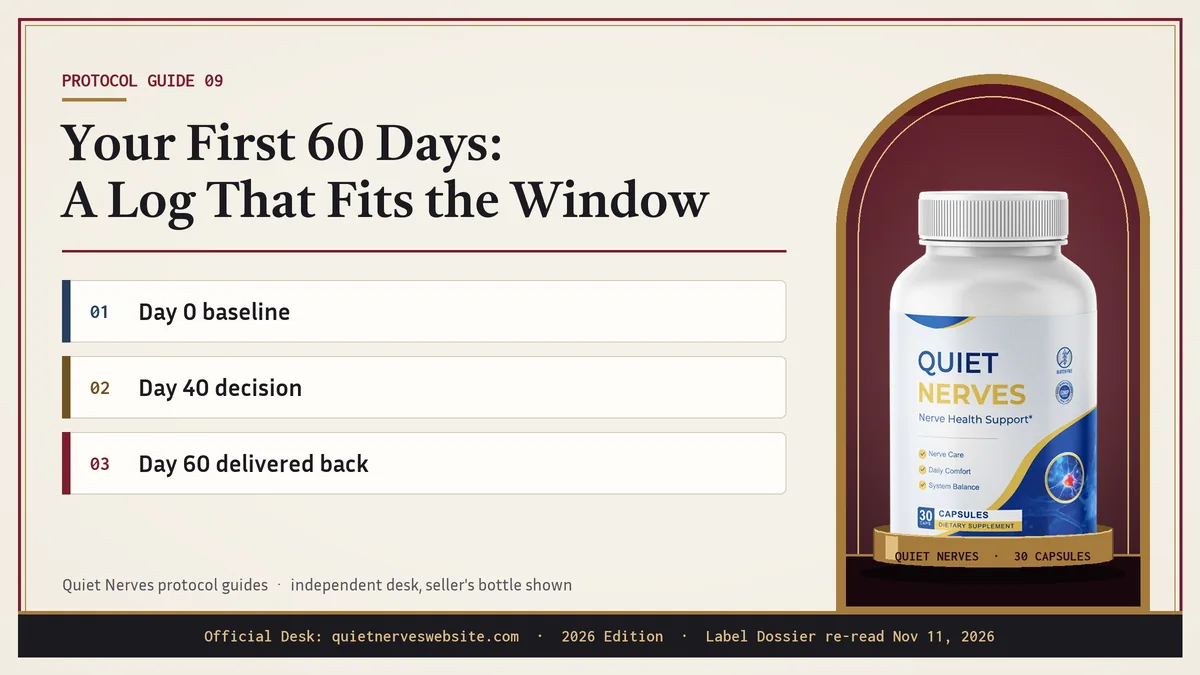
A bottle of Quiet Nerves lasts 30 days. The refund promise lasts 60, and the seller's five policy pages disagree about when that clock starts. This guide turns the mismatch into a calendar: a baseline before the first capsule, a five-minute weekly log, and a decision on day 40 that still leaves time to get a tracked parcel back to Aurora, Colorado.
Why a written log beats a general impression
Nerve symptoms move on their own. Burning feet are worse after a long day standing, better after a good night, worse in a week of poor glucose control. People tend to start a new supplement when symptoms peak, and symptoms that have peaked usually drift back toward their average whether or not anything was taken. Statisticians call this regression to the mean, and it flatters every remedy that is started on a bad week.
Expectation adds a second layer. The seller's FAQ tells buyers that many users notice improvement within the first two to four weeks [1], which is itself a suggestion. Drug trials for neuropathic pain are run against placebo for exactly this reason [2]: people given an inert capsule and a hopeful message often report less pain too. The alpha lipoic acid trial most often quoted for nerve symptoms, SYDNEY 2, scored symptoms with a fixed questionnaire at fixed visits over five weeks and compared the result with a placebo group [3].
You cannot run a placebo group at your kitchen table. You can borrow the other half of the method: fixed questions, fixed days, numbers written down before you know how the story ends. A log does not prove a capsule works. It protects you from deciding on mood, and it gives you dated evidence if you ask for your money back.
Two clocks on one calendar
The capsule clock and the refund clock do not start together. Under the strictest of the seller's five wordings, the refund clock starts the day you order. The capsule clock starts when the parcel lands, and the seller quotes one to two business days of processing plus five to seven business days in transit [4,1]. Put both on one calendar and count every day from the order.
Two consequences follow. The honest test window is one bottle, not two: by the time a second bottle is half gone, the safest return dates have passed. And the days spent waiting for the parcel are not wasted. They are the baseline.
Days 0 to 7: build the baseline while the parcel travels
Start the log the day you order. A week of scores taken before the first capsule is worth more than any single reading, because it shows your own normal range.
- Four symptom scores, each from 0 (none) to 10 (the worst you can imagine): burning, tingling or pins and needles, numbness, and how much your feet or legs disturbed your sleep.
- Two objective numbers: hours slept, and the daily step count from a phone or watch.
- Your medicine list: every prescription with its dose and time of day, and every other supplement. If you measure glucose or blood pressure at home, keep those readings on the same sheet.
- Context: anything that changed in the past month, such as new shoes, a new medicine, an illness, or more or less alcohol.
- Two dates: the order date and, when it comes, the delivery date. Both go on the first line.
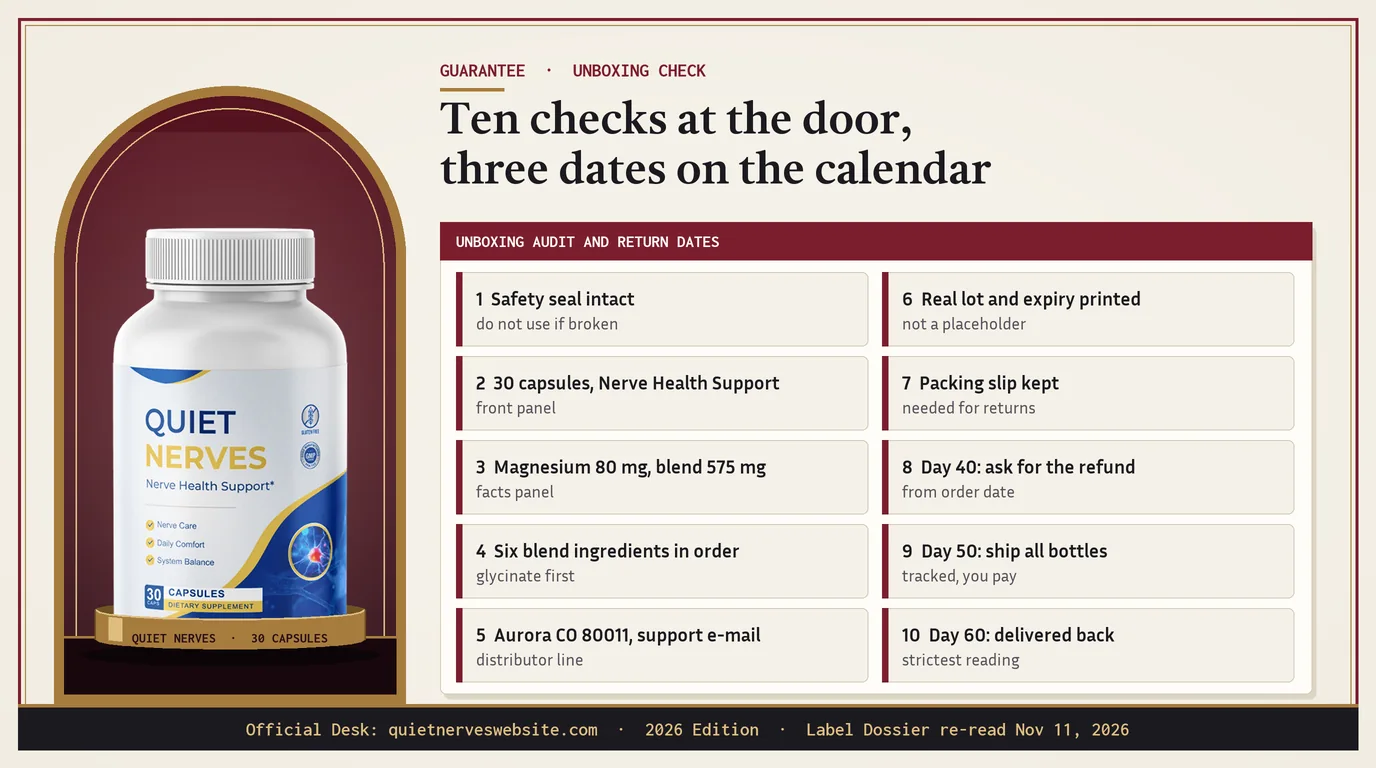
When the parcel arrives, photograph the sealed bottle, the lot code and the packing slip before you open anything. Our bottle check lists what to look for, and the packing slip is one of the items the seller asks to see again if you return the order [5]. Then take the first capsule the way the label and the seller's FAQ describe: one a day, with a meal and a full glass of water [6,1].
The weekly five-minute log
Choose one weekday and one time of day and keep them. Score the previous seven days as a whole, not the last hour, and write a number in every box even when nothing has changed. A row of identical numbers is a finding too.
| Day | Burning 0-10 | Tingling 0-10 | Numbness 0-10 | Sleep disturbed 0-10 | Sleep hours | Daily steps | Write down |
|---|---|---|---|---|---|---|---|
| 0 to 7 | Baseline week, no capsule yet. Order date and medicines | ||||||
| Delivery | Date, seal intact, lot code, first capsule | ||||||
| 14 | Tolerance: stomach, bowels, anything new | ||||||
| 21 | Anything else that changed this week | ||||||
| 30 | Compare with the baseline week | ||||||
| 40 | Decision day: continue, or request a refund | ||||||
| 50 | If returning: tracked parcel handed over by today | ||||||
| 60 | If returning: tracking shows delivered |
Checkpoints on days 14, 30 and 40
Day 14 is about tolerance, not benefit. You will have taken only a handful of capsules. Note any stomach upset, loose stools, rash or new symptom. The alpha lipoic acid trial described above ran for five weeks at a far higher dose, so an improvement after a few capsules says more about a good week than about the capsule [3].
Day 30 is the first real comparison. Set the past week beside the baseline week. Pain researchers commonly treat a fall of about two points on a 0 to 10 scale, or roughly 30%, as the smallest change that patients themselves call meaningful. Use the same bar. A move from 6 to 5 on one score sits inside ordinary week-to-week noise. A move from 6 to 4 that holds for two weeks running, with sleep or steps moving the same way, deserves to be taken seriously.
Day 40 is the decision. If the scores are clearly better by that standard, you have a reason to continue and a record to show your clinician. If they are flat, mixed or worse, the log has done its job and the refund window is still open.
Those numbers come from reading the seller's five policy versions side by side. The order page, the Shipping Policy and the Disclaimer count 60 days from the purchase date, while the Terms count from delivery [7,4,8,9]. The Refund Policy gives buyers seven calendar days to ship once support has sent return instructions [5], and the Shipping Policy says the parcel has to arrive within the 60 days. Asking on day 40 leaves twenty days for a reply, the seven-day shipping window and the carrier. The step-by-step version, with the return address and what goes in the box, is on our refund page.
If you bought three or six bottles, day 40 arrives with two or five of them unopened. They go back with the open one, because both policies ask for every bottle. For a time-boxed test the pack that fits the window is the smallest, two bottles at $167.99 with shipping; we may earn a commission if you order through that link, and the price page compares all three packs.
Rules of the test: change one thing
A log can only tell you about the capsule if the capsule is the only thing that changed.
- Leave prescriptions alone. Do not stop, skip or reduce a prescribed medicine to see what the capsule does by itself. If a prescriber changes a dose during the 40 days, write the date in the log and read the scores with that in mind.
- One capsule a day. The label says not to exceed the recommended dose, and doubling it does not turn a small amount into a studied one.
- Hold the background steady. New footwear, a new exercise plan, a change in alcohol intake or a steroid injection can each move nerve symptoms more than a supplement. If one of them happens, note it.
- Keep testing glucose as usual. If you have diabetes, your normal monitoring continues, and unusually low readings go to your clinician, not into a footnote.
- Mind the spacing. If you are prescribed an antibiotic during the test, follow the timing in our medication guide.
Reasons to stop before day 40
Stop the capsule and get medical advice if any of the following appear. Stopping early does not cost you the refund, since the request can be made on any day inside the window.
- Rash, swelling of the face or throat, or wheezing.
- Diarrhea or stomach pain that lasts more than a few days. Loose stools are the usual side effect of supplemental magnesium, although 80 mg is far below the 350 mg upper limit set for magnesium from supplements [10].
- Yellow skin or eyes, dark urine, itching or unusual tiredness. Turmeric supplements have been linked to rare cases of liver injury [11,12].
- Shakiness, sweating or confusion, particularly if you take insulin or a sulfonylurea.
- New weakness, numbness that spreads quickly, symptoms on one side only, or any change in bladder or bowel control. These are not side effects to log. They are reasons for same-day care, as set out in our guide to symptoms that need a doctor.
Serious reactions to any supplement can be reported to the FDA through MedWatch [13], and it is worth telling the seller as well.
Questions readers ask
How long should I try Quiet Nerves before deciding?
About one bottle. Counting from the order date, decide on day 40: by then you will have taken roughly 28 to 32 capsules and there are still twenty days left to request a refund, ship every bottle and have the parcel delivered inside the 60-day window.
Does the 60-day guarantee start at the order or at delivery?
What if I feel better in the second week?
Write it down and keep logging. Early improvement can come from the capsule, from natural fluctuation or from expectation, and a log cannot separate them. The comparison that counts is the day-30 and day-40 scores against a full baseline week.
Can I return bottles I have opened?
Should I track my blood sugar during the test?
If you have diabetes and already test at home, keep your usual schedule and note the readings on the same sheet. Alpha lipoic acid lowers glucose modestly at higher doses [14], so unexplained lows should be reported to your clinician, not just logged.
References
Numbered in order of first citation on this page. Study records were checked against PubMed on November 11, 2026; seller documents are quoted as read on the same day.
- Quiet Nerves. Sales page, ingredient descriptions, testimonials and FAQ. Read November 11, 2026. Source
- Finnerup NB, Attal N, Haroutounian S, et al. Pharmacotherapy for neuropathic pain in adults: a systematic review and meta-analysis. Lancet Neurol. 2015;14(2):162-73. PMID 25575710. PubMed
- Ziegler D, Ametov A, Barinov A, et al. Oral treatment with alpha-lipoic acid improves symptomatic diabetic polyneuropathy: the SYDNEY 2 trial. Diabetes Care. 2006;29(11):2365-70. PMID 17065669. PubMed
- Quiet Nerves. Shipping Policy, including the Returns clause. Read November 11, 2026. Source
- Quiet Nerves. Refund Policy. Read November 11, 2026. Source
- Quiet Nerves. Bottle label artwork with Supplement Facts panel, as published on the seller's order page. Read November 11, 2026. Source
- Quiet Nerves. Order page with the 2, 3 and 6 bottle packs (BuyGoods funnel). Read November 11, 2026. Source
- Quiet Nerves. Disclaimer, effective January 2026. Read November 11, 2026. Source
- Quiet Nerves. Terms and Conditions, effective January 2026. Read November 11, 2026. Source
- NIH Office of Dietary Supplements. Magnesium: Fact Sheet for Health Professionals. Updated January 6, 2026. Source
- Halegoua-DeMarzio D, Navarro V, Ahmad J, et al. Liver Injury Associated with Turmeric-A Growing Problem: Ten Cases from the Drug-Induced Liver Injury Network [DILIN]. Am J Med. 2023;136(2):200-206. PMID 36252717. PubMed
- LiverTox: Clinical and Research Information on Drug-Induced Liver Injury. Turmeric. National Institute of Diabetes and Digestive and Kidney Diseases. PMID 31643876. Source
- U.S. Food and Drug Administration. MedWatch: The FDA Safety Information and Adverse Event Reporting Program. Source
- Rahimlou M, Asadi M, Banaei Jahromi N, et al. Alpha-lipoic acid (ALA) supplementation effect on glycemic and inflammatory biomarkers: A Systematic Review and meta- analysis. Clin Nutr ESPEN. 2019;32:16-28. PMID 31221283. PubMed