Protocol Guide 12
Burning, Tingling, Numb Feet: What to Get Checked Before Any Capsule
Burning, tingling and numbness in the feet are symptoms with a list of causes, several of them treatable and a few of them urgent. The Quiet Nerves label cannot tell which one you have. This guide sets out the common causes, the warning signs, the blood tests neurologists start with and what treatment guidelines recommend, so that the capsule decision comes last, where it belongs.
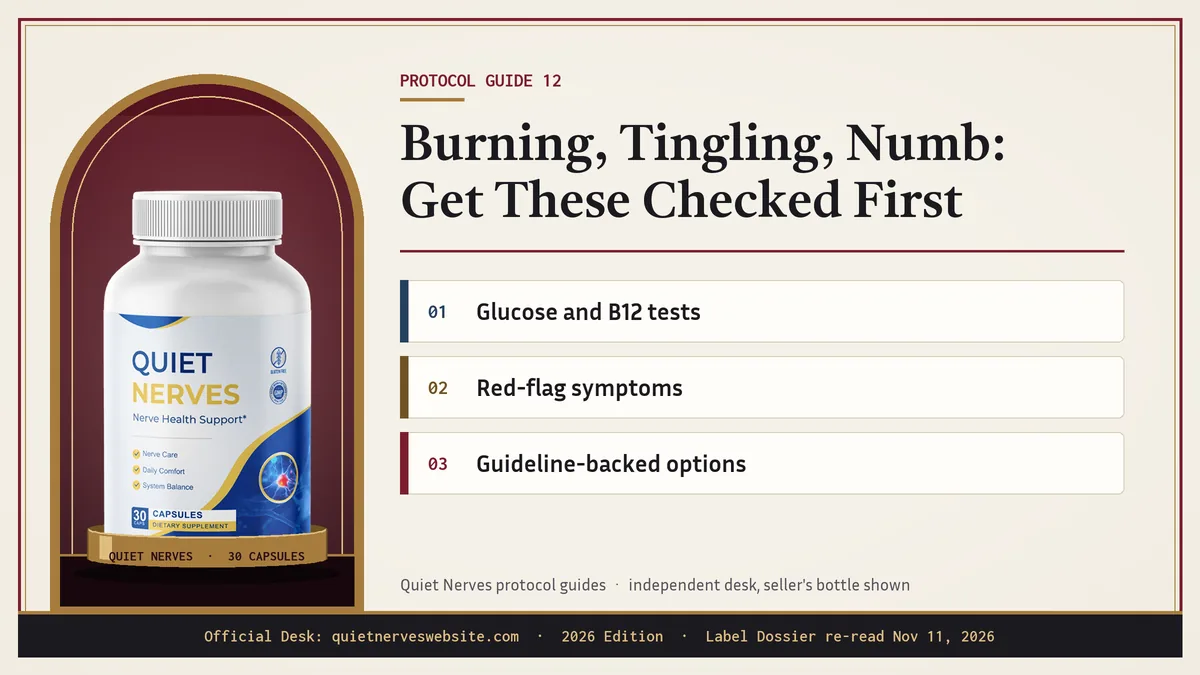
One symptom, many possible causes
Peripheral neuropathy is the general term for damage to the nerves that run outside the brain and spinal cord. It is common, and it becomes more common with each decade of life [1,2]. The typical picture is familiar: burning, tingling or numbness that starts in the toes and climbs slowly, the same on both sides, often worse at night. What matters for this guide is that the picture has many possible causes, and the Quiet Nerves label, like any supplement label, cannot tell you which one is yours [3].
| Cause | Clues that point toward it | Usual first step |
|---|---|---|
| Diabetes and prediabetes | Both feet, toes first, slowly rising; known or borderline high glucose | Fasting glucose or HbA1c |
| Low vitamin B12 | Numbness with unsteadiness; long-term metformin; little animal food in the diet | Serum B12, with follow-up tests if borderline |
| Alcohol | Years of heavy drinking, often with a poor diet | An honest history and a nutrition review |
| Thyroid or kidney disease | Fatigue, weight change, swelling, or known kidney problems | Thyroid and kidney blood tests |
| Medicines, including chemotherapy | Symptoms that began after a new drug or during cancer treatment | Medication review with the prescriber |
| Hereditary neuropathy | Relatives with similar feet, high arches, very slow progression | Referral to neurology |
| No cause found | A full work-up that comes back clean | Monitoring and symptom treatment |
Diabetes is the cause clinicians look for first [4,5]. Vitamin deficiencies, toxins and medicines form the second large group [6]. One link deserves special mention for readers with type 2 diabetes: long-term metformin use is associated with vitamin B12 deficiency [7], so a person can have two treatable contributors at once. When every test is normal the diagnosis is idiopathic neuropathy, which is frustrating, not rare, and still managed with a clinician.
Warning signs that should not wait
Most neuropathy develops over months or years. The patterns below are different, and none of them belongs in a 60-day supplement trial.
Several of these have effective treatments that work better early. A foot wound in a person with reduced sensation is the classic example. It is the complication that diabetes care is organized to catch, through daily foot checks at home and regular foot examinations in the clinic [5,8].
The first blood tests, and why they come before a capsule
The American Academy of Neurology reviewed which laboratory tests most often reveal a cause in people with the usual feet-first pattern. Three came out on top: blood glucose, vitamin B12 with its metabolites, and serum protein immunofixation electrophoresis, a test for abnormal blood proteins [9]. Clinicians add others according to the history, commonly thyroid and kidney function, and when glucose looks normal but the pattern fits they may look more closely for prediabetes.
These are ordinary tests, available through any primary care office. Their value lies in what they change. A low B12 level is corrected with B12, not with a blend that contains none. A raised glucose turns the plan toward glucose control. An abnormal protein result sends the patient to a specialist. A medicine that turns out to be the culprit can sometimes be swapped.
What the guidelines recommend for painful diabetic neuropathy
Three documents shape most treatment decisions, and they agree with each other more than they differ.
- The American Diabetes Association position statement (2017) stresses glucose management and foot care, and names pregabalin and duloxetine as initial drug choices for pain, with gabapentin as another option. It advises against opioids as early treatment [8].
- The American Academy of Neurology guideline (2022) tells clinicians to offer a drug from one of four classes: tricyclic antidepressants, serotonin-norepinephrine reuptake inhibitors, gabapentinoids or sodium channel blockers. It also discusses topical options and recommends against opioids [10].
- The Lancet Neurology meta-analysis (2015) pooled the trials behind most of those classes and gave its strongest recommendation to tricyclics, the same reuptake inhibitors, pregabalin and gabapentin. It also showed the limits: for each of them, several patients have to be treated for one to gain substantial relief [11].
Two things are absent from all three. None promises a cure for established nerve damage; the realistic aims are less pain, better sleep and protection of the feet. And none recommends a multi-ingredient capsule of the kind reviewed on this site. For alpha lipoic acid on its own, the best studied of the six ingredients, a 2024 Cochrane review concluded that oral treatment probably makes little or no difference to symptoms at six months [12].
Movement, feet and glucose: the unglamorous part
The measures with the least marketing behind them do a good share of the work. Glucose management is the foundation in the diabetes guidance [8]. Daily foot inspection, shoes that fit and prompt care for small injuries prevent the complications that cost people their mobility [5]. Cutting back on alcohol removes one direct cause.
Exercise has early evidence of its own. In a small study, 17 people with diabetic neuropathy completed a supervised ten-week program of aerobic and strength training. Pain and neuropathic symptoms fell, and skin biopsies showed more branching of small nerve fibers [13]. Seventeen participants make a pilot, not a verdict. It is still more direct evidence of nerve-level change than exists for the capsule this site reviews, and walking has no refund deadline.
Where a low-dose capsule belongs
At the bottom of the list, and only after the steps above. One capsule supplies 80 mg of magnesium and a 575 mg blend in which, by our label arithmetic, the five other ingredients share between 8 and 131 mg. The alpha lipoic acid trials used 600 mg a day, and even at that dose the record is mixed: symptom scores improved over five weeks in SYDNEY 2, while the four-year NATHAN 1 trial missed its main endpoint [14,15].
The seller's FAQ nevertheless describes the product as designed to relieve the discomfort of neuropathy [16]. That is a disease claim. Supplements are not permitted to make one, and the same page carries the standard statement that the product is not intended to diagnose, treat, cure or prevent any disease [17]. Readers should believe the disclaimer.
If your tests are done, your treatment is settled and you still want to try the capsule, three rules keep the trial honest. Tell your clinician and pharmacist, using the checklist in our medication guide. Keep every prescription exactly as it is. And put the trial on a calendar with a written baseline and a decision date, as laid out in the 60-day tracking plan. The side effects page covers what to watch for along the way.
Questions readers ask
Can Quiet Nerves treat neuropathy?
No. It is a dietary supplement, and supplements may not claim to treat, cure or prevent a disease [17]. Its label quantifies one ingredient, 80 mg of magnesium, and the amounts of the other five are too small to match the doses used in human trials.
What blood tests should I ask about for numb or tingling feet?
Start with blood glucose, vitamin B12 with its metabolites, and serum protein immunofixation electrophoresis. Those were the three highest-yield tests in the American Academy of Neurology review [9]. Your clinician may add thyroid and kidney tests depending on your history.
When is foot numbness an emergency?
Seek urgent care for weakness or numbness that spreads over days, loss of bladder or bowel control, numbness around the groin, sudden one-sided symptoms, or an infected foot wound. These patterns are not typical slow neuropathy and should not wait for an appointment.
Does metformin cause nerve symptoms?
Is it reasonable to try the capsule while I wait for an appointment?
The amounts on the label are small, yet the label itself tells anyone on medication or with a medical condition to ask a physician first. The larger risk is delay: do not let a 60-day trial postpone a blood test that could find a treatable cause.
References
Numbered in order of first citation on this page. Study records were checked against PubMed on November 11, 2026; seller documents are quoted as read on the same day.
- Hanewinckel R, Drenthen J, van Oijen M, et al. Prevalence of polyneuropathy in the general middle-aged and elderly population. Neurology. 2016;87(18):1892-1898. PMID 27683845. PubMed
- National Institute of Neurological Disorders and Stroke. Peripheral Neuropathy. Source
- MedlinePlus. Peripheral Neuropathy. U.S. National Library of Medicine. Source
- Callaghan BC, Cheng HT, Stables CL, et al. Diabetic neuropathy: clinical manifestations and current treatments. Lancet Neurol. 2012;11(6):521-34. PMID 22608666. PubMed
- National Institute of Diabetes and Digestive and Kidney Diseases. Diabetic Neuropathy. Source
- Staff NP, Windebank AJ. Peripheral neuropathy due to vitamin deficiency, toxins, and medications. Continuum (Minneap Minn). 2014;20(5 Peripheral Nervous System Disorders):1293-306. PMID 25299283. PubMed
- Aroda VR, Edelstein SL, Goldberg RB, et al. Long-term Metformin Use and Vitamin B12 Deficiency in the Diabetes Prevention Program Outcomes Study. J Clin Endocrinol Metab. 2016;101(4):1754-61. PMID 26900641. PubMed
- Pop-Busui R, Boulton AJ, Feldman EL, et al. Diabetic Neuropathy: A Position Statement by the American Diabetes Association. Diabetes Care. 2017;40(1):136-154. PMID 27999003. PubMed
- England JD, Gronseth GS, Franklin G, et al. Practice Parameter: evaluation of distal symmetric polyneuropathy: role of laboratory and genetic testing (an evidence-based review). Report of the American Academy of Neurology, American Association of Neuromuscular and Electrodiagnostic Medicine, and American Academy of Physical Medicine and Rehabilitation. Neurology. 2009;72(2):185-92. PMID 19056666. PubMed
- Price R, Smith D, Franklin G, et al. Oral and Topical Treatment of Painful Diabetic Polyneuropathy: Practice Guideline Update Summary: Report of the AAN Guideline Subcommittee. Neurology. 2022;98(1):31-43. PMID 34965987. PubMed
- Finnerup NB, Attal N, Haroutounian S, et al. Pharmacotherapy for neuropathic pain in adults: a systematic review and meta-analysis. Lancet Neurol. 2015;14(2):162-73. PMID 25575710. PubMed
- Baicus C, Purcarea A, von Elm E, et al. Alpha-lipoic acid for diabetic peripheral neuropathy. Cochrane Database Syst Rev. 2024;1(1):CD012967. PMID 38205823. PubMed
- Kluding PM, Pasnoor M, Singh R, et al. The effect of exercise on neuropathic symptoms, nerve function, and cutaneous innervation in people with diabetic peripheral neuropathy. J Diabetes Complications. 2012;26(5):424-9. PMID 22717465. PubMed
- Ziegler D, Ametov A, Barinov A, et al. Oral treatment with alpha-lipoic acid improves symptomatic diabetic polyneuropathy: the SYDNEY 2 trial. Diabetes Care. 2006;29(11):2365-70. PMID 17065669. PubMed
- Ziegler D, Low PA, Litchy WJ, et al. Efficacy and safety of antioxidant treatment with α-lipoic acid over 4 years in diabetic polyneuropathy: the NATHAN 1 trial. Diabetes Care. 2011;34(9):2054-60. PMID 21775755. PubMed
- Quiet Nerves. Sales page, ingredient descriptions, testimonials and FAQ. Read November 11, 2026. Source
- 21 CFR 101.93. Certain types of statements for dietary supplements (structure/function claims and the disclaimer). Source