Monograph 05
CoQ10 (Ubiquinone) and Nerves: The 400 mg Trial vs a Shared 575 mg Blend
Coenzyme Q10, in the ubiquinone form, closes the Quiet Nerves ingredient list. Last place in a proprietary blend means the smallest share by weight. The only randomized trial of CoQ10 in nerve symptoms used 400 mg a day for twelve weeks. This monograph compares those two facts, explains how the compound is absorbed, and reviews the warfarin question.
Last on the list, and what that position means
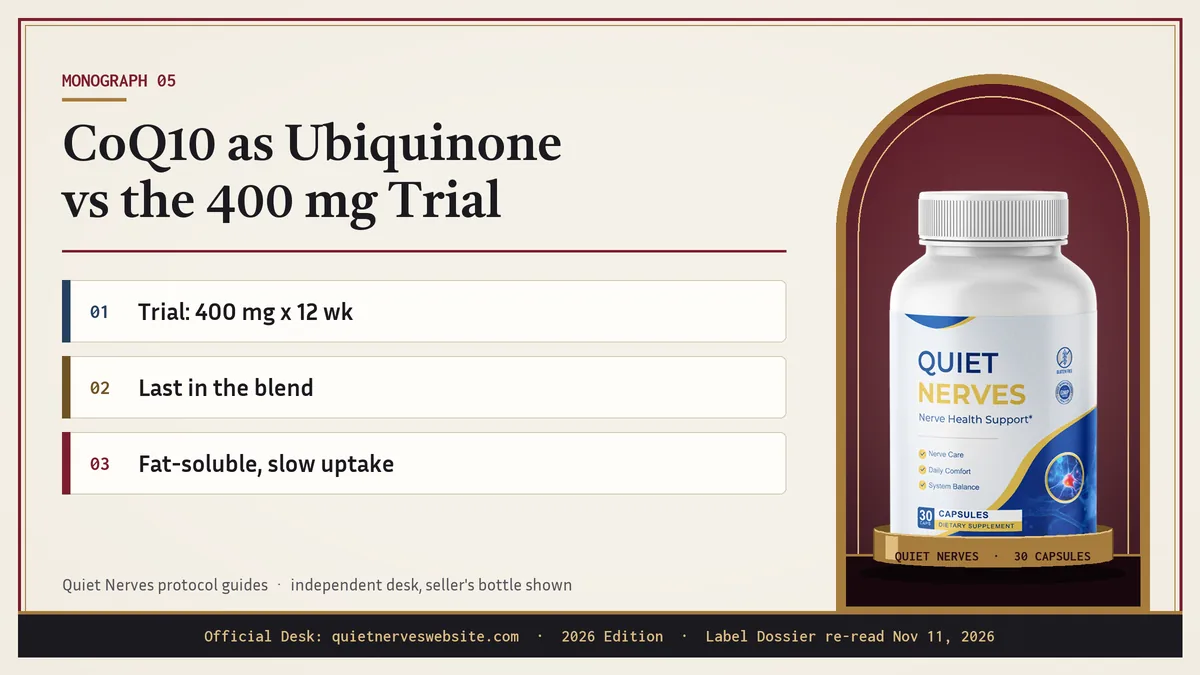
The Quiet Nerves panel ends its proprietary blend with "Coenzyme Q 10 (as Ubiquinone)".[1] Under U.S. labeling rules the components of a blend appear in descending order of predominance by weight.[2] The final name on the list is therefore the lightest ingredient in the blend, or at best tied with the one before it. No milligram amount is printed.
The seller's ingredient card gives CoQ10 a prominent role all the same. It says the compound "plays a direct role in cellular energy production, helping nerve cells generate the power they need", and that it "supports cardiovascular health, ensuring healthy circulation reaches the peripheral nerves in your extremities".[3] Both statements describe real biology. Whether a capsule can act on that biology depends on dose and absorption, the two subjects of this monograph.
Ubiquinone, ubiquinol and a slow route into the body
CoQ10 exists in two interchangeable states. Ubiquinone is the oxidized form and ubiquinol is the reduced form; cells convert one to the other continuously as part of energy metabolism in the mitochondria. Supplements are sold in both forms. The label here specifies ubiquinone, the form named in the nerve trial discussed below.
Whichever form is swallowed, absorption is slow and incomplete. CoQ10 is a large, fat-soluble molecule. A pharmacokinetic review describes peak blood levels arriving about six hours after a dose, a long elimination half-life of roughly 33 hours, and uptake that depends on fat in the gut and becomes less efficient as the dose rises.[4] Solubilized, oil-based formulations were developed for that reason.
The 400 mg, twelve-week nerve trial
One randomized, double-blind, placebo-controlled study has tested ubiquinone specifically in nerve disease. It enrolled 49 patients with diabetic polyneuropathy and gave them 400 mg of ubiquinone a day or placebo for 12 weeks. Symptom scores and nerve conduction measures improved in the treated group.[5]
It is a legitimate, encouraging result, and it has clear limits. Forty-nine people is a small trial. Twelve weeks is short for a condition that develops over years. All participants had diabetes, so the finding says nothing direct about nerve symptoms from other causes. As far as we could verify, it has not been followed by a large confirmatory trial. A fair summary is that CoQ10 at 400 mg a day is a reasonable research lead in diabetic polyneuropathy and not an established treatment.
Heart and blood pressure studies as a dose yardstick
Most CoQ10 research has been cardiovascular. Those studies are not evidence for nerve benefits, but they show what an active dose looks like, and every one of them sits far above what this label can hold.
| Study | Condition | Daily dose | Duration | Result |
|---|---|---|---|---|
| Hernandez-Ojeda 2012 | Diabetic polyneuropathy, 49 patients | 400 mg ubiquinone | 12 weeks | Symptom and nerve conduction scores improved |
| Q-SYMBIO, Mortensen 2014 | Chronic heart failure | 300 mg | 2 years | Fewer major cardiovascular events than placebo |
| Hodgson 2002 | Type 2 diabetes | 200 mg | 12 weeks | Lower blood pressure and HbA1c |
| Zhao 2022, meta-analysis | Cardiometabolic disorders | 100 to 200 mg most effective | Varied | Lower systolic blood pressure |
| Quiet Nerves label | Not a trial | At most about 1.5 mg to about 26 mg | One capsule daily | Not tested |
Across heart failure, blood pressure and glucose control, the doses that produced measurable effects ranged from 100 to 400 mg a day.[6,7,8] The seller's sentence about healthy circulation reaching the peripheral nerves borrows from this literature. None of these cardiovascular trials measured nerve outcomes, and none used a dose in the single or low double digits.
One fifth of the remainder at most
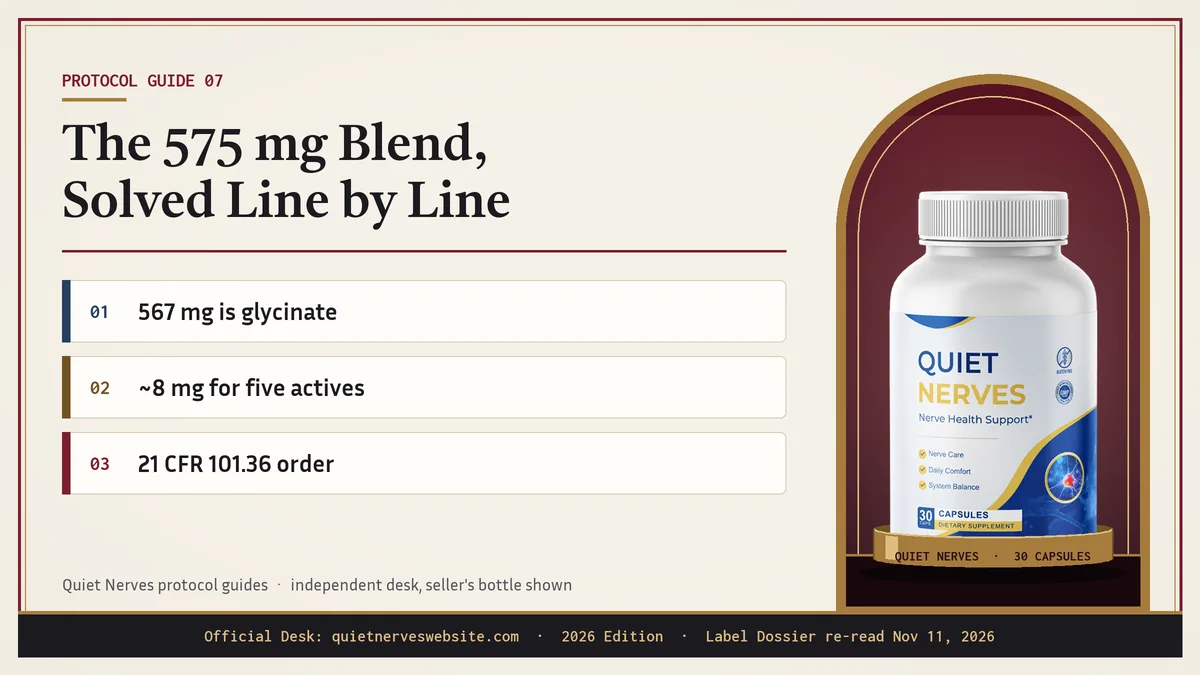
The amount of CoQ10 in the capsule can be bounded from the panel. Magnesium is printed at 80 mg and comes "from proprietary blend" as magnesium glycinate, a compound that is 14.1% magnesium when fully reacted. About 567 mg of the 575 mg blend is therefore glycinate, and about 7.5 mg is left for alpha lipoic acid, butcher's broom, L-carnitine, turmeric extract and CoQ10 together.
That last line is specific to the final position. For the ingredients higher up, the ceiling assumes the ones below them are tiny. For CoQ10 the ceiling assumes a perfectly even split, which would be an unusual way to formulate. The realistic amount is below the ceiling in either reading. As always, this is arithmetic from the printed label and not a laboratory assay; the derivation for each ingredient is in the 575 mg blend, solved, and the panel is transcribed on the label facts page.
Safety record and the warfarin question
CoQ10 has one of the cleaner safety files among popular supplements. A formal safety assessment identified an observed safe level of 1,200 mg a day, many times any amount relevant here.[9] The National Center for Complementary and Integrative Health reports no serious side effects, with occasional mild complaints such as digestive upset or trouble sleeping.[10]
The interaction most often raised is with warfarin. CoQ10 is structurally related to vitamin K, and a review of alternative therapies and warfarin collected case reports in which CoQ10 appeared to reduce the anticoagulant's effect.[11] When the question was tested directly in a randomized, double-blind crossover trial, 100 mg of CoQ10 a day did not change warfarin dose requirements or INR.[12] The evidence therefore points both ways, with the controlled trial being the more reassuring.
Because CoQ10 can lower blood pressure and glucose modestly at 100 to 200 mg a day, people on antihypertensive or diabetes medicine are usually advised to mention it to their prescriber. At the label ceiling those effects are improbable, though the advice costs nothing to follow.
The CoQ10 line, summed up
CoQ10 as ubiquinone has a small positive nerve trial at 400 mg a day, a respectable cardiovascular literature at 100 to 300 mg, and a reassuring safety record. In this product it is the last and lightest item in a blend that is almost entirely magnesium glycinate, in a dry capsule, at a ceiling of about 1.5 mg to about 26 mg. The seller's eight published references include no CoQ10 study.[13]
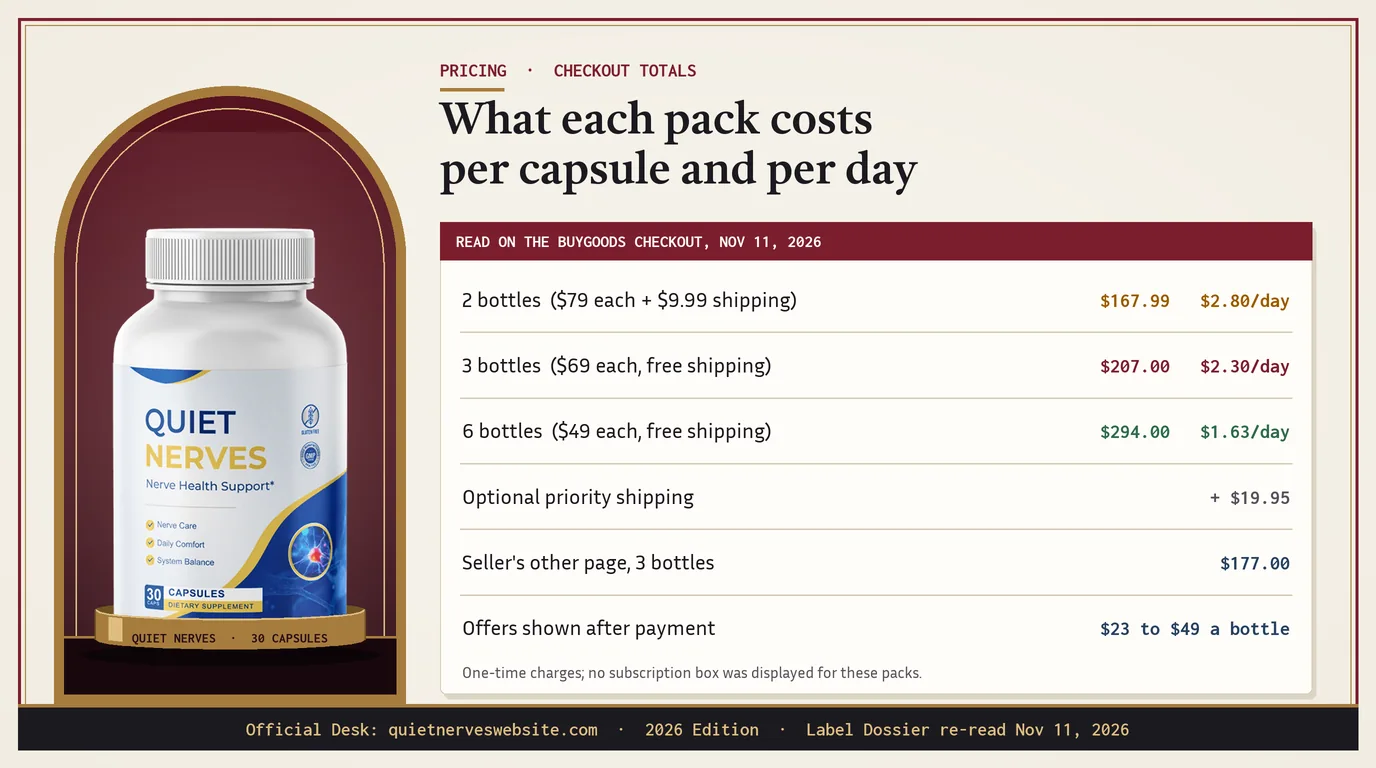
For a reader who wants to try CoQ10 at a studied dose, a single-ingredient product with the amount printed on the label is the direct route, discussed with a clinician first. For a reader weighing this formula as a whole, the sixth monograph covers butcher's broom, a vein herb in a nerve formula, and the cost per day of each pack is on the pricing page. Anyone who decides to buy can open the seller's 6-bottle order page, $49 a bottle with free U.S. shipping; we may earn a commission on that order.
Questions readers ask
How much CoQ10 is in Quiet Nerves?
The label does not print an amount. CoQ10 is the last ingredient in the 575 mg blend, so by label arithmetic it can be at most about 1.5 mg if the magnesium glycinate is fully reacted, or about 26 mg under the most generous reading.
What dose of CoQ10 was studied for nerve symptoms?
400 mg of ubiquinone a day for 12 weeks. That randomized trial enrolled 49 people with diabetic polyneuropathy and found better symptom and nerve conduction scores than placebo. It is the only trial of its kind we could verify.
Is ubiquinone or ubiquinol the better form?
The body converts each into the other, and both are sold as supplements. The Quiet Nerves label specifies ubiquinone, the same form named in the nerve trial. At the amount this capsule can hold, the choice of form matters much less than the dose.
Does CoQ10 interfere with warfarin?
The evidence is mixed. Case reports describe a reduced warfarin effect, while a randomized crossover trial of 100 mg a day found no change in INR or warfarin dose. People on warfarin should still tell their anticoagulation clinic about any new supplement.
Should CoQ10 be taken with food?
Yes. It is fat soluble and absorbed slowly, with blood levels peaking about six hours after a dose, and a meal that contains some fat improves uptake. The seller's instruction to take the capsule with a meal fits this ingredient.
References
Numbered in order of first citation on this page. Study records were checked against PubMed on November 11, 2026; seller documents are quoted as read on the same day.
- Quiet Nerves. Bottle label artwork with Supplement Facts panel, as published on the seller's order page. Read November 11, 2026. Source
- 21 CFR 101.36. Nutrition labeling of dietary supplements (proprietary blends listed in descending order of predominance by weight). Source
- Quiet Nerves. Sales page, ingredient descriptions, testimonials and FAQ. Read November 11, 2026. Source
- Bhagavan HN, Chopra RK. Coenzyme Q10: absorption, tissue uptake, metabolism and pharmacokinetics. Free Radic Res. 2006;40(5):445-53. PMID 16551570. PubMed
- Hernández-Ojeda J, Cardona-Muñoz EG, Román-Pintos LM, et al. The effect of ubiquinone in diabetic polyneuropathy: a randomized double-blind placebo-controlled study. J Diabetes Complications. 2012;26(4):352-8. PMID 22595020. PubMed
- Mortensen SA, Rosenfeldt F, Kumar A, et al. The effect of coenzyme Q10 on morbidity and mortality in chronic heart failure: results from Q-SYMBIO: a randomized double-blind trial. JACC Heart Fail. 2014;2(6):641-9. PMID 25282031. PubMed
- Hodgson JM, Watts GF, Playford DA, et al. Coenzyme Q10 improves blood pressure and glycaemic control: a controlled trial in subjects with type 2 diabetes. Eur J Clin Nutr. 2002;56(11):1137-42. PMID 12428181. PubMed
- Zhao D, Liang Y, Dai S, et al. Dose-Response Effect of Coenzyme Q10 Supplementation on Blood Pressure among Patients with Cardiometabolic Disorders: A Grading of Recommendations Assessment, Development, and Evaluation (GRADE)-Assessed Systematic Review and Meta-Analysis of Randomized Controlled Trials. Adv Nutr. 2022;13(6):2180-2194. PMID 36130103. PubMed
- Hidaka T, Fujii K, Funahashi I, et al. Safety assessment of coenzyme Q10 (CoQ10). Biofactors. 2008;32(1-4):199-208. PMID 19096117. PubMed
- National Center for Complementary and Integrative Health. Coenzyme Q10. Source
- Heck AM, DeWitt BA, Lukes AL. Potential interactions between alternative therapies and warfarin. Am J Health Syst Pharm. 2000;57(13):1221-7; quiz 1228-30. PMID 10902065. PubMed
- Engelsen J, Nielsen JD, Hansen KF. [Effect of Coenzyme Q10 and Ginkgo biloba on warfarin dosage in patients on long-term warfarin treatment. A randomized, double-blind, placebo-controlled cross-over trial]. Ugeskr Laeger. 2003;165(18):1868-71. PMID 12772396. PubMed
- Quiet Nerves. Scientific References page (eight citations). Read November 11, 2026. Source