Buyer audit
Quiet Nerves Reviews & Complaints: What Can Be Verified, and What Cannot
A review is evidence only if someone can check who wrote it. We audited every source of buyer feedback on Quiet Nerves that we could find on November 11, 2026: the seller's five testimonials, its 4.9 out of 5 graphic, the open review platforms and the search results. Then we read the seller's own paperwork for the problems it makes likely, and scored the product ourselves: 3.7 out of 10.
Four kinds of review, ranked by what each can prove
Before reading any praise or any complaint, it helps to ask who controls the page it sits on. Feedback about a supplement reaches a shopper through four channels, and they are not equally checkable.
| Source | Who controls it | Can a reader verify the buyer? | Good for | Useless for |
|---|---|---|---|---|
| Open review platform or forum | The platform and the individual writer | Sometimes, through order-verified badges or account history | Patterns in delivery, billing and refunds | Proving an ingredient works |
| Testimonial on the seller's page | The seller | No | Seeing what the seller wants you to feel | Typical results |
| Press release or sponsored article | Whoever paid for the placement | No | Confirming that a brand is advertising | Independent experience |
| Affiliate review site, this one included | A publisher paid on sales | Only if sources are shown | Label and policy reading | Disinterested enthusiasm |
We belong in the last row. The QN Monograph Desk is paid a commission when a reader orders through our links, which is exactly why this page shows where each statement comes from and why its bottom line is a 3.7 out of 10. For Quiet Nerves, the first row turned out to be empty on the day we looked, so most of what follows is an audit of rows two and three and of the seller's own documents.
The seller's five testimonials, read closely
The sales page presents five customers, each with a first name, a last initial, an age and a city. We paraphrase them here instead of reprinting them, and we tabulate the two things a reader of a nerve supplement page would want to know: does the person describe nerve symptoms, and is there anything to check.[1]
| Shown as | What the text describes | Burning, tingling or numbness mentioned? | Checkable detail? |
|---|---|---|---|
| Margaret S., 68, Phoenix, AZ | Two years of a restless, jittery feeling; calmer and steadier after about a month; still taking it at six months | No | None |
| Robert T., 72, Charlotte, NC | A skeptic whose wife noticed he was more relaxed at dinner and less fidgety in the evening | No | None |
| Linda H., 65, Portland, OR | Clean ingredients, a bottle that lasts a month, feeling more balanced through the day | No | None |
| James W., 74, Dayton, OH | Feeling tense and wound up; says his doctor approved the label; about ten weeks of use | No | None |
| Rockie M., 71, Tampa, FL | A capsule with breakfast, calm instead of wound up by evening, better sleep | No | None |
Three patterns stand out. First, the ages cluster between 65 and 74, which mirrors the audience the sales copy addresses. Second, nothing links any of the five to an order, a platform profile or a date. Third, and most important, not one of them describes the symptoms the product is sold for. The page headline promises nerve health, and the seller's FAQ speaks of discomfort associated with neuropathy; the testimonials speak of nervousness. They describe calm, steadiness and sleep, the everyday sense of the word nerves, not the anatomical one.
That mismatch has a possible explanation and a limit. Magnesium is widely marketed for relaxation and sleep, and the research there is thin: a systematic review called the anxiety evidence suggestive but of poor quality, and pooled sleep trials in older adults found a modest benefit on low-quality evidence, with individual trials using doses such as 500 mg a day, several times the 80 mg in this capsule.[2,3,4] So even the story the testimonials actually tell is not supported at the label dose. The remark that a doctor approved the label is third-hand and unverifiable, and should be weighted at zero.
Two pieces of context complete the picture. The Federal Trade Commission's Endorsement Guides treat a testimonial about a product's key benefit as an implied claim that the experience is typical, and expect the advertiser either to be able to substantiate that or to disclose clearly what buyers can generally expect.[5] And one of the seller's own post-payment pages carries small print saying that testimonials were forwarded by users of Quiet Nerves and related products and do not guarantee similar results. If that wording covers the five accounts above, some of them may not be about this capsule at all.[6]
A 4.9 out of 5 with no number underneath
Twice on the sales page, a row of five stars sits beside the words 4.9/5 Customer Rating. There is no count of ratings, no platform name, no link, no date range and no description of how buyers were verified.
An average means nothing without its denominator. A 4.9 built from ten ratings is nine fives and one four. A 4.9 built from ten thousand is a different object entirely, and one that would normally be shown off with a link. With no count, the reader cannot tell which of these is on the page, or whether the figure was collected at all. A usable rating has four parts: who collected it, how many people answered, over what period, and how a response was tied to a purchase.
For that reason we do not repeat the stars. This site shows no star graphic for the product, and the structured data on our pages carries no aggregate rating, because publishing one would mean vouching for a number we cannot trace. If the seller releases the underlying data, or moves its reviews to a platform that verifies orders, we will link to it and date the change.
What the independent platforms held on November 11, 2026
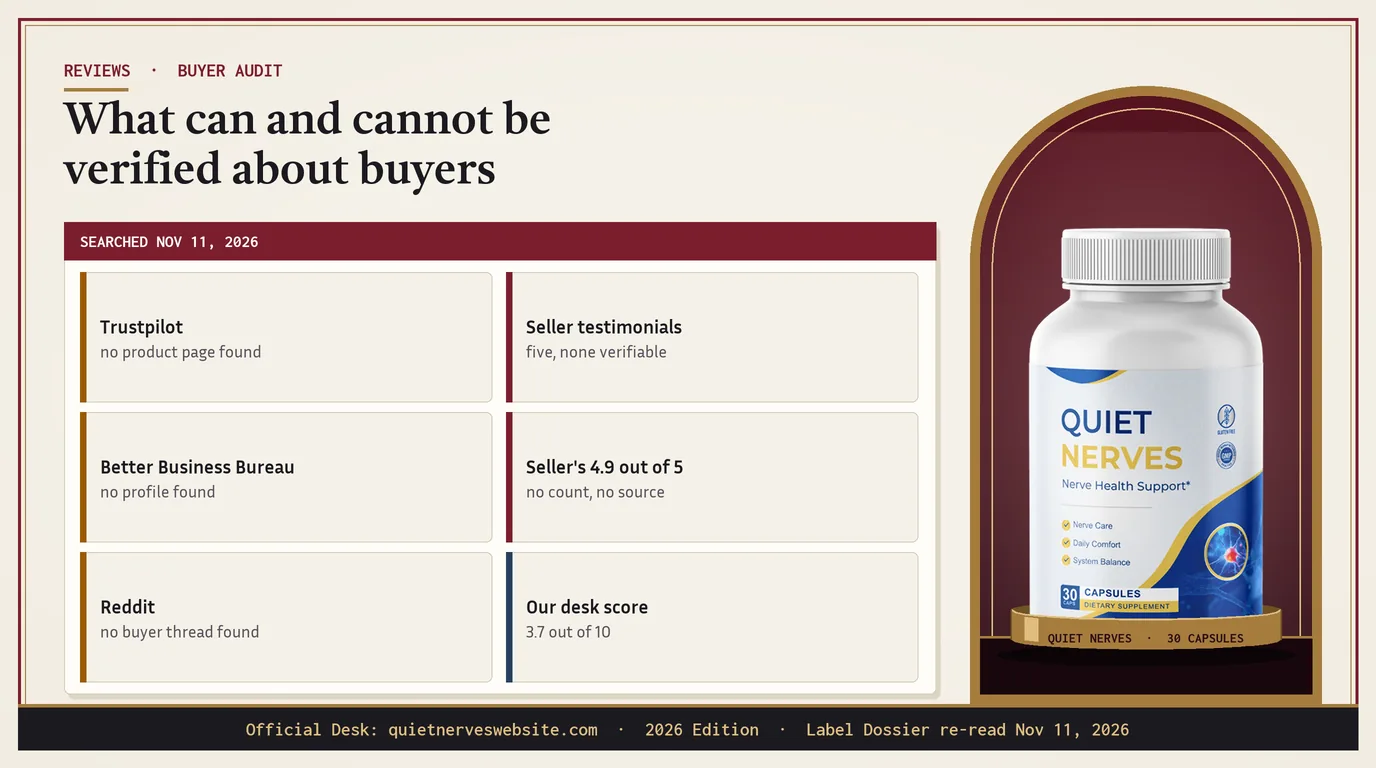
We ran web searches for the product name together with the words reviews, complaints, Trustpilot, BBB and Reddit, and a second search for the phrase official website. The result is short.
| Where | What was there | What it tells a shopper |
|---|---|---|
| Trustpilot | No page for the product or the seller | No platform-moderated reviews exist to read |
| Better Business Bureau | No business profile | No complaint history, no rating, no accreditation either way |
| No thread about the product | No unprompted buyer discussion | |
| General search on the brand name | Press releases, free-hosted pages, form pages and look-alike storefronts | Promotion in several formats, not feedback |
| Search for the official website | At least four other domains advertised as official | The bottle prints only one: quietnerves.com |
| Amazon, Walmart, eBay | Not searched in this audit; no listing verified by us | The seller's paperwork covers orders placed through its own pages |
It is tempting to read an empty table as a verdict, in either direction. It is neither. The seller's terms carry an effective date of January 2026, so the brand in its current form appears to be young, and reviews accumulate slowly for products that are sold through a private order page and never route buyers to a public platform. An absence of complaints is not evidence of satisfied customers, and an absence of praise is not evidence of a problem. The honest starting point is simply that nobody outside the seller has published data.[7]
The promotional results do carry one piece of information. Several of them call themselves official or link to domains other than the one on the bottle. We did not buy from those pages and cannot say who operates them. A reader who wants the company that printed the label should use the address on the label, and our guide to telling the seller's page from the look-alikes explains how to check.
Friction the seller's own paperwork makes likely
Nothing in this section is a reported complaint. It is a reading of documents. Where two of the seller's pages disagree, a buyer and a support agent can each point to a sentence that supports them, and that is the raw material of most disputes. We list the disagreements we found, the argument each one invites, and the move that protects a buyer.[8,9,7,10]
| Where the documents pull apart | Dispute it invites | Protective move |
|---|---|---|
| The 60 days start at purchase on the order page, shipping policy and disclaimer, but at delivery in the terms | A return that is on time by one page and late by another | Count from the order date |
| The shipping policy wants the return delivered inside 60 days; the refund page gives 7 days to ship after instructions | A parcel still in transit on day 60 | Ask by day 40, ship by day 50 |
| The refund page says the product price is refunded; the terms allow a fee of up to 20% | A smaller refund than the buyer expected | Ask support in writing which clause applies before posting the parcel |
| A missing bottle means a partial refund in one sentence and no refund in another | A reduced or refused refund | Return every bottle, the empty ones included |
| The two-bottle card says free shipping; the order box adds $9.99 | A charge higher than the advertised price | Read the order box, not the card |
| A post-payment page is titled as if the order were unfinished | Extra bottles ordered by mistake | Decline each offer; every button is a new charge |
| The label prints [email protected]; the main site's contact page prints a different mailbox | A request sent to a desk that does not answer | Write to the label address and keep the sent message |
| UPS is named as primary carrier while USPS is named for missing parcels and required for returns | Confusion over who holds the tracking | Keep both tracking numbers and screenshots |
| Orders can be cancelled only within 24 hours | A change of mind on day two | Decide before paying, not after |
The refund material is the densest part of that table, and it has its own page: refund steps decoded. Prices and the post-payment sequence are set out on the pricing page.
If an order goes wrong: an escalation ladder
Problems with a mail-order supplement are usually solved at the first or second rung. The later rungs exist for the cases that are not, and each has a clock attached.
- Write to the seller in the format its policy asks for. The refund page specifies a subject line made of the words Refund Request, then Order # and your number. Include your full name, the e-mail used at purchase, a plain description and photos. The mailbox printed on the bottle is [email protected]; the contact page also lists a phone line, +1 (719) 824-3226, and an SMS number, +1 (844) 920-2613.[11]
- Call the retailer of record. BuyGoods took the payment and its name is on your statement. Its order support line is 302-404-2568. Have the order ID from the receipt e-mail ready.[12]
- Dispute the charge with a credit card issuer. Federal billing-error rules give a cardholder 60 days from the statement that first shows the charge to send the issuer a written notice, for example for goods not delivered as agreed. Debit cards follow different rules, so ask the bank.[13]
- Report the practice. Deceptive advertising or billing can be reported at ReportFraud.ftc.gov. Shipping delays have their own federal rule: a seller that cannot ship in the time it promised must tell the buyer and offer the choice of a refund.[14,15]
- Report a health reaction separately. A suspected side effect belongs with your clinician first and then with the FDA's MedWatch program, which accepts reports about dietary supplements from consumers.[16]
Whatever the rung, the same file wins the argument: the receipt e-mail, a screenshot of the order box, tracking numbers in both directions, photographs of what was in the parcel and of what you sent back, and dated copies of every message. Our support directory lists each channel with the wording to use.
Seven questions to put to any Quiet Nerves review
New pages about this product will keep appearing, and some will be more candid than others. These seven checks take about two minutes and work on any of them, ours included.
- Does it state the label correctly? One capsule a day, 80 mg of magnesium, a 575 mg blend with no individual amounts. A review that lists precise milligrams for alpha lipoic acid or coenzyme Q10 is quoting numbers the seller has not published.
- Does it say how the page earns money? A review that links to a checkout is almost certainly paid on sales. That does not make it wrong, but it should say so before the first button.
- Does every rating come with a count and a source? Stars without a denominator are decoration.
- Does the experience match the product's claim? Calm and sleep are not nerve comfort. A testimonial should describe the thing being sold.
- Is the timeline plausible? Dramatic change in days, from a capsule whose only itemized content is 80 mg of magnesium, deserves doubt. No trial of the finished product exists.
- Does it call itself official from another domain? The label prints quietnerves.com. A page elsewhere that claims to be the official site is, at minimum, careless with words.
- Do its prices match the checkout? The totals on November 11, 2026 were $167.99, $207 and $294. A page quoting other figures is out of date or describing a different order page.
| Signal on the page | Most reasonable reading |
|---|---|
| Exact milligrams for all six ingredients | Invented or copied from another product; the label gives one amount |
| Phrases such as cures neuropathy or reverses nerve damage | A disease claim that a supplement may not make |
| No disclosure, several order buttons | An advertisement presented as a review |
| A coupon code or an expiring-offer timer | Sales pressure, not information |
| Label photo, dated prices, named sources | A page that can at least be checked |
The second row matters for more than style. Structure and function statements such as supports nerve health are allowed on supplements when they carry the FDA disclaimer; statements about treating, curing or relieving a disease are not.[17,18]
Our own score: 3.7 out of 10, with the working shown
We do not have customer data, so we do not publish a customer rating. What we publish is an editorial score: six questions that can be answered from documents, each marked from 0 to 10, averaged without weights. The six marks add up to 22, and 22 divided by 6 is 3.67, shown as 3.7.
| Axis | Score | Why |
|---|---|---|
| Label transparency | 3 | One itemized amount, magnesium 80 mg; five actives hidden in a 575 mg blend; no manufacturer named; the lot field on the published artwork is a placeholder |
| Dose adequacy against human trials | 2 | The blend leaves about 8 mg, or about 131 mg if buffered, for five actives; trials used 600 mg of alpha lipoic acid, 1,500 to 3,000 mg of acetyl-L-carnitine and 400 mg of coenzyme Q10 |
| Safety at the label dose | 8 | One capsule; magnesium far below the 350 mg upper limit for supplements; ordinary cautions; no finished-product study, which is why this is not a 10 |
| Refund terms | 4 | A 60-day policy and a U.S. address exist, but in five wordings, with buyer-paid return postage and a possible 20% fee |
| Price for value | 3 | $1.63 to $2.80 a day for 80 mg of magnesium plus quantities nobody can verify |
| Marketing accuracy | 2 | A neuropathy claim beside the FDA disclaimer, clinically effective doses with no doses published, an unsourced 4.9/5, and a reference list in which three PMIDs open the wrong paper and two studies concern testosterone |
The two lowest marks are linked. A formula can only be judged against research if its amounts are known, and here the label's own arithmetic shows that the five blended ingredients cannot approach the doses in the trials usually cited for them.[19,20,21,22] The marketing mark reflects the seller's reference page as well: of eight citations, none studies alpha lipoic acid, L-carnitine, butcher's broom, curcumin, coenzyme Q10 or the product itself.[23]
What would move the score is not mysterious. Publishing the milligrams of each ingredient and a certificate of analysis would lift the first two axes. One refund text instead of five would lift the fourth. Sourcing the star rating and correcting the reference list would lift the last. None of that requires changing the capsule.
What would change this audit
This page is dated, and it will be re-read. Three developments would lead us to rewrite sections of it: a public review page for the product on a platform that verifies purchases; a pattern of dated, documented buyer reports about delivery, billing or refunds; or a change in the seller's own documents, such as a single refund policy or a published rating source. When any of those happens we will say what changed and when.
We do not collect or publish reader testimonials, favorable or not, because we have no way of verifying an order and an unverified story would repeat the weakness this page criticizes. What we do accept is paperwork. If you have a receipt, a refund e-mail or a tracking record that contradicts something written here, send it to [email protected] and we will check it against the seller's documents. Our methods are set out in the editorial charter.
For readers who have weighed all of this and still want to try the capsule, the seller's order page opens through our order desk. We may earn a commission; the price is set by the seller and is the same either way.
Questions readers ask
Are there verified customer reviews of Quiet Nerves?
Not on any independent platform we could find. As of November 11, 2026 the product had no Trustpilot page, no Better Business Bureau profile and no Reddit discussion. The only customer voices are five testimonials selected by the seller, which cannot be tied to orders. Search results under the brand name are promotional pages and press releases.
Is the 4.9 out of 5 rating on the sales page real?
It cannot be verified. The graphic shows five stars and the figure 4.9/5 with no number of ratings, no platform, no link and no dates. An average without a count carries no information, so we treat it as an advertising element and do not reproduce it in our own markup.
Are there complaints about Quiet Nerves?
We found no complaint record: no Better Business Bureau file, no Trustpilot reviews and no forum threads on the date of our audit. That is an absence of data, not a clean bill of health. The seller's documents do contain conflicts, such as five refund wordings and a $9.99 fee on a card that says free shipping, that could plausibly lead to disputes.
Is Quiet Nerves a scam?
The evidence does not support calling it a scam. There is a physical product with a published label, an established retailer of record in BuyGoods, a U.S. return address and written refund terms. The fair criticism is different: most amounts are undisclosed, the marketing overstates what the formula can do, and extra offers appear after payment. Our editorial score is 3.7 out of 10.
Do the testimonials show it works for neuropathy?
No. None of the five testimonials mentions burning, tingling, numbness or nerve pain; they describe feeling calmer and sleeping better. No clinical trial of the finished capsule has been published, and a dietary supplement is not permitted to claim that it treats or relieves a disease such as neuropathy.[17]
Where can I report a bad experience with an order?
Start with the seller at [email protected], then BuyGoods at 302-404-2568, then your credit card issuer within 60 days of the statement showing the charge. Deceptive practices can be reported at ReportFraud.ftc.gov, and a suspected side effect goes to your clinician and to FDA MedWatch. Keep the receipt, screenshots and tracking numbers.
Does this site post customer reviews?
No. We cannot verify who bought the product, so we publish no reader testimonials and no star ratings. This page audits other sources and adds a document-based editorial score. We are an independent desk paid by commission on orders, not the seller, and the seller's own site is quietnerves.com.
References
Numbered in order of first citation on this page. Study records were checked against PubMed on November 11, 2026; seller documents are quoted as read on the same day.
- Quiet Nerves. Sales page, ingredient descriptions, testimonials and FAQ. Read November 11, 2026. Source
- Boyle NB, Lawton C, Dye L. The Effects of Magnesium Supplementation on Subjective Anxiety and Stress-A Systematic Review. Nutrients. 2017;9(5). PMID 28445426. PubMed
- Mah J, Pitre T. Oral magnesium supplementation for insomnia in older adults: a Systematic Review & Meta-Analysis. BMC Complement Med Ther. 2021;21(1):125. PMID 33865376. PubMed
- Abbasi B, Kimiagar M, Sadeghniiat K, et al. The effect of magnesium supplementation on primary insomnia in elderly: A double-blind placebo-controlled clinical trial. J Res Med Sci. 2012;17(12):1161-9. PMID 23853635. PubMed
- 16 CFR Part 255. Guides Concerning Use of Endorsements and Testimonials in Advertising. Source
- Quiet Nerves. Post-payment offer pages shown after checkout ('Your Order Is Not Complete Yet'). Read November 11, 2026. Source
- Quiet Nerves. Terms and Conditions, effective January 2026. Read November 11, 2026. Source
- Quiet Nerves. Refund Policy. Read November 11, 2026. Source
- Quiet Nerves. Shipping Policy, including the Returns clause. Read November 11, 2026. Source
- Quiet Nerves. Disclaimer, effective January 2026. Read November 11, 2026. Source
- Quiet Nerves. Contact Us page. Read November 11, 2026. Source
- BuyGoods. Secure checkout for Quiet Nerves (order totals, shipping line, retailer statement). Read November 11, 2026. Source
- 12 CFR 1026.13. Billing error resolution (Regulation Z, credit card disputes). Source
- Federal Trade Commission. ReportFraud.ftc.gov. Source
- 16 CFR Part 435. Mail, Internet, or Telephone Order Merchandise (FTC shipment and refund-on-delay rule). Source
- U.S. Food and Drug Administration. MedWatch: The FDA Safety Information and Adverse Event Reporting Program. Source
- 21 CFR 101.93. Certain types of statements for dietary supplements (structure/function claims and the disclaimer). Source
- U.S. Food and Drug Administration. Structure/Function Claims. Source
- Ziegler D, Ametov A, Barinov A, et al. Oral treatment with alpha-lipoic acid improves symptomatic diabetic polyneuropathy: the SYDNEY 2 trial. Diabetes Care. 2006;29(11):2365-70. PMID 17065669. PubMed
- Sima AA, Calvani M, Mehra M, et al. Acetyl-L-carnitine improves pain, nerve regeneration, and vibratory perception in patients with chronic diabetic neuropathy: an analysis of two randomized placebo-controlled trials. Diabetes Care. 2005;28(1):89-94. PMID 15616239. PubMed
- Hernández-Ojeda J, Cardona-Muñoz EG, Román-Pintos LM, et al. The effect of ubiquinone in diabetic polyneuropathy: a randomized double-blind placebo-controlled study. J Diabetes Complications. 2012;26(4):352-8. PMID 22595020. PubMed
- NIH Office of Dietary Supplements. Magnesium: Fact Sheet for Health Professionals. Updated January 6, 2026. Source
- Quiet Nerves. Scientific References page (eight citations). Read November 11, 2026. Source