Monograph 04
Turmeric 95% Curcuminoids: Absorption Limits, Liver Reports and Nerve Data
Turmeric extract standardized to 95% curcuminoids is the fifth ingredient in the Quiet Nerves blend. The percentage describes the purity of the extract, not how much of it is in the capsule or how much reaches the blood. This monograph covers both gaps, the one human nerve trial that used a different formulation, and the liver injury reports that every turmeric user should know about.
What the 95% on the label describes
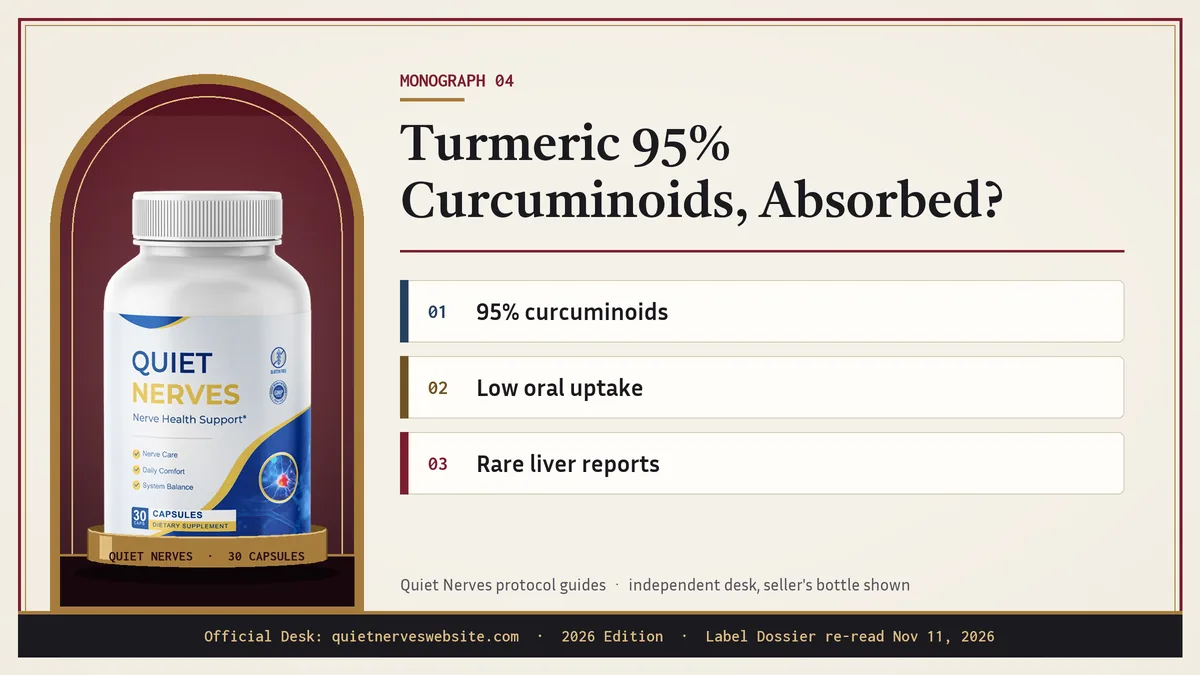
The Quiet Nerves panel lists "Turmeric (Curcuma longa) Rhizome Extract 95% Curcuminoids" as the fifth item in its 575 mg proprietary blend.[1] Turmeric root as a spice contains only a few percent of curcuminoids, the yellow pigments (curcumin and its two close relatives) that are the subject of most research. An extract "standardized to 95%" has been concentrated until those pigments make up 95% of its weight.
So the figure is a statement about purity. It says that whatever quantity of extract went into the capsule is nearly all curcuminoids. It does not say what that quantity is. A milligram of 95% extract and a gram of 95% extract carry the same percentage on a label.
The seller leans on the number. Its ingredient card says that "not all turmeric is created equal", that the 95% concentration supports "a healthy inflammatory response in the peripheral nervous system", and that this is "the difference between a spice and a therapeutic-grade ingredient".[2] Concentration is one half of a dose. The other half, the amount, is not printed, and the label's own arithmetic limits it sharply, as shown below.
Why swallowed curcumin barely reaches the blood
Curcumin has a well-documented absorption problem. A review titled "Bioavailability of curcumin: problems and promises" attributed it to poor absorption, rapid metabolism and rapid elimination, which together keep blood levels very low after an oral dose.[3]
Two human studies make the point with numbers. In one, volunteers who swallowed 2 grams of curcumin alone had barely detectable levels in serum; adding 20 mg of piperine, a black pepper compound that slows curcumin's breakdown, raised bioavailability about twenty-fold.[4] In a dose-escalation study, single doses of a curcuminoid formulation as high as 12 grams were tolerated, yet curcumin could be detected in serum only in volunteers who took 10 or 12 grams.[5]
The nerve evidence: one human trial, in a different formulation
The human evidence for curcumin and nerve symptoms is short.
| Source | Type | Formulation and dose | Finding | Relevance to this label |
|---|---|---|---|---|
| Asadi 2019 | Randomized trial, 80 adults with type 2 diabetes and neuropathy | Nano-curcumin, 80 mg a day for 8 weeks | Neuropathy scores fell versus placebo | Different, enhanced-absorption form |
| Silveira 2023 | Systematic review of animal models | Turmeric preparations, various | Laboratory evidence only | No human outcomes |
| Daily 2016 | Meta-analysis of arthritis trials | About 1,000 mg curcumin a day | Joint symptoms improved | Different condition, far higher dose |
| Quiet Nerves label | Product panel | Standard 95% extract, amount not printed | Not tested | Ceiling of about 1.9 mg to about 33 mg |
The single randomized trial in diabetic neuropathy gave 80 patients either 80 mg of nano-curcumin a day or placebo for eight weeks, and neuropathy scores improved in the treated group.[6] "Nano" is the important word. Nano-formulations are engineered to get around the absorption barrier described above, so 80 mg of nano-curcumin cannot be equated with 80 mg of a conventional 95% extract, and one eight-week trial needs replication before anyone builds on it.
Beyond that study the trail runs through animals. A 2023 systematic review gathered the animal experiments on turmeric in peripheral neuropathy.[7] It is a useful map of the laboratory work, and it also shows where the field stands: most of the evidence comes from rodents, where doses and conditions rarely translate directly to people. The better-developed human literature concerns joints. A meta-analysis found that roughly 1,000 mg of curcumin a day improved arthritis symptoms over two to three months.[8] That is context for what an active dose looks like, and it is about a different complaint.
Fourth among five: the amount the panel allows
The label fixes magnesium at 80 mg "from proprietary blend". Because magnesium is 14.1% of fully reacted magnesium glycinate, about 567 mg of the 575 mg blend must be glycinate, and about 7.5 mg remains for the five other ingredients. They are listed in descending order by weight, and turmeric extract is fourth of the five.[9]
These figures are derived from the printed panel under stated assumptions. They are not a laboratory measurement, and the real amount could be lower than either ceiling. Add the absorption data and the picture is plain: a few milligrams of conventional curcuminoids, taken without an absorption aid, is unlikely to produce a measurable level in blood. The same derivation for every ingredient is in the 575 mg blend, solved, and the ingredients page sets the six actives side by side.
Liver injury reports and who should be careful
Turmeric has a long record of safe use as a food. Concentrated supplements are a newer exposure, and they have produced a signal that hepatologists now watch.
The U.S. Drug-Induced Liver Injury Network published ten cases of liver injury attributed to turmeric supplements. Seven of the ten patients carried the same genetic marker, HLA-B*35:01, which suggests an uncommon, inherited susceptibility more than a simple dose effect.[10] The NIH LiverTox database maintains a turmeric entry that tracks these reports, and the National Center for Complementary and Integrative Health cautions that products engineered for higher bioavailability may increase harmful effects along with desirable ones.[11,12]
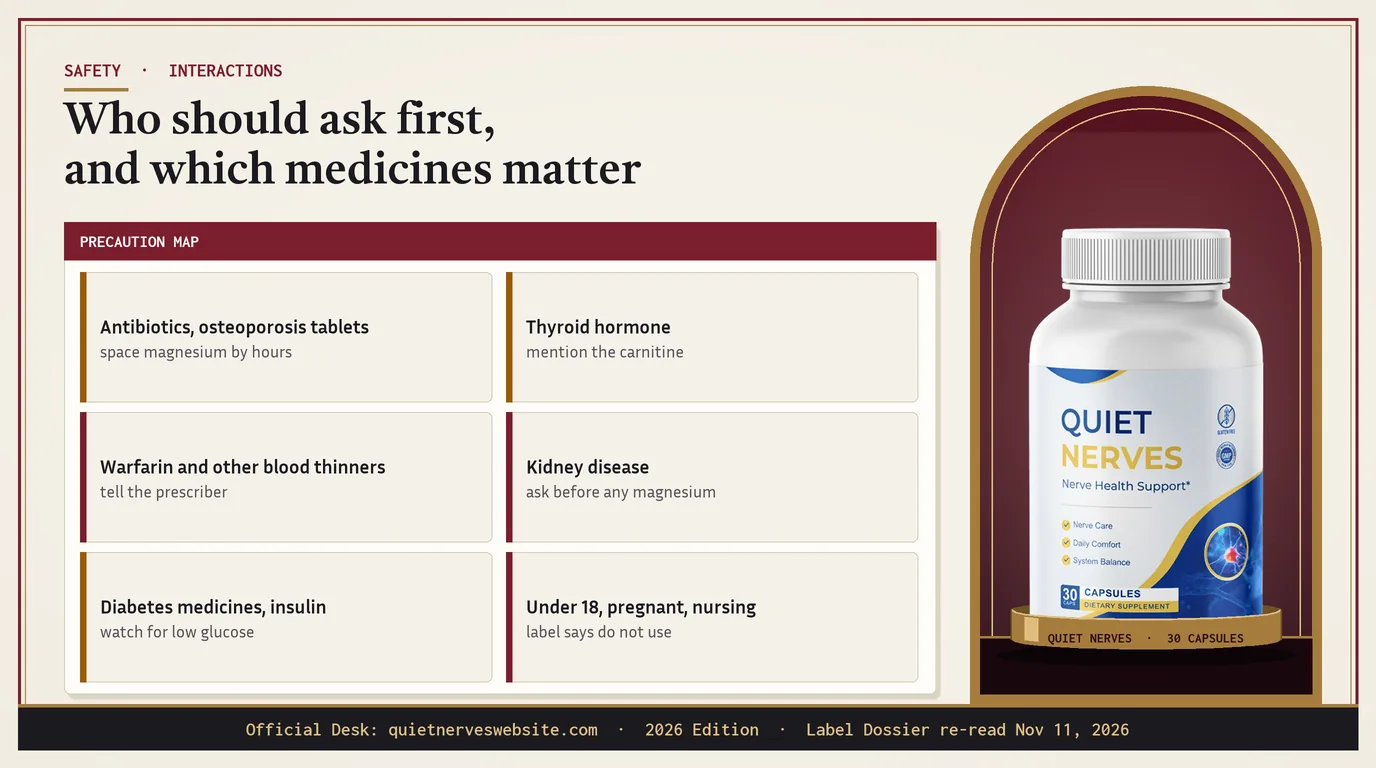
Two further points round out the safety file. The European Medicines Agency's herbal monograph for turmeric rhizome covers traditional use for mild digestive complaints such as a feeling of fullness and slow digestion; it does not cover nerve symptoms.[13] And for people on anticoagulant or antiplatelet medicine, a rat study found that curcumin changed blood levels of warfarin and clopidogrel, without changing their effect on clotting in that experiment.[14] Human data are sparse, so the standard advice is to tell the prescriber. The drug-by-drug list is on our side effects and interactions page.
Where the turmeric line leaves the capsule
Turmeric extract earns its place on many labels because the name is familiar and the research base, mostly in joints, is real. In this capsule it faces three constraints at once: an amount capped at about 2 mg to about 33 mg, an absorption problem the formula does nothing to solve, and a nerve evidence base that consists of one trial with a different formulation.
The seller's list of eight scientific references contains no turmeric or curcumin study, so the "therapeutic-grade" wording is not anchored to a source a reader can open.[15] The next monograph in the ingredient series, on CoQ10 as ubiquinone, finds the same pattern at the end of the blend. If the capsule still appeals after all of that, the lowest price per bottle is the 6-bottle pack at $49: open the seller's order page. We may earn a commission on orders placed through that link.
Questions readers ask
What does 95% curcuminoids mean on the Quiet Nerves label?
It means the turmeric extract is 95% curcuminoids by weight. It describes the purity of the extract and says nothing about how many milligrams are in the capsule; that amount is not printed.
How much turmeric extract is in a capsule?
Unknown, but bounded. Label arithmetic puts the ceiling at about 1.9 mg if the magnesium glycinate is fully reacted and at about 33 mg under the most generous reading, since turmeric is fourth of the five ingredients sharing the remainder of the 575 mg blend.
Is curcumin well absorbed?
No. In human studies 2 grams of plain curcumin produced barely detectable serum levels, and single doses had to reach 10 to 12 grams before curcumin was measurable. Piperine or special formulations raise absorption, and neither is on this label.
Has curcumin been tested for neuropathy in people?
Once, in a form this product does not use. An eight-week randomized trial in 80 adults with type 2 diabetes found lower neuropathy scores with 80 mg a day of nano-curcumin. Standard 95% extract has not been tested this way.
Can turmeric supplements harm the liver?
Rarely, yes. The U.S. Drug-Induced Liver Injury Network reported ten cases linked to turmeric supplements, seven of them in people with the HLA-B*35:01 gene variant. Stop any turmeric product and seek testing if jaundice, dark urine or unusual fatigue appears.
References
Numbered in order of first citation on this page. Study records were checked against PubMed on November 11, 2026; seller documents are quoted as read on the same day.
- Quiet Nerves. Bottle label artwork with Supplement Facts panel, as published on the seller's order page. Read November 11, 2026. Source
- Quiet Nerves. Sales page, ingredient descriptions, testimonials and FAQ. Read November 11, 2026. Source
- Anand P, Kunnumakkara AB, Newman RA, et al. Bioavailability of curcumin: problems and promises. Mol Pharm. 2007;4(6):807-18. PMID 17999464. PubMed
- Shoba G, Joy D, Joseph T, et al. Influence of piperine on the pharmacokinetics of curcumin in animals and human volunteers. Planta Med. 1998;64(4):353-6. PMID 9619120. PubMed
- Lao CD, Ruffin MT 4th, Normolle D, et al. Dose escalation of a curcuminoid formulation. BMC Complement Altern Med. 2006;6:10. PMID 16545122. PubMed
- Asadi S, Gholami MS, Siassi F, et al. Nano curcumin supplementation reduced the severity of diabetic sensorimotor polyneuropathy in patients with type 2 diabetes mellitus: A randomized double-blind placebo- controlled clinical trial. Complement Ther Med. 2019;43:253-260. PMID 30935539. PubMed
- Silveira RS, Baldoni AO, Couto RO, et al. In vivo efficacy of turmeric (Curcuma longa L.) in the treatment of peripheral neuropathy: A systematic review of animal models. An Acad Bras Cienc. 2023;95(3):e20200447. PMID 37937613. PubMed
- Daily JW, Yang M, Park S. Efficacy of Turmeric Extracts and Curcumin for Alleviating the Symptoms of Joint Arthritis: A Systematic Review and Meta-Analysis of Randomized Clinical Trials. J Med Food. 2016;19(8):717-29. PMID 27533649. PubMed
- 21 CFR 101.36. Nutrition labeling of dietary supplements (proprietary blends listed in descending order of predominance by weight). Source
- Halegoua-DeMarzio D, Navarro V, Ahmad J, et al. Liver Injury Associated with Turmeric-A Growing Problem: Ten Cases from the Drug-Induced Liver Injury Network [DILIN]. Am J Med. 2023;136(2):200-206. PMID 36252717. PubMed
- LiverTox: Clinical and Research Information on Drug-Induced Liver Injury. Turmeric. National Institute of Diabetes and Digestive and Kidney Diseases. PMID 31643876. Source
- National Center for Complementary and Integrative Health. Turmeric: Usefulness and Safety. Source
- European Medicines Agency, Committee on Herbal Medicinal Products. Curcumae longae rhizoma (turmeric): herbal monograph. Source
- Liu AC, Zhao LX, Lou HX. Curcumin alters the pharmacokinetics of warfarin and clopidogrel in Wistar rats but has no effect on anticoagulation or antiplatelet aggregation. Planta Med. 2013;79(11):971-7. PMID 23807811. PubMed
- Quiet Nerves. Scientific References page (eight citations). Read November 11, 2026. Source