Protocol Guide 07
The 575 mg Proprietary Blend, Solved Line by Line
The Quiet Nerves panel prints exactly one amount, 80 mg of magnesium, and one total, a 575 mg proprietary blend. Those two figures, plus a federal rule about the order in which blend ingredients are listed, are enough to put a ceiling on everything the label leaves out. Below is the arithmetic, each assumption behind it, and what would prove it wrong.
What the rule lets a blend keep private, and what it cannot
Federal labeling rules allow a supplement maker to group ingredients under a blend name and print one combined weight instead of six separate ones. The rule is 21 CFR 101.36, and it attaches two conditions that matter here [1]. First, the total weight of the blend has to appear on the panel. Second, the ingredients inside it have to be listed in descending order of predominance by weight, heaviest first. The FDA's own labeling guide repeats both points for manufacturers [2].
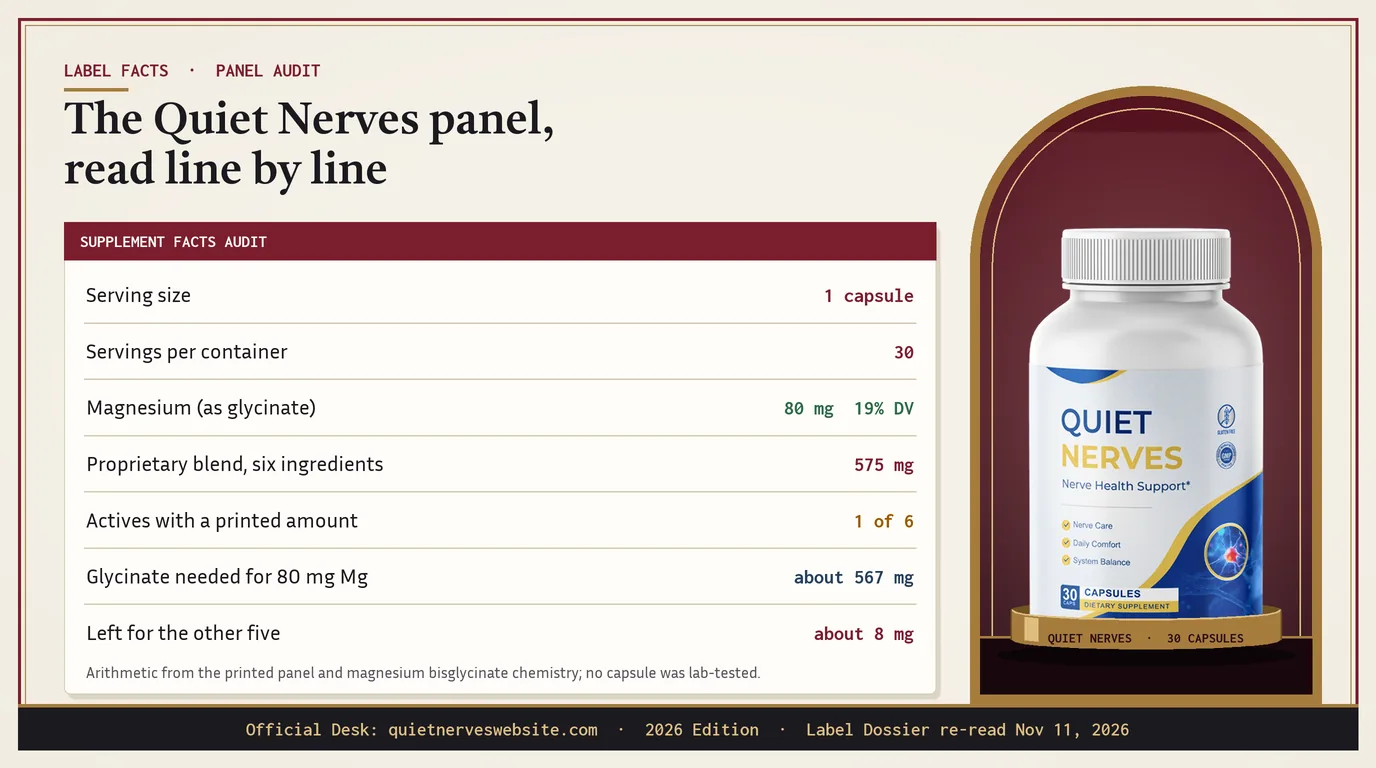
Quiet Nerves uses that allowance. Its panel shows a Proprietary Blend of 575 mg per capsule and then names six ingredients in this order: magnesium glycinate, alpha lipoic acid, butcher's broom root extract, L-carnitine, turmeric rhizome extract standardized to 95% curcuminoids, and coenzyme Q10 as ubiquinone [3]. No individual amount is printed for any of them. A reader is left with a total and a ranking.
A total and a ranking are more informative than they look. Add one further number and six unknowns collapse into narrow ranges. This label supplies that number, probably without intending to. The full panel, line by line, is on our label audit.
The magnesium line is the key to the lock
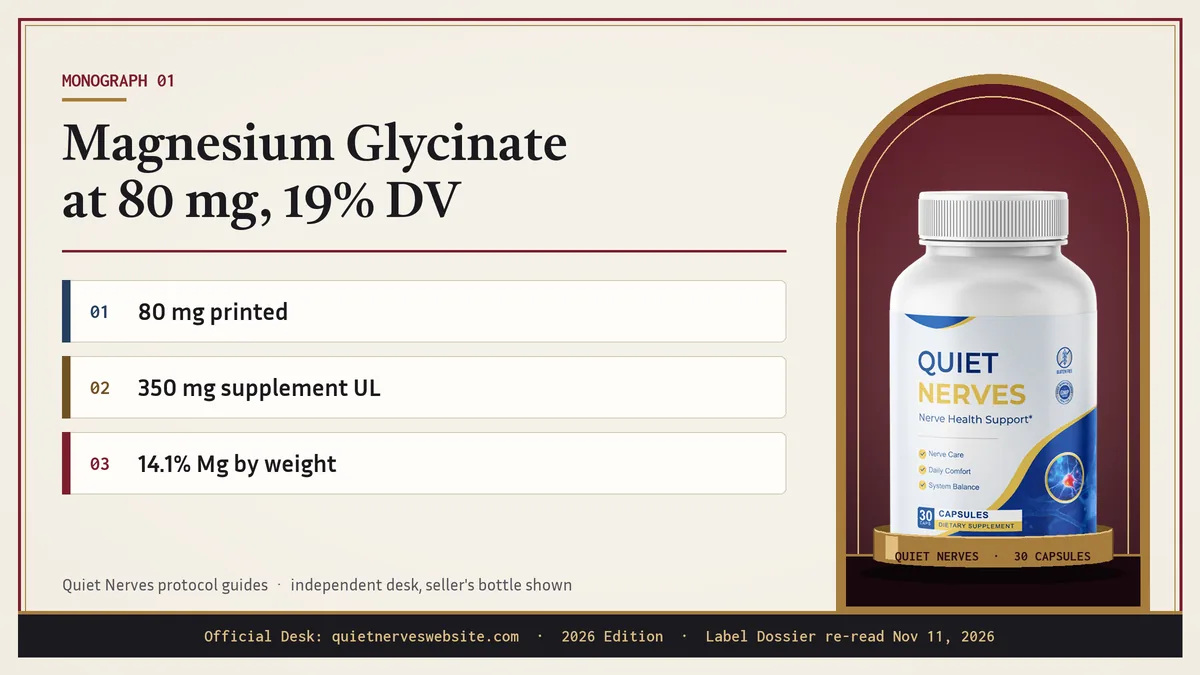
Nutrients that have an official Daily Value cannot disappear into a blend. They are declared with their own amount even when their source ingredient sits inside one. So the Quiet Nerves panel carries a separate line above the blend: magnesium, 80 mg, 19% of the Daily Value, with the note that it comes as magnesium glycinate from the proprietary blend [3]. The percentage checks out, since the adult Daily Value for magnesium is 420 mg and 80 divided by 420 is 19% [4].
That note ties the two lines together. Whatever weight of magnesium glycinate is in the blend, it has to deliver 80 mg of elemental magnesium. Magnesium glycinate is not pure magnesium. In its fully reacted form, called magnesium bisglycinate, one magnesium atom is bound to two molecules of the amino acid glycine. The atom weighs 24.305 units and the whole compound 172.42, so magnesium makes up 14.1% of the material and glycine the other 85.9%.
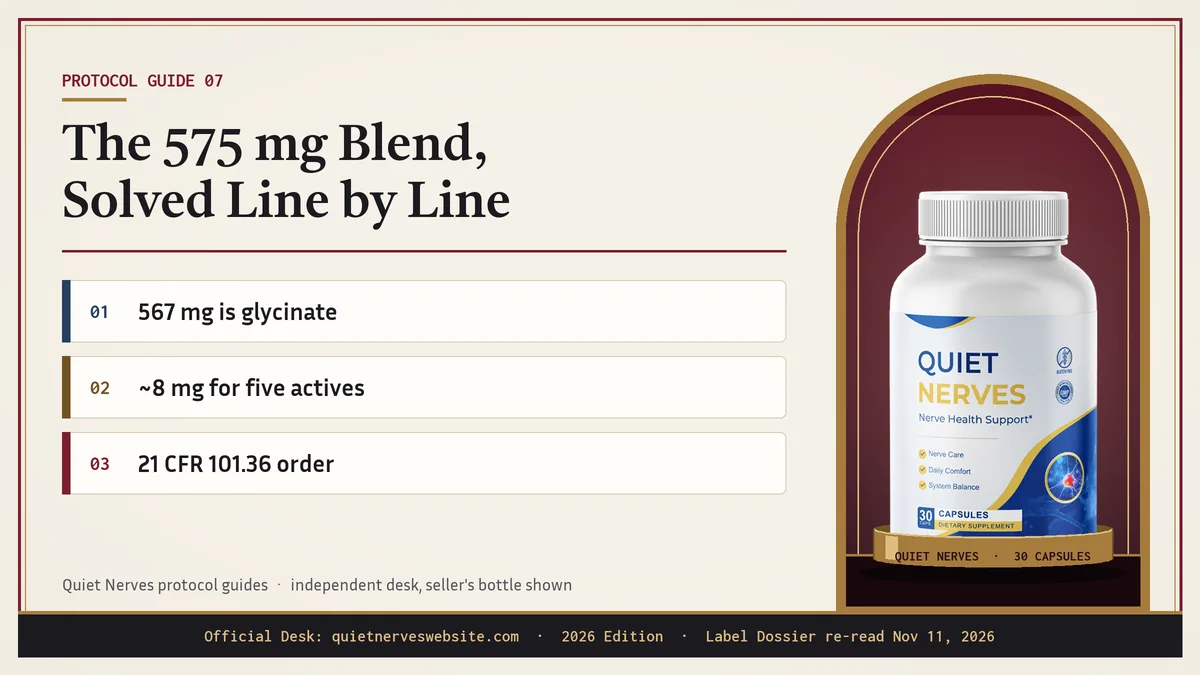
Read the last line twice. If the raw material is what the panel calls it, close to 99% of the blend is the magnesium compound, and alpha lipoic acid, butcher's broom, L-carnitine, turmeric extract and CoQ10 divide a combined 7.5 mg. What 80 mg of magnesium can reasonably be expected to do is the subject of our magnesium glycinate monograph.
Two possible raw materials, two remainders
Ingredient suppliers sell more than one grade under the glycinate name. The fully reacted chelate is the grade the arithmetic above assumes. Another grade, usually described as buffered, blends the chelate with magnesium oxide. Oxide is 60.3% magnesium by weight, so a buffered material carries more magnesium per milligram, about 18% in a typical case, and less of it is needed to reach 80 mg.
We cannot tell from a label which grade is inside the capsule, so we carry both through the rest of the math. The panel names glycinate as the only magnesium source and mentions no oxide, which makes the fully reacted reading the one closest to the printed words. The buffered reading is the generous one.
| Assumed raw material | Magnesium content | Weight needed for 80 mg | Left for the other five |
|---|---|---|---|
| Fully reacted bisglycinate | 14.1% | about 567 mg | about 8 mg |
| Buffered glycinate | 18% | about 444 mg | about 131 mg |
| Heavily buffered, for illustration only | 20% | 400 mg | 175 mg |
One boundary is worth stating. A material with less than 13.9% magnesium could not deliver 80 mg inside a 575 mg blend at all, because the glycinate alone would outweigh the printed total. The label is self-consistent only at 13.9% or above, and the fully reacted chelate sits just over that line.
How a ranking becomes a set of ceilings
Call the remainder R. Five ingredients share it, and the rule says each one weighs at least as much as the one listed after it. That ordering produces a ceiling for every position. The first of the five can at most take all of R. The second can never exceed half of R, because the ingredient above it must weigh at least as much, and two equal halves already use everything. By the same logic the third tops out at a third of R, the fourth at a quarter and the fifth at a fifth.
| Ingredient, in label order | Ceiling if R is 7.5 mg | Ceiling if R is 131 mg | Daily dose in the trial we cite | Generous ceiling as a share of that dose |
|---|---|---|---|---|
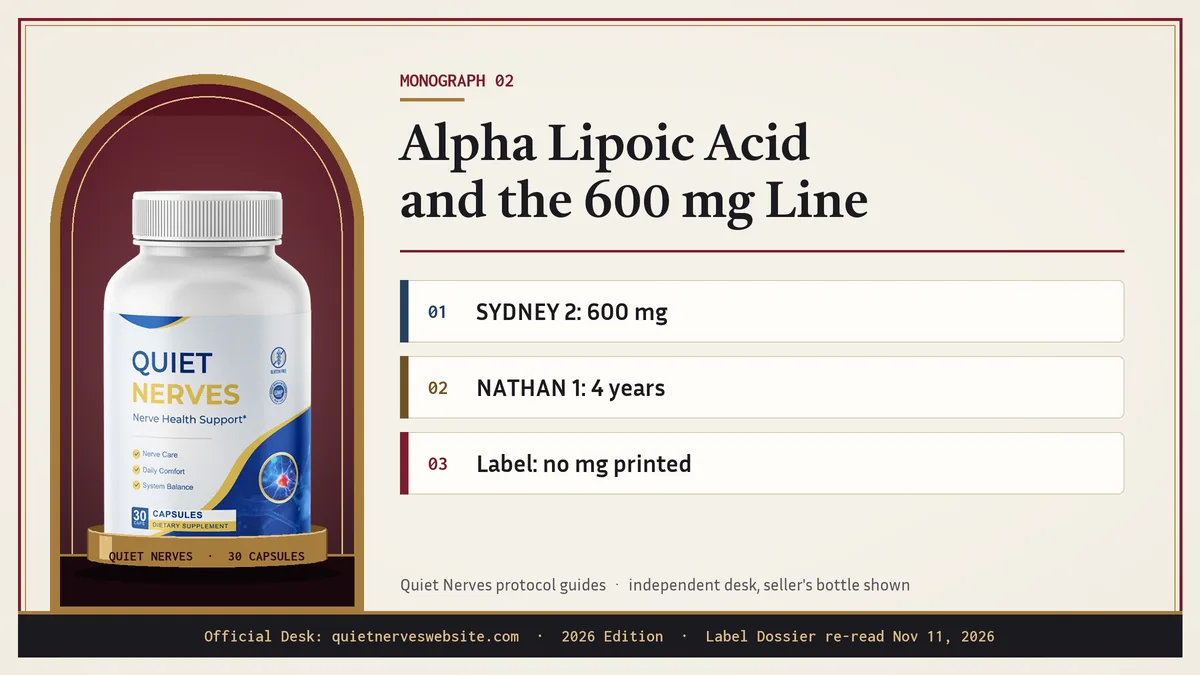
| Alpha lipoic acid | 7.5 mg | 131 mg | 600 mg, SYDNEY 2 [5] | 22% |
| Butcher's broom root extract | 3.8 mg | 65 mg | 72 to 75 mg, a vein trial [6] | 87 to 90% |
| L-carnitine | 2.5 mg | 44 mg | 1,500 to 3,000 mg of acetyl-L-carnitine [7] | 3% or less |
| Turmeric extract, 95% curcuminoids | 1.9 mg | 33 mg | 80 mg of nano-curcumin [8] | not comparable, different form |
| Coenzyme Q10 | 1.5 mg | 26 mg | 400 mg for 12 weeks [9] | 6.5% |
Three cautions keep this table honest. The ceilings are maximums, not estimates, and they cannot all be true together: if alpha lipoic acid really took all 131 mg, the four ingredients below it would hold nothing. The butcher's broom figure approaches a trial dose only in the generous reading, only if that single ingredient takes half the remainder, and the trial in question measured leg swelling in chronic venous insufficiency, not nerve symptoms. And the curcumin trial used an enhanced-absorption nano formulation, so its 80 mg cannot be lined up against ordinary 95% extract milligram for milligram.
The equal split: the single likeliest guess
Ceilings describe the best case for each ingredient taken alone. A more useful single estimate is the equal split, in which the five ingredients share the remainder evenly. It is the flattest arrangement the ordering rule allows. Any other legal arrangement moves weight toward the top of the list and away from the bottom.
Split evenly, 7.5 mg gives 1.5 mg of each ingredient per capsule. Split evenly, 131 mg gives about 26 mg of each. Notice that 26 mg is also the ceiling for CoQ10, the last name on the list: the final ingredient in a blend can never hold more than an equal share. For alpha lipoic acid, the ingredient with the most human nerve data, an equal split means somewhere between 0.25% and about 4% of the daily amount studied, a comparison we develop in the alpha lipoic acid monograph.
Real formulas are rarely flat. The seller's page gives some of its longest descriptions to L-carnitine and turmeric, yet they stand fourth and fifth in the weight ranking, which limits them to a third and a quarter of the remainder. Length of description is not weight in the capsule. The panel order is.
What would prove this arithmetic wrong
We did not open a capsule or send one to a laboratory. Everything above follows from three printed facts (80 mg of magnesium, a 575 mg blend, the order of six names) and one piece of textbook chemistry. That makes the conclusion easy to overturn if any input differs from what the label says.
- A per-ingredient panel. If the seller published milligrams for each of the six ingredients, the estimates on this page would be replaced by facts the same day.
- A certificate of analysis. A lot-specific certificate from the manufacturer or an outside laboratory, showing the assayed amount of each active, would settle both the grade of glycinate and the split of the remainder.
- A different magnesium source. If part of the 80 mg comes from an ingredient the panel does not name, more room opens up in the blend, and the label acquires a second problem.
- A printing error. If the magnesium line or the blend total is misprinted, the arithmetic inherits the mistake.
Manufacturers are not required to hand certificates to consumers. They are required, under the dietary supplement manufacturing rule, to set specifications for the identity, purity, strength and composition of each finished batch and to keep the records [11]. A seller confident in its doses can therefore answer a direct question. The bottle artwork we read carries a placeholder in the lot field, so quote the lot code stamped on your own bottle when you write.
Asking the seller for the missing numbers
The label gives one mailbox, [email protected], and that is the address to use [3]. Keep the message short, ask closed questions and request documents by name. If you receive an answer, we would like to read it: forward it to the desk address in the footer and we will update this page and date the change.
Message requesting per-ingredient amounts and a certificate of analysis
Subject: Quiet Nerves, per-capsule amounts and CoA for lot [your lot code]

Hello,

I have a bottle of Quiet Nerves, lot [your lot code]. The Supplement Facts panel lists a 575 mg proprietary blend without individual amounts. Before I continue I would like to know:

1. How many milligrams of alpha lipoic acid, butcher's broom root extract, L-carnitine, turmeric extract and coenzyme Q10 are in one capsule?
2. Is the magnesium glycinate a fully reacted bisglycinate, or a buffered grade that contains magnesium oxide?
3. Can you send the certificate of analysis for my lot, and the name of the facility that manufactured it?

Thank you,
[name, order number]
A reply with numbers would let you compare the capsule with the trials summarized on our ingredient pages. No reply, or a reply without numbers, is also information. Either way the purchase decision can rest on something firmer than adjectives, and the price math shows what each capsule costs while you wait.
Questions readers ask
How much alpha lipoic acid is in a Quiet Nerves capsule?
The label does not say. The arithmetic caps it at about 8 mg if the magnesium glycinate is a fully reacted chelate and at about 131 mg under the most generous buffered reading. The oral trials for nerve symptoms used 600 mg a day [5].
Is it legal to keep amounts inside a proprietary blend?
Yes. 21 CFR 101.36 lets a manufacturer print one total weight for a blend, provided the ingredients are named in descending order by weight [1]. Legal is not the same as informative: the format stops a buyer from comparing a capsule with a study dose, which is why we do the math.
Why does magnesium have its own line when the other five do not?
Because magnesium has an official Daily Value. Nutrients with a Daily Value are declared with an amount and a percentage even when their source sits inside a blend, so the panel shows 80 mg and 19%. The other five have no Daily Value and can be listed by name only.
Does this math mean the capsule does nothing?
It means something narrower. The one quantified ingredient, 80 mg of magnesium, is a real if modest contribution, about a fifth of the Daily Value. The five nerve-marketed ingredients cannot be present at the doses used in the human trials we cite. What that implies for you is a judgment the arithmetic cannot make.
Did the desk test a capsule in a laboratory?
No. Every figure on this page comes from the printed panel and from the formula weight of magnesium bisglycinate. A certificate of analysis from the seller would outrank all of it, and the template above is our suggestion for requesting one.
References
Numbered in order of first citation on this page. Study records were checked against PubMed on November 11, 2026; seller documents are quoted as read on the same day.
- 21 CFR 101.36. Nutrition labeling of dietary supplements (proprietary blends listed in descending order of predominance by weight). Source
- U.S. Food and Drug Administration. Dietary Supplement Labeling Guide. Source
- Quiet Nerves. Bottle label artwork with Supplement Facts panel, as published on the seller's order page. Read November 11, 2026. Source
- NIH Office of Dietary Supplements. Magnesium: Fact Sheet for Health Professionals. Updated January 6, 2026. Source
- Ziegler D, Ametov A, Barinov A, et al. Oral treatment with alpha-lipoic acid improves symptomatic diabetic polyneuropathy: the SYDNEY 2 trial. Diabetes Care. 2006;29(11):2365-70. PMID 17065669. PubMed
- Vanscheidt W, Jost V, Wolna P, et al. Efficacy and safety of a Butcher's broom preparation (Ruscus aculeatus L. extract) compared to placebo in patients suffering from chronic venous insufficiency. Arzneimittelforschung. 2002;52(4):243-50. PMID 12040966. PubMed
- Sima AA, Calvani M, Mehra M, et al. Acetyl-L-carnitine improves pain, nerve regeneration, and vibratory perception in patients with chronic diabetic neuropathy: an analysis of two randomized placebo-controlled trials. Diabetes Care. 2005;28(1):89-94. PMID 15616239. PubMed
- Asadi S, Gholami MS, Siassi F, et al. Nano curcumin supplementation reduced the severity of diabetic sensorimotor polyneuropathy in patients with type 2 diabetes mellitus: A randomized double-blind placebo- controlled clinical trial. Complement Ther Med. 2019;43:253-260. PMID 30935539. PubMed
- Hernández-Ojeda J, Cardona-Muñoz EG, Román-Pintos LM, et al. The effect of ubiquinone in diabetic polyneuropathy: a randomized double-blind placebo-controlled study. J Diabetes Complications. 2012;26(4):352-8. PMID 22595020. PubMed
- Quiet Nerves. Sales page, ingredient descriptions, testimonials and FAQ. Read November 11, 2026. Source
- 21 CFR Part 111. Current Good Manufacturing Practice in Manufacturing, Packaging, Labeling, or Holding Operations for Dietary Supplements. Source